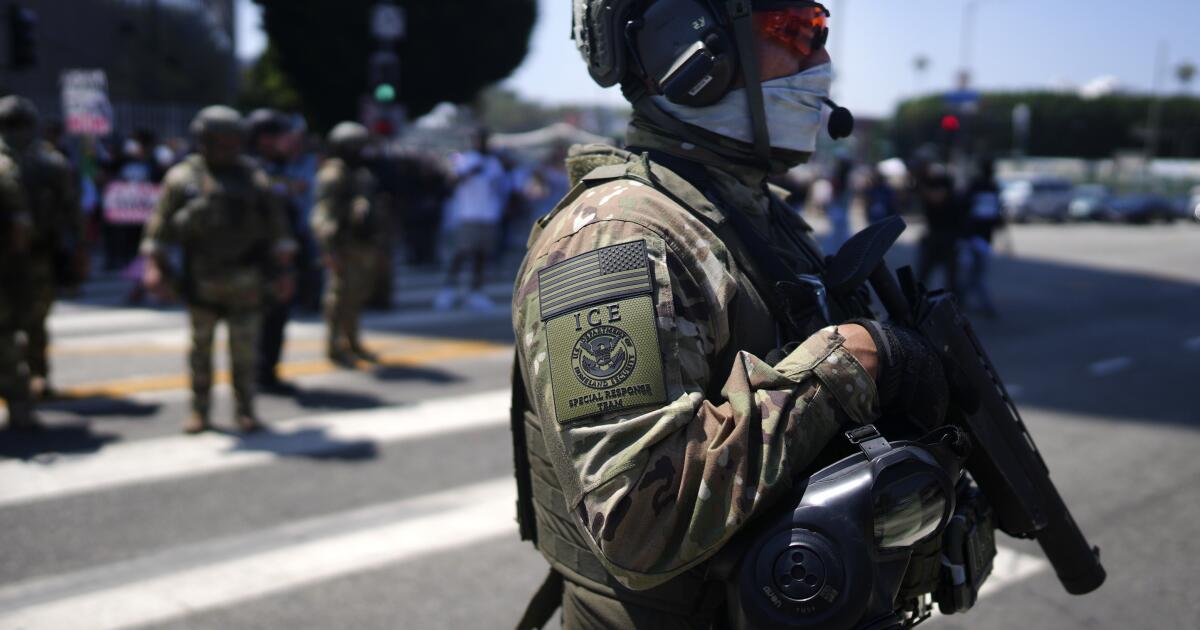
The Trump administration asked an appeals court Monday to immediately allow immigration agents to resume unfettered raids across Southern California, arguing that a federal judge’s order barring unconstitutional stops and arrests is akin to a “straitjacket” on its operations.
The order granted Friday night by U.S. District Judge Maame Ewusi-Mensah Frimpong “is inflicting irreparable harm by preventing the Executive from ensuring that immigration laws are enforced,” Department of Justice lawyers wrote in a motion asking for an emergency stay. “These harms will be compounded the longer that injunction is in place.”
Government lawyers argued Frimpong’s injunction was a first step to placing immigration enforcement under judicial monitorship and was “indefensible on every level.” They asked the higher court to pause the order while the appeal is heard.
Weeks of aggressive sweeps by masked and heavily armed federal agents seemed to abruptly cease in Los Angeles, Riverside, San Bernardino, Orange, Ventura, Santa Barbara and San Luis Obispo counties following Frimpong‘s order last week.
A coalition of civil rights groups and private attorneys sued the federal government, challenging the cases of three immigrants and two U.S. citizens swept up in chaotic arrests that have sown terror and sparked widespread protest since June 6.
“It should tell you everything you need to know that the federal government is rushing to appeal an order that instructs them only to follow the Constitution,” said Mohammad Tajsar, an attorney with ACLU of Southern California, who argued the case. “We look forward to defending the temporary restraining order and ensuring that communities across Southern California are safe from the federal government’s violence.”
Despite arguments from the Trump administration that its tactics are valid, Frimpong ruled that using race, ethnicity, language, accent, location or employment as a pretext for immigration enforcement is forbidden by the 4th Amendment, which protects against unreasonable searches and seizures by the government.
She said those factors cannot be used alone or in combination to form reasonable suspicion, the legal bar needed to detain someone.
Government lawyers flatly rejected that notion.
“Ethnicity can be a factor supporting reasonable suspicion in appropriate circumstances — for instance, if agents are acting on a tip that identifies that ethnicity — even if it would not be relevant in other circumstances,” lawyers stated in their motion. It further stated that speaking Spanish, being at a particular location or one’s job “can contribute to reasonable suspicion in at least some circumstances.”
Frimpong had also found that preventing detainees from meeting with lawyers violates the right to due process guaranteed by the 5th Amendment.
And she pointedly wrote, “What the federal government would have this court believe — in the face of a mountain of evidence presented in this case — is that none of this is actually happening.”
Department of Homeland Security Secretary Kristi Noem incorrectly referred to Frimpong as a man when responding to the order during a news conference Saturday, saying of the judge’s order: “He’s an idiot.”
“We have all the right in the world to go out on the streets and to uphold the law and to do what we’re going to do. So none of our operations are going to change,” Noem said. “We’re going to appeal it and we’re going to win.”
In addition to blocking roving patrols, the judge also ordered the Department of Homeland Security to open part of its detention facility in downtown Los Angeles to attorneys and legal aid groups.
The Trump administration did not immediately contest that portion of the ruling. Instead, it attacked the 4th Amendment claim, seeking a stay that would immediately restore the status quo for immigration agents across Southern California while the case is heard by judges from the higher court.
“It is untenable for a district judge to single-handedly ‘restructure the operations’ of federal immigration enforcement,” the appeal argued. “This judicial takeover cannot be allowed to stand.”
The arguments echoed sentiments the White House has been pounding for months as President Trump has sought to vastly expand the power of the presidency.
But some experts say the appeal’s success is unlikely.
“Their argument [is] the sky’s falling,” said professor Carl Tobias of the University of Richmond. “They make very extreme arguments, and that doesn’t necessarily help their case in the 9th Circuit.”
The appeal escalates an already fierce and sprawling legal battle over Trump’s promised mass deportations and the means used to achieve it.
The government is appealing another injunction imposed by a federal judge in the Eastern District of California after Border Patrol agents stopped and arrested dozens of farmworkers and laborers — including a U.S. citizen — during a days-long operation in the Central Valley in January.
The case, likely to be heard later this year, was brought by the ACLU on behalf of the United Farm Workers and other residents who accused agents of using racial profiling as they stopped people near farms, at filling stations and at Home Depot.
U.S. Border Patrol and its Sector Chief Greg Bovino, who has been a key figure in the raids across Southern California, was also named in that suit.
In another case, California sued and won a temporary restraining order that would have stripped the president of command, after the president deployed troops to quell anti-ICE protests in June.
But the appellate panel swiftly blocked that decision, before overturning it in mid-June, leaving thousands of soldiers in Trump’s hands.
The Trump appointee who authored the June 19 ruling, Judge Mark J. Bennett of Honolulu, also bristled at the government’s argument that the president’s actions in the case were “unreviewable.”
“Some of the things they say are unorthodox, arguments we don’t usually hear in court,” said Ming Hsu Chen, a professor at UC Law San Francisco. “Instead of framing this as executive overreach, they’re saying the judiciary’s efforts to put limits on executive power is judicial overreach.”
Last week, another 9th Circuit judge challenged that June decision, petitioning the court to rehear the issue with a larger “en banc” panel — a move that could nudge the case to the Supreme Court.
“Before [courts] became so politicized, many judges would often defer to the 3-judge panels that first heard appeals, because they trusted their colleagues,” Tobias said. “Increasing politicization of most appeals courts and somewhat decreased collegiality complicate efforts to predict how the Ninth’s judges will vote in this case.”
Meanwhile, California is gathering evidence to bolster its claim that Marines and National Guard forces participating in immigration enforcement run afoul of the Posse Comitatus Act, which forbids using soldiers to enforce civilian laws.
Compared to those questions, the legal issues in the L.A. appeal are simple, experts said.
“What makes this case different is how much it’s based on facts,” said Erwin Chemerinsky, dean of the UC Berkeley School of Law. “It’s much harder for an appellate court to overturn a trial court finding of fact then it is with regard to legal conclusions.”