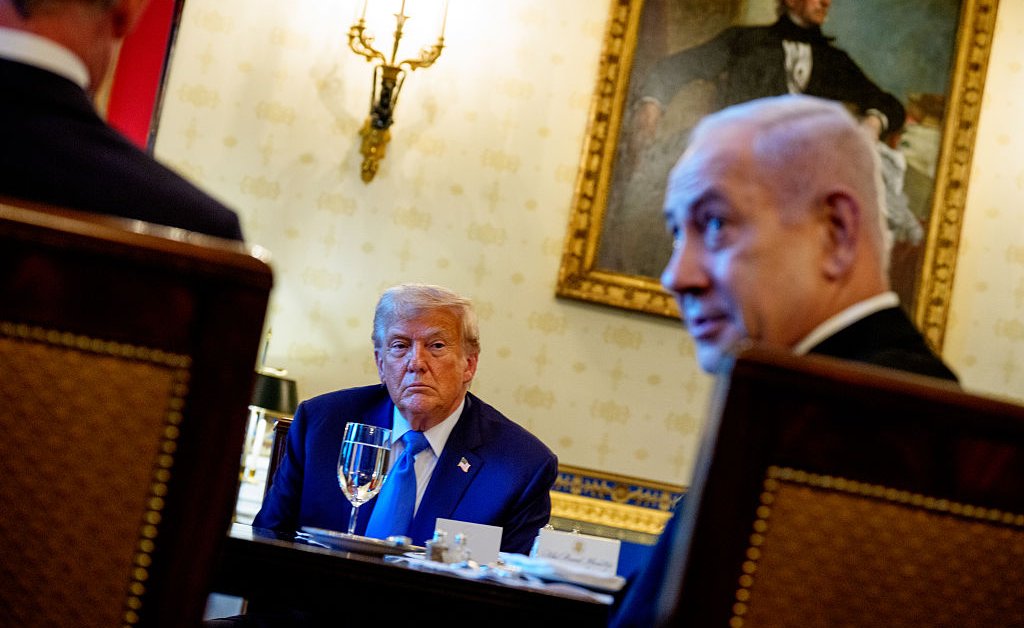
Israeli aggression appears to be vexing the Trump Administration.
The White House said Monday that President Donald Trump had not approved of Israel’s airstrikes on Syria last week, which reportedly continued even after the U.S. had told Israel to “stand down” after Israel bombed Syrian tanks on Tuesday. Israel launched new airstrikes on Damascus on Wednesday, killing at least three people and wounding dozens of others.
Israel said its strikes were aimed at “protecting” the Syrian Druze community after days of clashes between members of the Druze militia and Bedouin tribes as well as Syrian military intervention. At the same time, Israel’s government said the strikes were in retaliation for Syrian troops entering a region in southern Syria that Israel had unilaterally declared a demilitarized zone. The Syrian government has rejected that claim and repeatedly condemned Israeli military action towards Syria, including in recent months the seizure of Syrian territory and multiple airstrikes.
The Trump Administration brokered a cease-fire between Israel and Syria, U.S. envoy to Syria Tom Barrack said on Friday, but some within the Administration have grown restive over Israeli Prime Minister Benjamin Netanyahu’s recalcitrance, Axios reported on Sunday. “Bibi acted like a madman. He bombs everything all the time,” one official told the outlet. “This could undermine what Trump is trying to do.”
Trump was “caught off guard by the bombing in Syria and also the bombing of the Catholic Church in Gaza,” White House Press Secretary Karoline Leavitt told reporters on Monday, although she added that Trump “enjoys a good working relationship with Prime Minister Bibi Netanyahu and stays in frequent communication with him.”
“In both cases, the President quickly called the [Israeli] Prime Minister to rectify these situations,” Leavitt added.
Israel’s strikes on Syria and a Catholic Church in Gaza came after Netanyahu’s visit to Washington earlier this month, which appeared to signal progress towards a Gaza cease-fire deal even as critics have worried that a Trump-mediated cease-fire would involve the removal of Palestinians and redevelopment of the Gaza Strip under U.S. and/or Israeli control.
“Everything Israel is doing, from bombing civilians to bulldozing entire city blocks has been done with American bombs and bulldozers,” says William Figueroa, an assistant professor of international relations at the University of Groningen.
Clemens Chay, a research fellow at the National University of Singapore’s Middle East Institute, tells TIME that Trump has emboldened Israel by backing it militarily even as Israel has put at risk many U.S. goals, including by bombing Iran when Tehran was in the midst of nuclear talks with Washington and now bombing Syria after Trump had earlier signalled a desire to improve relations with the country by lifting U.S. sanctions.
Netanyahu likely took Trump’s “vague response to any military action as a ‘go-ahead,’” Chay says. “The U.S. President is well-known for vacillating in his positions towards various foreign policy issues, but the Israeli Prime Minister is now—following U.S. strikes on Iranian nuclear [facilities]—confident in his own ability of being the ‘Trump whisperer.’”
“Trump is continuing the failed policies of his predecessors by ceding the initiative to Israel,” Jon Hoffman, a foreign policy analyst at the Cato Institute, posted on X.
Even so, Israel depends critically on U.S. support: “It is not surprising that Israel signs a cease-fire when the United States applies real pressure, because they could not pursue any conflict, in Iran or in Gaza, without the continual supply of weapons, ammunition, and military tech from the United States,” Figueroa previously told TIME. “When the person signing the checks says they really mean it, you listen.”
It’s not the first time Israel has gambled that the U.S. would back it despite going against the Trump Administration’s advice. While Netanyahu has managed to sustain U.S. support, in part by “stroking Mr Trump’s ego” with a nomination for the Nobel Peace Prize and by allowing Trump to “claim victory” over brokering cease-fires in the Middle East, Chay says, Israel’s continued actions risk not only being seen as “an overstepping of boundaries by Trump officials, but worse, also as a form of unchecked Israeli military power by regional states.”
Israel reportedly agreed on Tuesday to stand down at Barrack’s request in order for the U.S. to negotiate a peace deal. But the next day, Israel escalated its attacks, bombing Syria’s military headquarters and a facility near the presidential palace.
“The bombing in Syria caught the President and the White House by surprise. The President doesn’t like turning on the television and seeing bombs dropped in a country he is seeking peace in and made a monumental announcement to help rebuild,” one official told Axios.
Another official suggested that the Israeli government was harming its reputation among the Trump Administration. “The Israelis need to get their head out of their asses,” the official told Axios.
Meanwhile, an Israeli official told Axios that Trump had not indicated concerns about Israeli intervention in Syria and had even supported Israeli action in Syria during his first few weeks in office.
Israel also came under fire after striking on Thursday the Holy Family Church in Gaza City, killing three people and wounding others who were sheltering there. The news shook the Catholic community around the world. Before his death, Pope Francis had held daily calls with the parish—Gaza’s only Catholic church. Francis’ successor, Pope Leo XIV posted on X that he was “deeply saddened to learn of the loss of life and injury” and reiterated the need for an immediate cease-fire.
The news also angered the Trump Administration. Leavitt said Thursday that Trump did not have a “positive reaction” to the attack and that he “called Prime Minister Netanyahu this morning to address the strikes on that church in Gaza.”
Netanyahu said in a Thursday statement that Israel “deeply regrets that a stray ammunition” hit the church, calling it a mistake. He said Israel was “investigating the incident and remains committed to protecting civilians and holy sites.”
The Israel Defense Forces said in a later statement that “an initial inquiry into reports regarding injured individuals in the Holy Family Church in Gaza City, suggests that fragments from a shell fired during operational activity in the area hit the church mistakenly. The cause of the incident is under review.”
Israel’s military added, “The IDF directs its strikes solely at military targets and makes every feasible effort to mitigate harm to civilians and religious structures, and regrets any unintentional damage caused to them.” Gazans, journalists and humanitarian organizations have recorded numerous Israeli attacks on civilian, religious, and aid sites over the course of the two-year war.
Murder of Palestinian American by Israeli settlers
The July 11 murder of Palestinian American Saif Musallet by a mob of Israeli settlers in the Israeli-occupied West Bank has also incited backlash from the U.S. government. Musallet’s family told CBS News that he had been visiting his family’s land in the town of Sinjil when he was surrounded and beaten by settlers for over three hours. The settlers blocked an ambulance and paramedics from reaching him, his family said. Musallet’s brother eventually carried him to an ambulance, but he died before reaching the hospital.
In a rare albeit tempered criticism of Israel, U.S. Ambassador to Israel Mike Huckabee, who is known to be an outspoken ally of Israeli settlers, called the attack a “criminal and terrorist act.” Huckabee said he asked Israel to “aggressively investigate” Mussallet’s murder. “Saif was just 20 yrs old,” Huckabee added. The IDF told CBS News last week that “a joint investigation was launched by the Israel Police and the Military Police Criminal Investigation Division.”
The United Nations High Commissioner for Human Rights Thameen Al-Kheetan sounded the alarm on rising violence by Israeli settlers and security forces in the West Bank. “Israel must immediately stop these killings, harassment and home demolitions across the occupied Palestinian territory,” Al-Kheetan said last week. “As the occupying power, Israel must take all feasible measures to ensure public order and safety in the West Bank. It is under the obligation to protect Palestinians from settler attacks and to end the unlawful use of force by its security forces. There must be thorough, independent and transparent investigations into all killings and all other alleged violations of international law. Those responsible must be held to account.”
Huckabee also visited the Christian community of Taybeh in the West Bank on Saturday after a church was reportedly attacked and vandalized by Israeli settlers.
“To commit an act of sacrilege by desecrating a place that is supposed to be a place of worship, it is an act of terror, and it is a crime. There should be consequences, and it should be harsh consequences because it is one of the last bastions of our civilization, the places where we worship,” Huckabee said in a statement. He later clarified on X that he did not attribute the cause of the arson attack on the church to anyone.
Israel’s post-cease-fire strikes on Iran
Israel came under fire directly from Trump in June when it continued to trade strikes with Iran within hours of the U.S. President publicly announcing a cease-fire. Trump’s cease-fire came after nearly two weeks of attacks between Israel and Iran that the U.S. even joined militarily, bombing three key Iranian nuclear facilities, despite Trump’s longtime professed aversion to military entanglement.
“I’m not happy with Iran, but I’m really not happy with Israel,” Trump told reporters on June 24, characterizing an Iranian missile strike that Israel cited as reason to retaliate as “one rocket that didn’t land anywhere.”
“Israel, as soon as we made the deal, they came out and they dropped a load of bombs, the likes of which I’ve never seen before,” Trump added.
The President also posted on Truth Social the same day: “ISRAEL. DO NOT DROP THOSE BOMBS. IF YOU DO IT IS A MAJOR VIOLATION. BRING YOUR PILOTS HOME, NOW!”Netanyahu appeared to heed Trump’s warning at the time, as the fragile cease-fire appeared to hold and the Israeli leader’s friendship with Trump seemed stronger than ever.
Still, experts caution that the Trump Administration’s apparent exasperation with Israel is unlikely to lead to any real change in bilateral relations. “Trump is certainly showing some on-again/off-again frustration with Netanyahu. And separately Trump is shifting his focus back to privileging his business-driven relations with others in the region, particularly the Gulf states,” says Phyllis Bennis, a fellow at the Institute for Policy Studies and director of its New Internationalism Project. “But I think it would be a mistake to equate those realities with changing his position towards Israel.”
“The Trump Administration has shown frustration with Netanyahu before, but it has never translated to anything less than full support in material and diplomatic terms,” says Figueroa. “It’s hard to imagine any red line left to be crossed that would be a tipping point for Trump.”