
The Issue
Suriname has yet to have the same exploration success as rising oil star Guyana to the west. The only offshore development approved to date is the Total-led GranMorgu oil scheme, which aims to start up in 2028 and reach a 220,000 barrel per day capacity. But while Suriname’s subsea oil and gas resources are considered more gassy and complex than Guyana’s, several industry sources have told Energy Intelligence that at least four big oil companies are betting on exploration success. The administration of Suriname President Jennifer Geerlings-Simons, who was sworn in on Jul. 16, is supportive of oil development, which could be transformative for the former Dutch colony of 600,000 inhabitants.
Low-Cost, Low-Carbon Barrels
For operator Total, GranMorgu is seen as a key source of “advantaged” oil barrels that can tick several strategic boxes for the French major, notably low development costs and a relatively low per-barrel carbon footprint.
Specifically, Total CEO Patrick Pouyanne has cited GranMorgu as one of a group of major upstream projects, alongside Angola’s Kaminho and Brazil’s Sepia-2 and Atapu-2, that will help backstop the company’s oil supply in the coming years. “These projects allow us to combat the natural decline of fields, which I remind you is 4% to 5% per year in the oil industry,” Pouyanne said. “So they are necessary to meet the demand of our customers, particularly in emerging countries.” At the same time, the company will use an all-electric floating, production storage and offloading (FPSO) unit for GranMorgu to push its Scope 1 and 2 (operational) emissions intensity below 16 kilograms CO2 equivalent per barrel of oil equivalent.
Total has been working in the country since 2019, when it farmed into Block 58, taking a 50% operated stake from APA, which was then known as Apache. The US independent has had a presence in Suriname since 2012 and acquired Block 58 in 2015. But the US company now has a much-reduced footprint offshore Suriname, having released acreage back to the regulator, including some that is part of the new Block 66.
While APA and Total’s drilling results were mixed, exploration and appraisal at the Krabdagu and Sapakara oil discoveries on Block 58, completed in 2023, firmed up gross estimated recoverable resources of more than 750 million barrels of oil.
Total Seeks Incremental Growth
Earlier this year, Pouyanne said GranMorgu was designed for four-year plateau production, with room to add more resources from more drilling, although specifics had yet to be defined. “We also explained we have selected quite a high plateau because we consider that GranMorgu could be the hub of more tiebacks,” the CEO said.
In June, Total farmed into APA-operated Block 53, adjacent to Block 58, taking a 25% stake from Spain-based Moeve (formerly Cepsa). In 2022, APA had drilled the roughly 50 million bbl Baja-1 discovery on the block. Total’s move shows how it “will leverage GranMorgu infrastructure to profitably develop additional resources and extend its production plateau,” according to Javier Rielo, Total’s senior vice president of Americas, exploration and production.
Pouyanne went further during Total’s Jul. 24 second-quarter earnings call, telling investors he had instructed his teams to go back and appraise some previous discoveries near Krabdagu and Sapakara. “The objective is to extend the [GranMorgu] plateau and to make a higher plateau, to create a lot of value from this infrastructure,” the CEO said, adding that the capacity of the GranMorgu FPSO could “easily” be extended to 240,000 b/d.
In May, Total drilled the Macaw-1 well in Block 64, to the northwest of GranMorgu, with results expected imminently. “Block 64 is not the same trend,” Pouyanne told investors earlier this year. “So I would say it’s more frontier exploration.”
SURINAME LICENSED OFFSHORE BLOCKS AND KEY EXPLORATION WELLS
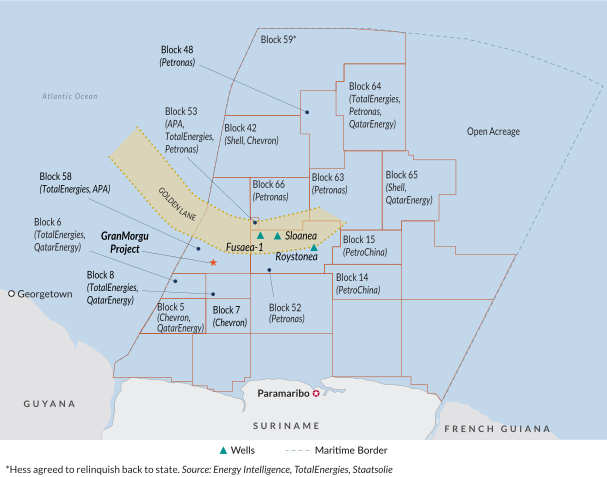
For its part, APA — which now has a limited overseas portfolio — says GranMorgu will generate free cash flow to supplement its work in the US, notably in the Permian Shale play. “Suriname first oil in 2028 will carry that free cash-flow growth into the next decade,” then-CFO Stephen Riney, who has since become company president, told investors in February.
Suriname’s national oil company (NOC) and upstream regulator, Staatsolie, has the option to back into all of the country’s green-lighted oil and gas developments. The NOC recently conducted a successful bond sale, raising some $1.6 billion to fund its share of GranMorgu expenses.
Petronas Mulls FLNG Potential
Meanwhile, Petronas has made at least three discoveries in Block 52: Sloanea-1, Roystonea-1 and Fusaea-1. The Malaysian NOC’s success with the drill bit is starting to coalesce into what could become Suriname’s second major hydrocarbons development. “The Sloanea-2 appraisal well validated earlier finds and demonstrated potential for a Floating Liquefied Natural Gas [FLNG] development, while the Fusaea-1 well confirmed our third hydrocarbon discovery,” Petronas said in its 2024 annual report. “Building on insights from Roystonea-1 and Sloanea-1, we are now evaluating an integrated development strategy that could unlock the block’s full potential,” the report added. In April, Petronas agreed to work on a detailed feasibility study with China-based Wison New Energies for a newbuild FLNG unit at Block 52.
Petronas, which operates Block 52 with a 100% share following Exxon Mobil’s late 2024 exit, stands out for its interest in the block’s gas potential. The NOC is working to build a global low-emissions, gas-focused portfolio and to grow its equity LNG volumes as some of its other international assets underperform and key domestic fields mature.
In its last annual report, Staatsolie said an FID for gas development on Block 52 could come as soon as the end of 2026, with a potential green light for an oil-based project there by 2027.
Petronas is also pushing ahead with a three-well campaign off Suriname later this year. The new wells are aimed at testing the Caiman-1 and Kiskadee-1 prospects in the country’s section of the so-called “golden lane,” an arc-like trend that extends from finds offshore Guyana into Suriname’s waters, according to Staatsolie. Petronas aims to look for more resources across its Suriname acreage, which now comprises five blocks after it acquired operatorship of the newly created Block 66 in June. Petronas has committed to drill a pair of wells in an initial exploration phase over an undisclosed time frame on the new block.
Petronas is not the only Asian NOC with acreage offshore Suriname — CNPC-listed affiliate PetroChina operates shallow-water production-sharing contracts Blocks 14 and 15 with a 70% stake, along with Staatsolie’s 30%.
Busy Exploration Spell Ahead
Total is not alone: Two other majors plan to pursue exploration offshore Suriname before the end of this year. Chevron plans to drill the Korikori-1 shallow-water well in Block 5 in the coming months. Fresh off winning its arbitration case against Exxon that confirmed its acquisition of Hess, and which will give Chevron a stake in Guyana’s prolific Stabroek Block, the US major sees Suriname as complementing work to the west.
On Jul. 8, just days before becoming part of Chevron, Hess announced it was to relinquish Block 59. The block will return to Staatsolie and become part of the country’s open acreage. Original partners Exxon and Equinor had ceded their stakes to Hess in July 2024.
Meanwhile, UK-based Shell plans to drill the Araku Deep-1 well in Block 65 later this year. “It’s an emerging play for [the] industry,” Pablo Tejera Cuesta, Shell’s pre-salt manager for Brazil, said of Suriname at May’s Offshore Technology Conference in Houston. “We are quite excited to do that well.”
QatarEnergy, which like Petronas is pursuing an overseas growth strategy, has partnered with Shell and Chevron on their Suriname blocks.
CompanyAssetsStage
TotalEnergiesBlock 58 (GranMorgu development)In development
Blocks 6, 8, 53Exploration
APABlock 58 (GranMorgu development)In development
Block 53Exploration
PetronasBlock 52Exploration, development, evaluation
Blocks 48, 63, 66, 64Exploration
ShellBlocks 42, 65Exploration
ChevronBlocks 5, 7, 42Exploration
QatarEnergyBlocks 5, 6, 8, 65Exploration
PetroChinaBlocks 14,15Exploration
Source: Energy Intelligence, companies, Staatsolie