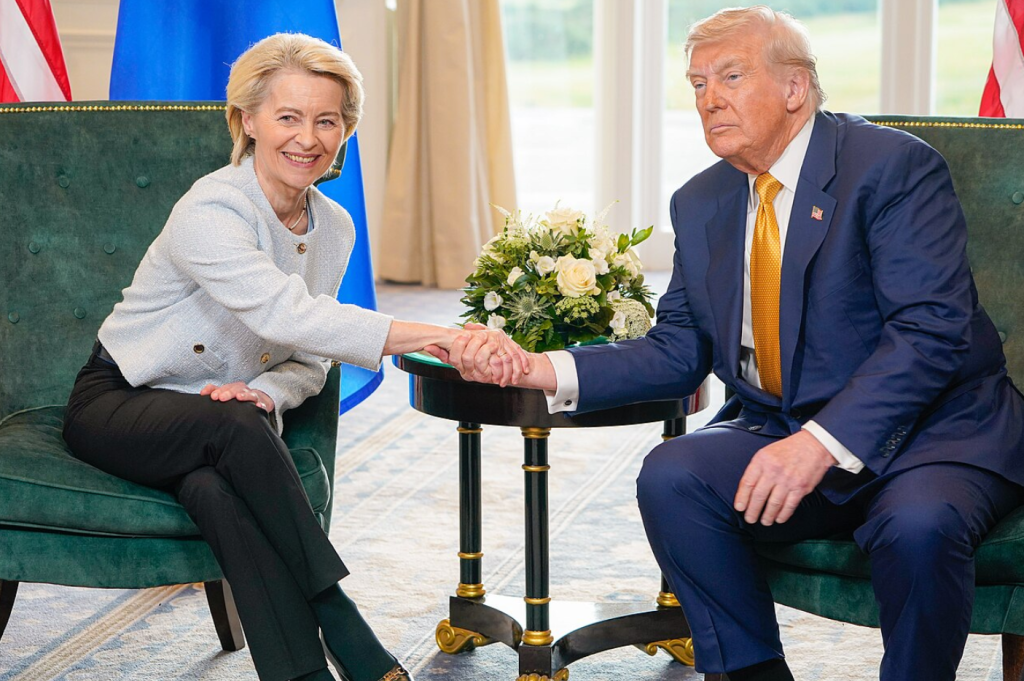
Brussels has called on Washington to start implementing the new EU-US trade deal, urging its largest trading partner to provide “immediate tariff relief” for Europe’s beleaguered exporters from 1 August.
The plea comes after the EU and the US clinched a long-awaited trade agreement on Sunday, which imposes a 15% blanket levy on most European exports.
Swift implementation is particularly important for European car manufacturers, who currently face a 27.5% duty on their €40 billion worth of annual exports to the US.
“It is the clear understanding of the European Union that the US will implement the agreed across-the-board tariff ceiling of 15%,” European Commission spokesperson for trade, Olof Gill, told reporters on Thursday.
“It is also our clear understanding that the US will implement the exemptions to the 15% ceiling as outlined by [Commission] president [Ursula] von der Leyen last Sunday. This means that from tomorrow, we will have the immediate tariff relief we have worked so hard to achieve and thus a far stronger position of stability and predictability for EU businesses and consumers,” he added.
Major differences in interpretation have emerged between Brussels and Washington since the deal was announced on Sunday. Key points of contention include the specific levies on EU metals and the timeline for imposing duties on the bloc’s €120 billion worth of pharmaceutical exports to the US.
Brussels also claims that the deal will see Washington restore pre-Trump tariff levels on aircraft, chemicals, drug generics, and natural resources. But a White House “Fact Sheet” released earlier this week makes no such commitments.
Trump has previously imposed a 50% tariff on steel and aluminium, a 25% duty on cars and car parts, and a 10% blanket levy on most other EU exports, affecting around €370 billion worth of EU goods, or 70% of the bloc’s exports to the US.
The duties come on top of the 4.8% average rate that applies to EU exporters before Trump returned to the White House in January.
Prior to Sunday’s announcement, Trump had also threatened to impose a 30% blanket levy on EU exports from 1 August, coinciding with the entry into force of sweeping “reciprocal tariffs” targeting US trading partners on Friday.
Gill added that EU steel and aluminium are expected to continue to face Trump’s 50% levy from Friday, although Brussels claims that Washington has agreed to implement a “quota system” that could lower the levy some on the metals.
He also said that alcoholic products, which are not covered by the agreement, are not expected to be offered immediate tariff relief.
Gill added that the EU’s pledged “elimination” of tariffs on US industrial goods will also not take effect on Friday.
“I don’t have a precise timeline for how our side of the bargain will be implemented, nor do I need to provide them at this point,” he said, adding that “the only thing that was agreed between the EU and US last weekend was that American tariffs, as I described, would kick in on 1 August.”
US Commerce Secretary Howard Lutnick told CNBC on Tuesday that steel and aluminium remain “on the table” and that “there’s plenty of horse trading still to do.”
EU Trade Commissioner Maroš Šefčovič remains “in constant, daily touch” with Lutnick and US Trade Representative Jamieson Greer, according to EU officials.
This article has been updated.
(de)