
Ukraine’s real GDP will grow by 2.1% in 2025, increasing slightly to 2.3% in 2026, and 3% in 2027, while inflation is expected to slow down, the National Bank of Ukraine (NBU) set out in its Inflation report for July 2025.
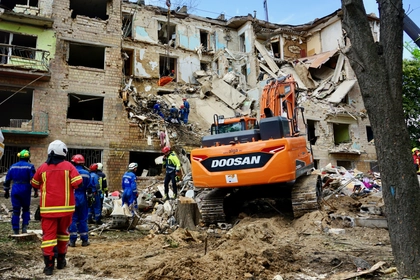
Russia’s increasingly intensive air attacks and further destruction of production facilities, infrastructure, and housing constrained growth, still stimulating migration of Ukrainians abroad and tension on the labor market.
Follow our coverage of the war on the @Kyivpost_official.
The pace of recovery will depend on the course of the war, the NBU wrote. If normalization occurs quickly, private investment and consumption will increase significantly, offsetting the effects of the rapid fiscal consolidation (spending the vast majority of the budget on defense rather than investment).
In this scenario, GDP growth might reach 3%-3.5%, according to the Inflation report.
Much of Ukraine’s macroeconomic stability still relies on international financial aid, which covers social wages, while Ukraine is spending more than 60-70% of its internal revenues on defense.
In 2025, Ukraine is expected to receive external financial assistance in the amount of around $54 billion, of which over $24 billion has already been received this year. As for the remaining $30 billion, the largest inflows are expected under Extraordinary Revenue Acceleration (ERA) loans ($18 billion until the end of the year) and Ukraine Facility ($8 billion), the NBU estimated.
Other Topics of Interest
Russian Drone Strikes on Ukraine Hit All-time Record in July
The analysis, which used data published by Ukraine’s air force, showed Russia fired 6,297 long-range drones into Ukraine last month – up nearly 16% compared with June.
The NBU forecasts that Ukraine will receive $35 billion in international aid in 2026 and $30 billion in 2027. “A third of these funds has already been announced by partners, and talks are underway regarding the rest,” the NBU wrote.
Ukraine has not yet found sources to finance the remaining $12.7 billion for Ukraine’s needs in 2025, Deputy NBU Governor Sergiy Nikolaychuk previously said presenting the macroeconomic forecast for Ukraine on Centre for Economic Strategy online event. The rest of the financing is confirmed from the Ukraine Facility, International Monetary Fund (IMF), and lending backed by Russian assets (ERA loan).
If security conditions normalize quickly and budget expenditure on defense decreases, Ukraine may need less official external support to maintain its defense capabilities, the NBU wrote.
Inflation peaked in May, as the NBU expected, and declined in June (14.3% year-over-year). At the same time, it was higher than forecast, primarily due to the impact of unfavorable weather conditions on the supply of food products.
Core inflation decreased to 12.1% year-over-year, somewhat faster than the NBU’s forecast. The still-high underlying price pressure reflected the effects from a rapid rise in food prices and businesses’ significant expenses on raw materials and wages, the NBU explained in the report.
Web search statistics also pointed to a moderate increase in households’ attention to the topic of inflation, the NBU noted. At the same time, short-term expectations of financial analysts improved, while their medium-term expectations remained stable, demonstrating their confidence in the temporary nature of the current inflation surge.
The NBU will continue to monitor inflation, keeping tight monetary policy, and will not decrease the key rate lower than the current 15.5% until the fourth quarter of 2025.
“At the same time, this decision will have no impact on lending, considering that the banks are intensely competing for quality borrowers,” the authors of the Inflation report wrote.
Russia’s devastating attacks affect Ukraine’s mining, gas and chemical industries
In the second quarter of 2025, Russia increased the quantity of air and drone attacks by 152% year-over-year and 32% quarter-over-quarter, the NBU wrote, citing ACLED. Combat engagements on the frontline increased 81% year-over-year and 21% quarter-over-quarter.
The attacks via air, alongside hostilities on the ground, caused Ukraine’s mining industry to drop by 17.5% year-over-year, particularly due to the closure of mines in Pokrovsk and Selidove. It also created a 7.4% year-over-year contraction in the chemical industry.
Repeated strikes on Ukraine’s gas production were among significant factors that dragged Ukraine’s GDP growth down.
Ukraine’s labor market is still experiencing tension due to a workforce shortage, but salaries reached the market expectations of candidates. However, non-salary competition is strengthening as more people ask for part-time work and remote work, the NBU wrote.
Internally displaced persons are also asking their future employees about accommodation that the company can help them to have or rent, according to the report.
Bad weather and the EU’s backlash on tariff-free trade
Ukraine’s agriculture was negatively affected by a $700 million loss of exports due to the EU’s move to end its tariff-free trade regime with Ukraine to protect European farmers.
April frosts, alongside the protracted war, became another hurdle for economic growth this year. Delayed sowing led to an inability to refill the depleted harvest gathered last year, slowing down the food processing and transport industries, which were underutilized.
According to the NBU’s preliminary estimates, headline inflation may rise slightly in July, while core inflation will continue to decline. In the following months, inflation is expected to move on a steady downward trajectory.