News item: the small military airport in Salerno, 45 miles south of Naples, reopened not long ago as Salerno Costa d’Amalfi and Cilento Airport. This arrival has been treated as a boon for the lower half of the Amalfi Coast; among the flurry of commercial airlines to offer flights this summer is British Airways, three times a week from Gatwick.
But the real headline, to my mind, should be the access Salerno now provides to everything below it. Southern Campania, Basilicata, Calabria and Puglia are all prime road-tripping (and whisper it, less saturated) destinations, connecting with ease and offering landscapes of alternating severe and serene beauty.
No single big luxury hospitality brand has yet got a toehold down here. Though it’s only a matter of time – particularly in Puglia, where Four Seasons has already tapped a massive plot on the Adriatic. Instead, the region is marked by some of the best little hotels in the Mezzogiorno. Two are ancestral family homes; only some have restaurants, and not one of them has a lift (your knees have been warned). But each in its way is an antidote to the high-spec sameness that is becoming the all-too-predictable language of luxury abroad.
Palazzo Belmonte is in the seaside village of Santa Maria di Castellabate, a 50-minute drive south from Salerno. The Cilento Coast, Campania’s anti-Amalfi, shares little of the glamour that prevails to the north, but enjoys a wilder version of its beauty. I first stayed at this hotel 18 years ago; it was run then by Prince Angelo Granito Pignatelli di Belmonte, whose family built the palazzo in the early 17th century. These days his daughters Francesca and Maria Sofia are in charge.
 The courtyard at Palazzo Belmonte
The hotel is actually a compound; garden villas containing the newer rooms, and Casa Eduardo, a three-storey townhouse neatly enclosed within Belmonte walls, which stays open in winter as a B&B. The five acres of old and lovely gardens give onto a sandy beach. Bougainvillea spills down the three-storey palazzo’s walls; a dusty ficus anchors the courtyard. Dirt paths weave between groves of lemon trees, which are harvested to make the marmalades served at breakfast.
The pool – a bright-blue rectangle, tapering to an arrow at either end – is so beyond retro it’s fabulous. At the bar above it, light lunches (pastas, a few salads) are served in summer. For dinner, you’re on your own: drive to Castellabate old town, up the hill above the hotel, or stroll into Santa Maria. (The go-to here is 1861, a hybrid bistro/fine-ish dining restaurant that punches way above its small-town weight.)
 Palazzo Belmonte’s “beyond retro” pool
  A suite at Palazzo Belmonte
Palazzo Belmonte’s brilliance is in its owners’ breezy disregard for fancy amenities, a posture enabled by the natural gorgeousness of the asset they own. They are proudly un-five star; the place, not the perks, is the thing here. Yes, there have been overtures from luxury hotel brands, di Belmonte says when I broach the rumours I’ve heard. No, she adds with a Gioconda-esque smile, they are not interested in selling.
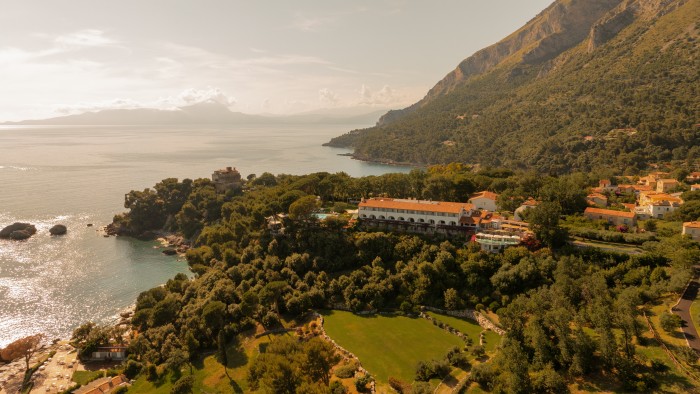
Around 65 miles to the south, on the Gulf of Policastro in Basilicata, is the Santavenere, the kind of hotel that is fast becoming an endangered species: small, discreet and owned for most of its existence by the family that built it in the early 1950s.
 Santavenere in Basilicata
 Each hotel is an antidote to the high-spec sameness that is becoming all too predictable
The Santavenere sits on a bluff like a vintage yacht in a wide green harbour, surrounded by lawns, olive groves and woods, most of which belong to the property. The 26 rooms and suites are complemented by what feels like acres of living rooms, full of long sofas, reading nooks and card tables. Patina – actual, as opposed to aspirational – is everywhere, gleaming from the 70-year-old pale-pink ceramic tiles that still line every floor, and the burnished chestnut panels of the flawless corner bar.
The hotel was full when I stayed, but I never saw any of the restaurants close to busy. There are half again as many loungers around the huge oval pool as there are guests, and it’s the same story down at the beach club, which stretches the length of the property. Paolo Barletta and Aldo Melpignano, respectively the CEO of Santavenere’s owner Arsenale and the property’s operational partner, have their hands in some fancy places: Melpignano’s other hotel, Borgo Egnazia, has hosted both the G7 Summit and Justin Timberlake’s wedding; Barletta owns Soho House and La Minerva in Rome. But they’re adamant the Santavenere should remain its historic self.
 The view from outside a suite at Santavenere © Maria Shollenbarger
 A suite at Santavenere
 Onward, to the hazy Gulf of Taranto, right in the arch of Italy’s boot and deep in its most ancient history. Francis Ford Coppola may or may not care much about the ancient temple complexes and other Magna Graecia glories that surround Bernalda, where he owns the nine-room Palazzo Margherita. The hilltop town is where his paternal grandfather was born, and that, and the beauty of the 19th-century house and its ravishing walled garden, is why he bought it in 2005. (There’s no verified family connection to the property itself, though Coppola has entertained the theory that his great uncle might have stolen in occasionally to court a family maid.)
 The garden at Palazzo Margherita © Gundolf Pfotenhaue
Palazzo Margherita opened in 2012 following a renovation overseen by Jacques Grange, and yet it remains mostly a niche destination. The barely marked door – no name, just a street number – leads into a grand courtyard bracketed by balustrades. The suites are high-ceilinged, frescoed and full of period furniture – a couple of them have terraces. An old stable building at the garden’s edge has been converted into double rooms; Coppola himself occupied one of them during my stay, and the soft peck of his laptop was occasionally audible through the open door when I passed.
 The pool at Palazzo Margherita © Gundolf Pfotenhaue
 A garden suite room at Palazzo Margherita © Gundolf Pfotenhaue
That such a confabulation of old-world gentility is hidden away in such a remote little town – conjured by a famous film director and an equally famous interior designer – casts a bit of magic over this place. I had 13 years’ worth of expectations built up around it, a recipe for disappointment. I left wishing I could stay a week.
Three hours of fast, flat driving to the south-east is Salento, the southernmost part of Puglia. In 2018, shortly after Francesco Petrucci came into full possession of Palazzo Daniele, the largest private house in the tiny town of Gagliano del Capo, he commissioned Milanese architects Palomba Serafini Associati (who have their own holiday house not far away) to effect a very minimal intervention. He then moved into one half of it, and spent several months weighing whether to open the other as a private holiday rental or a hotel. The hotel won out.
 The courtyard at Palazzo Daniele © Serena Eller
The results, seven years later, are still unique, simultaneously hyper-local and trendsetting. The Roman hotelier Gabriele Salini, whom Petrucci brought on to oversee operations, is largely to thank for that. All the rooms showcase works by artists that Petrucci befriended in his previous life running an art festival. I slept in the one-bedroom house he renovated atop the palazzo’s roof, where he stays these days when he’s in town, accessed via a semi-concealed door (ask for the Black Suite, but be prepared to do some climbing).
 Palazzo Daniele’s common room © Cosmo Laera
 The bathroom of a royal junior suite at Palazzo Daniele © Serena Eller
 A suite at Palazzo Daniele
There’s a garden bar shaded by carob trees, and a smaller courtyard next to a very chic boutique that’s especially cool in the mornings. Wind ruffles the creeping fig that blankets the entire palazzo – vivid green in July, it blazes orange-red in early November, just before the hotel closes. The fastest way to the pool is via the kitchen, manned by chefs Sonia and Nunzia, and the menu, based on what’s freshest, is unfailingly excellent.
To get up to the baroque city of Lecce from Gagliano is an hour-long drive through countryside that’s placid and agrarian, but not without scars – from illegal development, neglect and, above all, xylella, the disease that has killed around a third of the region’s 60 million olive trees. The groves that surround Masseria Trapanà are, thankfully, still fairly intact. And once you’re inside the high walls of this property 15 minutes outside of town, it doesn’t really matter: the masseria has its own stretches of contemplative green.
 The pool at Masseria Trapanà © Maria Shollenbarger
 The living room at Masseria Trapanà in Puglia © Maria Shollenbarger
Recommended

The last time I saw Trapanà was 10 years ago, just as its Australian owner, Rob Potter-Sanders, was preparing to open. The hotel has gone on to become a destination for stylish Sydneysiders; cheery groups of them dining alfresco are a common sight. When I stayed it was unusually quiet, and I had Trapanà’s best things more or less to myself. The airy double living room, with its Moroccan kilims and deep white sofas, has ceilings of creamy pietra leccese stone. The pool is in its own walled garden, surrounded by wrought-iron lanterns. There’s a croquet pitch connected to a cactus garden. The suites, following the footprint of the 500-year-old building, are huge; so are the wrought-iron beds and the fireplaces, which put one in mind of coming back when the nights are cool.
Masseria Trapanà, from €360; Strada Vicinale Masseria Trapanà 9, 73100 Lecce; trapana.com
Palazzo Belmonte, from €200; Via Senatore Manente Comunale 22, 84048 Santa Maria di Castellabate, Salerno; palazzobelmonte.com
Palazzo Daniele, from €520; Corso Umberto I 60, 73034 Gagliano del Capo, Lecce; palazzodaniele.com
Palazzo Margherita, from €625; Corso Umberto I 64, 75012 Bernalda, Basilicata; thefamilycoppolahideaways.com
Santavenere, from £330; Via Conte Stefano Rivetti 1, 85046 Maratea, Potenza; santavenere.it