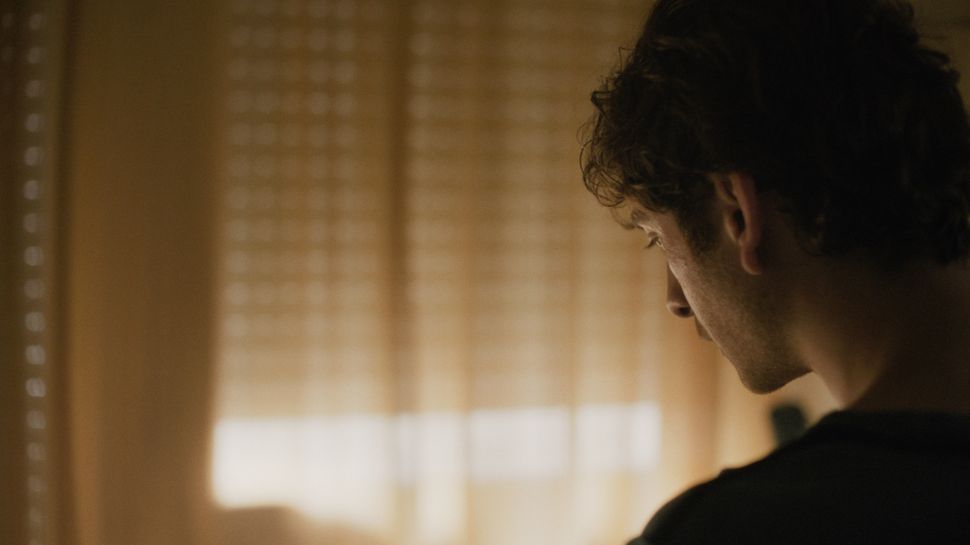
“The heat keeps rising. People grow distant, in curious kinds of solitude. This is where Jonah (28) provides comfort for strangers. But when he finds himself in the role of the father for 9-year-old Nika, his life starts to unravel.” Welcome to the world of Don’t Let the Sun, the first fiction feature from Swiss documentary filmmaker Jacqueline Zünd (Where We Belong, Almost There, Goodnight Nobody), a cinematic contemplation of how external factors, namely climate change, could affect and shape our inner worlds.
Written by Zünd and Arne Kohlweyer, with Nikolai von Graevenitz as cinematographer, the movie stars Levan Gelbakhiani (And Then We Danced), Maria Pia Pepe, Agnese Claisse (Amore Synthétique), and Karidja Touré (Girlhood). Sideral Cinema is handling international sales.
Ahead of its world premiere in the Filmmakers of the Present program of the 78th edition of the Locarno Film Festival on Aug. 9, the Locarno website promises “a delicate drama about the fragility of human relations.”
Zünd talked to THR about Don’t Let the Sun, crafting an almost silent movie about alienation, how she overcame her fear of actors, how close our world is to the one depicted in the film, and the climate change documentary she is working on.
After making a name for yourself with documentaries, how did you decide to make a fiction feature?
The whole journey started while shooting my second documentary in Japan, when I discovered this agency where you can rent people for every social role – you can rent a friend for your birthday party, or a lost daughter, or maybe just somebody sitting next to you as a silent companion. And I got fascinated by that, but didn’t want to make a film about this agency thing, because films about that already exist.
But it made me think about the fragility of human relations, and how external conditions can change or influence us, and what we need in terms of relations. In Don’t Let the Sun, it is the heat that pushes the alienation forward. When it’s already unbearable to be with yourself and in your own skin, how is it possible to be close to somebody else?
How far from or close to the situation in Don’t Let the Sun do you see us right now?
It’s not that far from our reality. But I didn’t want to make a film about a dark, dystopian future. For me, it’s more of a step aside than a step forward, a glimpse into a possibility.
There are scenes where we see Jonah engaging in an activity that I would describe as “power-hugging,” or maybe “hug wrestling.” Is that based on a real thing or a kind of reference you could explain?
It’s a reference to Claire Denis’ Beau Travail. I was looking for something he can do, a sport, or so he does for himself. And I was looking for something that expresses the need for intimacy that, at the same time, you can’t stand. It’s not wrestling. It’s more something between a dance and the reactions between magnets.

‘Don’t Let the Sun’
Courtesy of Lomotion
The visuals are stunning. How and where did you film the shots of the sun burning down onto the city? And where did you find that Brutalist building in the movie?
Like in all my films before, I worked with the DOP Nikolai von Graevenitz. It was great to create this atmospheric cinematic universe together.
We worked quite close to the way we work in documentary. I always had this tropical Brutalism in mind for depicting this world, which shouldn’t be recognizable. So I was looking for a Brutalist, futuristic city that is at the same time old-school to get something like a mixture of times. I really wanted to shoot in São Paulo, but then it got complicated and also politically a bit delicate. So we were forced to look for other places.
And then I discovered in Milan this really beautiful place by architect Aldo Rossi. It’s a building complex from the ’60s. I also knew a social housing building in Genoa. I always drove home from holidays and saw that building, and I have wanted to make a film in this building. I always tried to do other stuff there, but I finally did it for the movie. It was just the perfect setting for this one, with these huge stairs [that the characters] walk up.
How did you create the images of the sun burning down onto empty streets?
The image of the sun was just the normal sun, but for the images of the empty city, Sebastian Mez, who is also a filmmaker, took out all the people in his [visual effects] work. It took him hours and hours. He made a film [The Great Void] about a completely empty world where he also took away all the people. It’s a documentary film, and when I saw it, I was like: wow!
Why did you decide to make Don’t Let the Sun in English?
The world I was creating was for me just a city where people from all over the world live. So I wanted to have them speak in English in all different accents. For casting, that was very nice, because the whole world was open, but at the same time, it made it very difficult, because the whole world was open. Luckily, I had the help of Chiara Polizzi, the casting director from Italy who works on the Alice Rohrbacher films, and she’s very good for casting kids.
So how did you find your cast, especially young Maria Pia Pepe?
Don’t Let the Sun ist her first appearance. I just saw her in a casting video and fell in love with her. She just had this old soul I was looking for. She is brilliant. She was 11 when we shot. We did a lot of night shooting. So, for her, we had to watch the hours, but she was always awake. Luckily, she’s a night person.
How did you find Levan?
I saw him in And Then We Danced, his first film appearance, and we were really lucky that we could work with him on his second film. It was just super great to work with him. For an actor, it’s super hard because we have almost no dialogue in the film. So it’s a difficult piece of work for an actor. You have to do a lot of work with your body and face.
Jacqueline Zünd
Courtesy of Wolfgang Schmidt
Funny that you mention that because I was going to ask you about this dominance of visual storytelling…
It’s almost like a silent movie. That’s what I aimed to do, and in editing, even more dialogue just went away.
The title Don’t Let the Sun obviously fits the climate change feel, but I wanted to ask what else may have inspired it?
My basic inspiration came from the old song from the ’60s, Don’t Let the Sun Catch You Crying [by Gerry and the Pacemakers]. It was just like the impact of the emotionality of the film. I thought about using the full title, but then I felt like it’s much better just to leave out the second half, because a lot of things also get lost in the heat. Everything gets very minimal.
What was the hardest part of the production?
I think it was really hard because I always wanted to make it kind of method acting. I wanted to shoot in the summer, so we shot in August in Milan. It was a really stupid idea in the end because it was 40 degrees [Celsius], and we were inside. We had 30 people in this little apartment. We could hardly breathe. It was really hard.
What was the most difficult part about moving from documentary to fiction filmmaking?
Coming from the documentary world, I had never done a fiction film until now, because I think I’ve always been afraid of actors. But I found out this is complete bullshit. I realized that these are just human beings. And I was so lucky that I was surrounded by beautiful human beings, and I had the best time. For me, it was the most beautiful experience working together with the actors. And it was so liberating also to work with people who played and aren’t talking as themselves, like in my documentary films. I mean, I work a lot in scenes too in that work, so it’s like a hybrid form.
‘Don’t Let the Sun’
Courtesy of Lomotion
Are you working on anything else right now? And will we see you making more fiction features?
I am working on a documentary film about heat and its impact on people. I’m in the editing process now.
The title is (laughs) Heat. It’s still a working title, but I think it’s going to stay, because I think it’s very, very direct and powerful. I think it should be finished by the first quarter of 2026.
It was kind of a parallel work, which is nice, because the two films inspired each other, because I did a lot of research for the fiction film, which I could use for the documentary, and vice versa. For example, the cooling room you see in Don’t Let the Sun was inspired by something I saw it in New York. They provide these rooms to people who can’t afford air conditioning. It’s not a luxury place, but more for poor people, but you can go there during heat waves.
So researching and working on both films was a very nice experience. And I think maybe I will continue working like this. I would like to do more fiction. I have already started writing some ideas, but it’s too early to talk about them.