Editor’s Note: This article has been updated with more details about Macron’s comments.
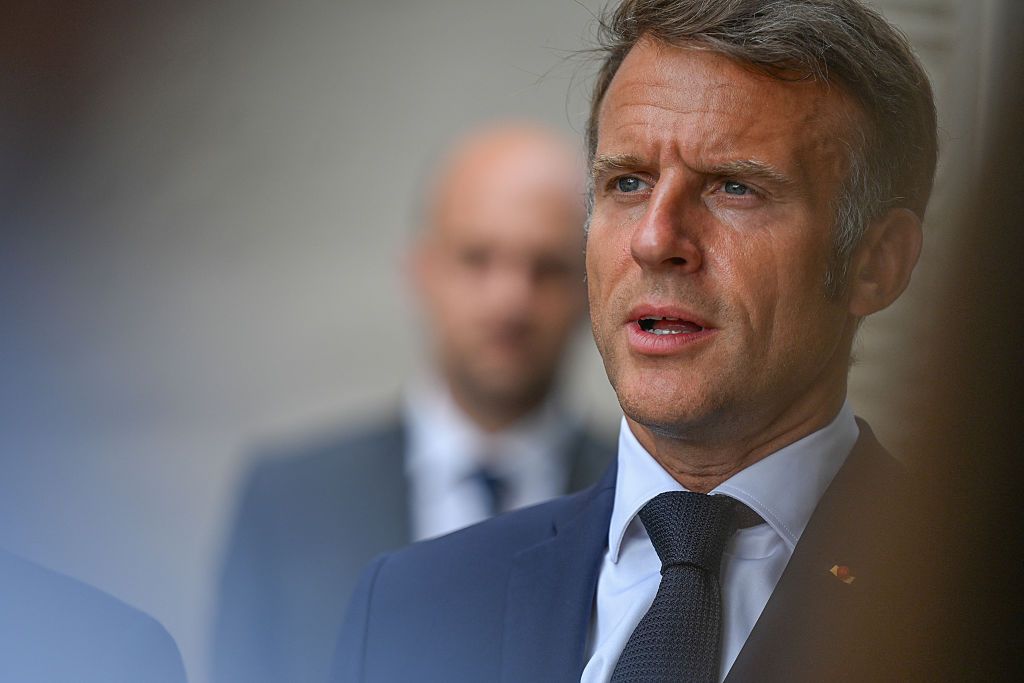
The United States is prepared to provide Ukraine with security guarantees once peace is established, but NATO membership is not on the table as a possible guarantee, French President Emmanuel Macron said Aug. 13.
Macron’s remakrs followed a video call with U.S. President Donald Trump, President Volodymyr Zelensky, and several European leaders. The online talks come just two days before Trump is set to meet Russian President Vladimir Putin in Alaska on Aug. 15.
Speaking to reporters after a the call, Macron relayed Trump’s assurances that Washington was ready to support European security after the war — but ruled out NATO membership for Ukraine.
“President Trump expressed this clearly in these terms,” Macron told the press.
“He even said things that are very important to me: the fact that NATO should not be part of these security guarantees, which we know is a key point for the Russian side, but that the United States and all the allies that are willing should be part of them.”
Ukrainian and European leaders have long urged the U.S. to back robust security guarantees for Kyiv in the event of a ceasefire agreement with Russia. The Trump administration has thus far been hesitant to commit to such guarantees, a stance that initially derailed the U.S.-Ukraine minerals deal and has injected uncertainty into the plans of the so-called “coalition of the willing.”
Macron hailed Washington’s readiness to commit to security guarantees as a positive, despite Trump’s opposition to Ukraine’s NATO membership.
Zelensky has repeatedly said that NATO accession is the best possible security guarantee for postwar Ukraine. Kyiv officially applied for NATO membership in September 2022 after Russia illegally declared the annexation of four Ukrainian oblasts.
Russian propaganda issues frequently — and falsely — cite NATO expansion and Ukraine’s NATO ambitions as a justification for the full-scale invasion. Trump himself has echoed these narratives, claiming former President Joe Biden’s support for Ukraine’s NATO aspirations provoked the war.
Macron also said that urging Putin to commit to a ceasefire was a top priority for Trump going into the Alaska summit, and that Trump agreed that any discussions about territory required Zelensky’s participation.
“(T)erritorial issues that fall under Ukraine’s jurisdiction cannot be negotiated and will only be negotiated by the Ukrainian president,” Macron said.
“This is the position we support, and it was very clearly expressed by President Trump.”
Kyiv and its European allies convened the conversation with Trump to discuss the war and to express concern about the upcoming meeting, which excludes Ukraine. Leaders from Finland, France, the United Kingdom, Italy, Poland, the European Union, and NATO Secretary-General Mark Rutte attended the video call.
A ceasefire in Ukraine was a major topic of discussion: “President Trump said this is one of his priorities in conversation with President Putin,” Zelensky told reporters during a joint press conference with German Chancellor Friedrich Merz.
According to Merz, European leaders are doing everything they can to ensure the Trump-Putin summit moves “in the right direction,” amid fears that Ukraine may be sold out by Trump.
As Putin, Trump debate Ukraine’s future borders, Donetsk Oblast residents are split on what they would accept to end the war
KRAMATORSK, Donetsk Oblast — U.S. President Donald Trump began to actively push Ukraine to accept losing its land and people to Russia, following years of brutal, all-out war. People in Kramatorsk, the largest Ukrainian-held city in Donetsk Oblast — a region that Russia wants and Trump is thinking of handing over in full — have met the recent news with unease. Those who spoke with the Kyiv Independent, however, still maintain a fragile hope for a lasting peace — something this region hasn’t se