Hey folks!
What’s that one dish you can eat any day without complaining?
Chances are, it’s got a potato in it.
Think about it. Aloo ki sabzi at home, crispy fries with a burger, chips with chai… potatoes are everywhere. No wonder it’s the world’s most eaten vegetable.
And it’s not just tasty, it’s efficient too. Back in the 16th century, early Irish farmers discovered that a single acre of potatoes could feed ten people — way better than wheat or oats.
Add to that the fact that it’s packed with vitamin C, potassium and pairs beautifully with almost anything — peas, paneer, biryani, you name it, and you know why the potato is such a global superstar.
But here’s the catch. While potato is the most eaten vegetable, it’s not the favourite. That crown goes to the tomato. By sheer production volume, tomatoes win the popularity contest. And honestly, it makes sense. They’re as versatile as it gets. Eat them raw like a fruit (which they technically are), toss them into a curry, or just squeeze them into a ketchup.
Now here’s the plot twist. Potatoes and tomatoes aren’t just kitchen buddies. They’re actually related. In fact, without the tomato, the potato may have never existed. Yup! You read that right.
A recent study found that millions of years ago, a tomato-like plant and a potato-like cousin crossbred naturally. Together, they passed on the right set of genes to create what eventually became… the potato. If you’re wondering how, well, tomatoes carried the SP6A gene (which helps plants grow tubers), while etuberosum, the potato’s cousin, had the IT1 gene (which grows underground stems). When these came together, the plant began forming tuber roots. And over time, we got the potato we know today.
Or as the New York Times put it — a potato is basically a 9-million-year-old tomato. 😂
Crazy, right? So the next time you bite into fries, wedges or an aloo tikki, remember, you’re really just munching on ancient tomatoes in disguise.
Here’s a soundtrack to put you in the mood 🎵
Loche by Kunal Kemmu
You can thank our reader Rishi Chavan for this beautiful rec.
What caught our eye this week 👀
Seeds from space?
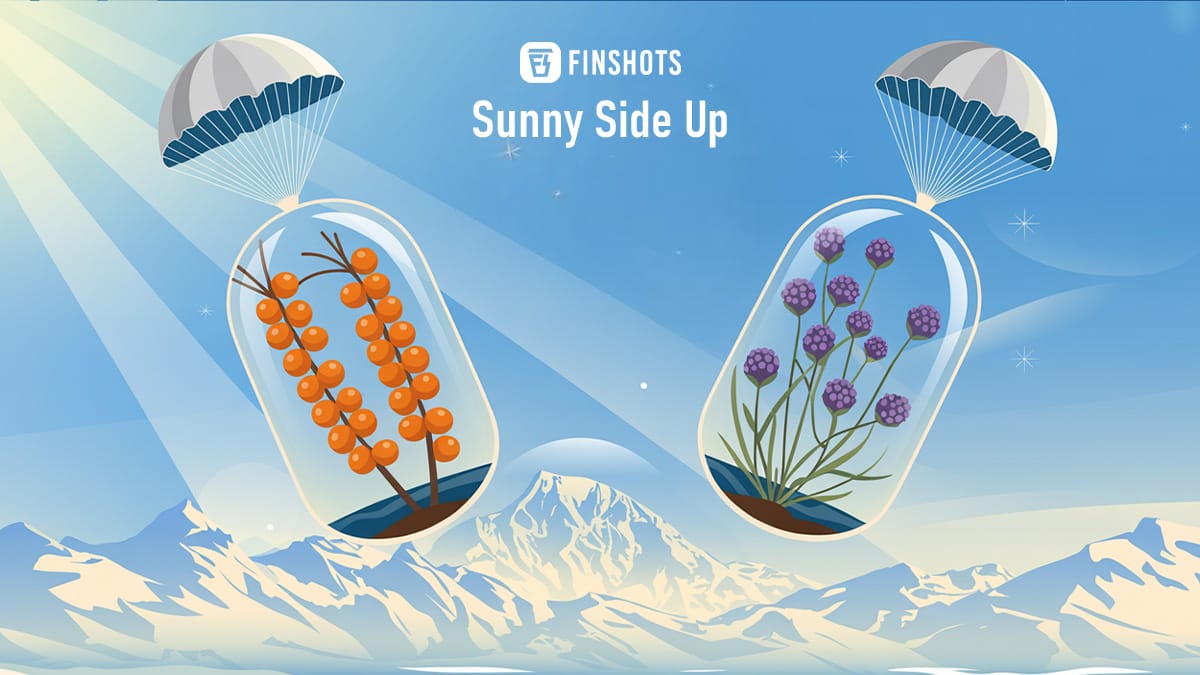
Two humble Ladakhi crops — seabuckthorn and Himalayan buckwheat — came back from an unusual trip last week. They hitched a ride on NASA’s Crew-10 capsule, spent days floating around the International Space Station, and are now back on Earth.
But why on earth (or off it) would you send seeds to space?
Because space is the ultimate stress test. Up there, seeds face microgravity, cosmic radiation, and wild temperature swings they’d never get on Earth. That stress can sometimes trigger tiny genetic changes. Most don’t matter, some even make plants weaker, but once in a while you get a winner. A seed that’s more resilient to cold, drought, or poor soil. China’s been doing this for a while, producing “space-bred” crop varieties. And this time, a US-based bioastronautics firm and an Indian startup wanted to study how different seeds respond to those space stresses before germination. By studying the genetic and metabolic changes, scientists hope to unlock clues for growing food on long-term space missions and also breed crops that can handle drought, degraded soils, and extreme weather on Earth.
Sounds interesting, right? But here’s the part you might not think about. Space seeds could come with another layer of debate, one that echoes the Monsanto saga. Back in the 1990s and 2000s, Monsanto developed genetically modified (GM) seeds that were resistant to its own herbicide. Farmers loved the yields, but the seeds were patented. That meant they couldn’t legally save and replant them, and they had to buy new seeds every year from the company. And in a way, it trapped farmers in a cycle of dependency and pushed out traditional crop varieties. And the result? Decades of lawsuits, protests, and a deep mistrust of “big agri” seed control. We’ve seen a similar tale in India as well, and Monsanto’s corporate power has impacted the lives of farmers as well as ordinary people.
Space seeds aren’t genetically modified, but they’re still altered by their environment. If one turns out to be a “super” crop, who owns it? Will farmers be free to save and replant it, or will it come with a licence fee every season? And if it’s valuable, global treaties could require benefits to be shared with the source community.
That’s not to say the Ladakhi crops sent to space this time will face the same issues. Part of the seeds will go for scientific analysis, and the rest are said to be given back to the local communities of Ladakh.
But yeah, a few years from now, maybe someone in Leh might be biting into a seabuckthorn berry that’s juicier, frost-proof, and keeps for weeks, all thanks to the seed’s trip in orbit. The bigger question then would be who gets to plant it. And here’s hoping we never have to find out the hard way!
Infographic 📊

Readers Recommend 🗒️
This week, our reader Bhratesh Agrawal recommends watching The Founder, a docudrama about Ray Kroc, the man who turned our favourite McDonald’s into one of the world’s biggest restaurant chains today.
Thanks for the rec, Bhratesh!
Finshots Weekly Quiz 🧠
It’s time to announce the winner of our previous weekly quiz. And the winner is…🥁
Shalini Rosa Kurian! Congratulations. Keep an eye on your inbox and we’ll get in touch with you soon to send over your Finshots merch.
That’s it from us this week. We’ll see you next Sunday!
Until then, send us your book, music, business movies, documentaries or podcast recommendations. We’ll feature them in the newsletter! Also, don’t forget to tell us what you thought of today’s edition. Just hit reply to this email (or if you’re reading this on the web, drop us a message at morning@finshots.in).
🖖🏽
Don’t forget to share this edition on WhatsApp, LinkedIn and X.