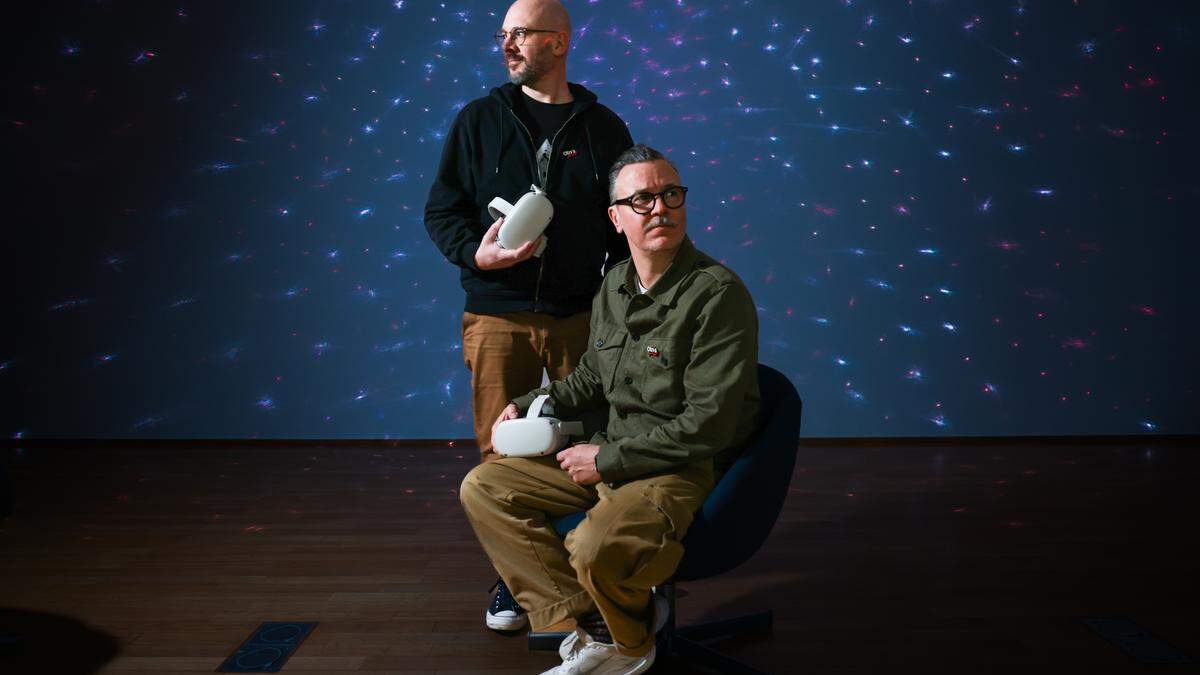
Just seven years after Luxembourg first started getting serious about what was then called VR film, the Grand Duchy has emerged as an unlikely leader in the world of XR (extended reality) or, as it is now more commonly called, immersive cinema.
Last September, five Luxembourg co-productions were selected for the Venice Immersive competition at the Venice Film Festival. Les Films Fauves co-production Ito Meikyu by Boris Labbé came away with the Grand Prix, and the Special Jury Prize went to Oto’s Planet by Gwenael François, a Skill Lab co-production.
“I think that was the moment when everybody realised that Luxembourg has become a major world player in immersive work,” said Guy Daleiden, director of the Luxembourg Film Fund.
Daleiden has been at the forefront of the Grand Duchy’s push to support and encourage immersive cinema. By 2016 it was clear that filmmaking using advanced technologies was going to have a serious future, he said. “But we didn’t really know what it was. Everybody told us to go to Montreal and have a look at developments over there because they were at the forefront of everything.”
The Film Fund’s Quebecois counter – part, the Société de développement des entreprises culturelles (Sodec), helped put Daleiden’s team in contact with XR studios, producers and exhibitors. It was a visit to Montreal’s Phi Centre, which specialises in showing immersive film, that really opened up Daleiden’s eyes to the significance and possibilities of the new technologies being used to make film that was different from the standard projection onto a screen. “We were really captivated,” he said.
So, the Film Fund decided to bring over to the Grand Duchy some of the films they had seen, “to show the Luxembourg public what was going on in virtual reality and maybe generate interest from the audiovisual sector.”
Showcase opportunities
“Running this agency, I have to come up with new ideas. As an administration we cannot stand still, we have to adapt,” he said. “It’s not up to us to decide what the industry has to do, but we have an obligation to show the players what opportunities, what new developments are out there, and what they could do differently.”
We have an obligation to show the players what opportunities are out there
Guy Daleiden
Luxembourg Film Fund director
The first VR Pavilion, hosted at the Casino contemporary art forum as part of the Luxembourg City Film Festival in 2016, screened two films. The interest it generated soon saw the annual showcase expand to five films and it is now held at Neimënster over 17 days, while the Film Fund and Phi Centre – represented by its Chief for New Media Partnerships Myriam Achard – also host a two-day Immersive Days conference that brings to Luxembourg industry experts, professionals and artists from around the world.
The Film Fund, which in 2025 celebrates its 30th anniversary, was backed in its promotion of immersive film by the Luxembourg government. “When we started developing a professional Luxembourg film industry, cinema was almost 100 years old. So, we were very late, and I didn’t want to have the same delay for VR film,” Daleiden said. Crucially, the political will was also there. Then-Prime Minister Xavier Bettel, who was also responsible for media, was an early champion of supporting the new technologies. “He said: ‘when the digital train leaves the station, I don’t want to be left behind on the platform, I want to be in the driver’s seat’.”
Film Fund director Guy Daleiden © Photo credit: Marc Wilwert
The local audiovisual industry did sit up and take notice, even though some production companies had already taken baby steps into the XR world. For example, a_Bahn, launched in 2011 by producer Marion Guth along with filmmaking brothers Nicolas Blies and Stéphane Hueber-Blies, was thinking about using new technologies to help them break free from established norms of visual storytelling. “Innovation and hybridisation were part of our DNA,” Guth said.
Hueber-Blies was far from a technology addict when he first started making films, he said. “With Nicolas, and with Marion as producer, we first ask ourselves what we want to say. And then we ask what medium and technology we can use to convey that in the most compelling way. The technology, specifically, is a response not the reason why we did it.”
The Blies brothers’ latest project, however, took that a step further. Ceci est mon Coeur is an intimate, semi-autobiographical story about a boy coming to terms with his own body. The audience, donning earphones and a quilted cloak fitted with custom-made LED lights, is free to wander between screens, including one that is transparent, showing scenes that illustrate the narrative. “The software to manage the choreography between the sound, the visuals, the lights was created from scratch,” explained Guth.
Envy of Europe
The a_Bahn producers – also including François Le Gall since 2017 – have even created their own studio together with composer and entrepreneur Damiano Picci. Velvet Flare includes specialists in spatial sound – “which is quite unique in Europe,” said Guth – fashion and animation, as well as electronic developers.
“People in Europe are jealous that we have such a studio,” said Hueber-Blies. “It is a young studio, but we can do everything we want to do at Velvet Flare.” International production companies and even a high-end French fashion house showed an interest in the technology a_Bahn was using when Ceci est mon Coeur was screened at Venice last year.
As well as enhancing the Luxembourg immersive film ecosystem, the studio also adds another string to a_Bahn’s bow on the international scene.
“As a producer, it’s cool to have the money. But to attract a producer from France or Belgium or Canada, you also have to have the means to create a piece,” Hueber-Blies explained. The challenge also lies in trying to convince “classic” producers to think a little differently about ways to tell a story. “For us, it is quite easy and natural to think outside the box,” he said.
Over at Skill Lab, Gwenael François and producer Julien Becker turned to Luxembourg animation studio Zeilt Productions for the character design and modelling for Oto’s Planet, an interactive film that allows viewers wearing VR goggles to rotate the titular planet and drive the story using their hands.
The animators at Zeilt did the animation of the characters using real actors and motion capture. “They also fought over the animation of the dog, because they thought it was so cute,” François said. But the planet and rest of the design was done by Canadian outfit Dpt., which specialises in creating interactive virtual worlds.
“It’s made using the same engine as a video game, because it’s live, it’s not calculated at all,” François explained. “It’s not like a movie where you simply render an image,” Becker added. “You move in the film, so it has to react.”
The collaboration with producers from abroad is vital, said Becker. “Luxembourg is renowned for its animation studios – there are others apart from Zeilt – but something that we need to innovate in perhaps is programmers or developers focused on game engines. We don’t really have a gaming industry in Luxembourg, yet.”
Distribution challenge
Distribution for immersive film, on the other hand, still poses financial and logistical challenges. Traditional films have potential access to a range of video on demand streaming platforms, but immersive films are pushed into video game stores. “But there are millions of games in those stores, so it’s very difficult to get visibility,” Becker explained.
The challenges for a_Bahn’s project are even greater. “The business model is closer to a mix of cinema and theatre,” Guth said. “We have to tour.”
During a two-month residency in Luxembourg earlier this year, the installation was limited to just six viewers at a time. Bigger distribution at international venues will create a new challenge to synchronise 20 headsets and cloaks, Guth said. Incorporating connected garments into a specific scenography and storytelling is unique. “Nobody has ever done it before,” said Hueber-Blies. “So, museums, art centres, producers, distributors, they don’t know exactly how to distribute it.” Ceci est mon Coeur will be shown at the Wales Millennium Centre in Cardiff in October and there are also talks with a venue in Melbourne and the South Bank in London.
Marion Guth and Stéphane Huber-Blies of a_Bahn © Photo credit: Marc Wilwert
The logistics and cost of distributing immersive installations can be a heavy, Daleiden said. “We have realised that while the production of immersive film is maybe a little bit cheaper than traditional cinema, the distribution costs are more expensive. And you have to include those costs into the production budget.”
Just 3-5% of the Film Fund’s production support budget is currently awarded to immersive film projects, Daleiden said. The advantage Luxembourg has is that it did not spend what he reckons could have taken two years to set up specific support mechanisms for XR productions. Rather it adapted its existing framework. “Those countries that decided to develop something specifically for immersive film are now running behind.”
A growing number of Luxembourg production companies from the more traditional side of the industry are showing an interest in immersive film, said Guth, praising Daleiden and the Film Fund for having what she called “the audacity” to really dive into immersive filmmaking, see what is happening around the world and decide where Luxembourg wants to position itself. “It was seen as witchcraft ten years ago, but now it’s fully accepted,” she joked.
It may be fully accepted, but that does not mean that the industry will rest on its laurels. The journey is far from over, as Daleiden explained. “Since I started watching virtual reality projects seven years ago, there has been a huge evolution from VR to augmented reality, to mixed reality, to AI, and now the immersive projects,” he said. “Luxembourg producers and directors have played a part in that. But we don’t know where we are going next, how the mix will develop. You just know, it doesn’t end with this.”