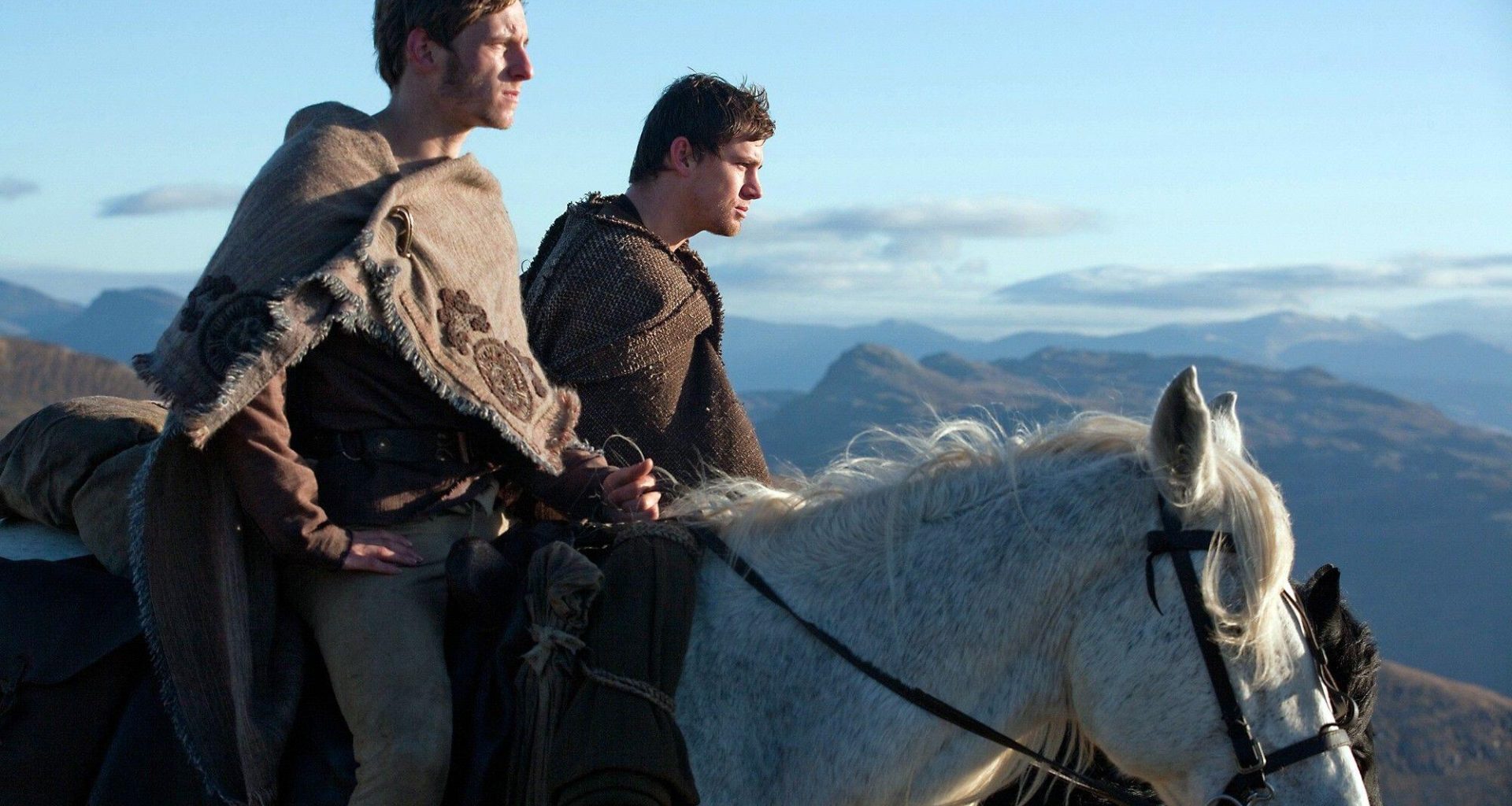
It is a curious, and not comforting, idiosyncrasy of Great Britain that its vast body of native mythology, the entire epic cycles spanning the breadth of an ancient island civilisation, is so little known domestically. How many otherwise literate readers would draw a blank when asked who Rhiannon was, or how Lludd confined the warring dragons within the bowels of Dinas Emrys? It is as if, in forging the United Kingdom, the deepest roots of Britishness were buried away, like offerings deposited in a mountain lake. Any nation requires its own body of literature, whether heroic or tragic, to crystallise the national myth. Yet in today’s circumstances, where it is not hard to see a nascent British nation-state struggling to be born from the collapsed star of empire, the stirring tales of imperial derring-do suitable for Edwardian prep schools will not do. What is required here is something homelier, cosier, more nostalgic and intimate: something of “ourselves alone”, as an earlier nationalist movement phrased it.
A strong case could be made that children’s literature, which by virtue of its audience often sheds the self-consciousness affecting many British writers, fits the bill perfectly: for what is childhood other than a lost and half-remembered homeland? An inward-looking British nationalism would owe more to the world of Brambly Hedge than the Lusiads or Kalevela: yet even Tolkien’s modern-day national epic, a conscious imitation of European nationalist myths, was explicitly written for children. Even the Edwardian high-summer whimsy of The Wind in the Willows is suddenly interrupted, in the “Piper at the Gates of Dawn” sequence, by a mystical, neo-pagan reverence for the spirits of the land. Tapping into the deeper wellsprings of cultural consciousness, children’s writing perhaps reveals hidden potentialities for such a project.
If we accept this thesis, then a suitable candidate, I would suggest, for such nationalist myth-making would be the postwar writer Rosemary Sutcliff’s series of novels, most of them ostensibly written for children, on Roman Britain and its violent collapse. For as Sutcliff remarked to an American audience, gathered to celebrate her work, “Children should be allowed the great themes, which are also often tragic themes, which they can receive and make use of better than most adults can.” Last year’s 70th anniversary of her most famous novel, that staple of the pre-Blair primary school library The Eagle of the Ninth, saw a modest flurry of appreciative retrospectives. Yet The Eagle, though her breakout book, is not representative of her mature body of work (which, by the way, offers passages of fine writing, particularly terse and beautiful nature-writing, far beyond that currently marketed towards adults). The Eagle is, essentially, a Kipling novel, directly influenced by her literary Sussex neighbour in space, if not time: indeed Puck of Pook’s Hill was Sutcliff’s childhood favourite.
The Eagle’s lead character, a young Roman officer, disguises himself as a native in a Boy’s Own adventure of self-discovery, leading him across the rainy Northwest Frontier to live among Pictland’s untamed frontier tribes, in their smoky mountain huts bedecked in the savage brilliance of “colourful native rugs”. The native tribes, driven to fury by “their holy men” to wage war against “the unbelievers” are, with great difficulty, outwitted by the decent, sensible young Roman subaltern, who then retires, like a good servant of the Raj, to live the quiet life of a Sussex country gentleman on his army pension. An obvious post-imperial novel, though perhaps not fully consciously, The Eagle is most interesting in establishing the mythic framework, and much of the anthropological quality, of her later, more morally and politically complex novels set within the context of the great Saxon migration — we might call it the Vortigernwave — that would carve an England from the land of the unwilling Britons.
Ultimately, though, Sutcliff’s reputation ought to rest on her great adult Arthurian novel, Sword at Sunset, written in a period of what she described as trancelike “possession”. With the medieval Matter of Britain as her subject, Sutcliff imagines a world where a society that once seemed enduring crumbles into disrepair. Yet the love of Britain, and its strange and ancient insular civilisation, drives its hero to a fierce, if doomed, rearguard defence, “that the things worth saving shall not go down into the dark”. Half-Roman and half-Briton — his battle cry is Yr Wydffa, the Welsh name for Snowdon whose official re-adoption is now resented by some Anglophones — her Artorius is torn between two worlds, that of Roman rationality and straight lines, and of native Celtic mysticism and curved and sinuous pattern-making.
This is a theme running throughout her books, in which the decent, sensible if officious Roman is an obvious stand-in for the modern Englishman, in a world where the Englishman’s actual ancestors are the wild invading barbarians. As she notes in the introduction to her children’s retelling of the Irish Ulster Cycle, “The Cuchulain Saga belongs to the Celts, the people of Ireland and Wales and the Highlands of Scotland, just as the story of Beowulf belongs to the Anglo-Saxons; that is very broadly speaking, to the English, and the Scottish Lowlanders. And neither Celt nor Saxon could have bred the other one’s story, for they belong to two quite different ways of thinking.” Fully adopting Matthew Arnold’s 19th-century distinction between the stolid, dependable Saxon, and the creative but erratic Celt, Sutcliff continues:
“However wild the happenings in the Saxon story, its feet remain firmly on the ground; and Beowulf and his companions are recognisably human beings grown to hero-size. But the Celtic tale leaps off into a world completely of the imagination, and the Red Branch Heroes have the blood of the Gods and the Fairy Kind (almost the same thing in Irish legend) running fiery in their veins. It is worth noticing this difference when reading either story, and remembering that in the main the people of Cuchulain and the people of Beowulf separately or mixed together are the stock that we in Britain are sprung from.”
A children’s writer today would not comfortably write the same thing, in the same way, yet a glance at Puffin novels of the Sixties and Seventies shows a world where the mythology of the British Isles, so bafflingly neglected today, was a common theme in postwar children’s writing. In other circumstances, we would term this, too, a kind of cultural nationalism: the creation of a shared corpus of myth spanning the British Isles, in which the Atlantic Archipelago, though at war with itself, is nevertheless a shared cultural unit.
For however distinct the Britons, or Picts, or Irish are in her novels, the Saxons or Romans are more different still: all the Celtic characters in her novels share a common religious and cultural worldview, and speak an apparently mutually intelligible language. Indeed, across her novels, Sutcliff creates her own pan-Isles vocabulary, gathered together from across dialects and eras with a brisk disregard for accuracy: a world of burns and bairns and kalegarths, where her British Celts say Sláinte as they down their anachronistic “fiery barley spirit”. Hibernicisms, of words and syntax, abound in her writing, whether justified by context or not: Sutcliff observed in her autobiography that her mother, of pure West Country extraction, would adopt a baffling Hiberno-English accent at moments of high emotion, “becoming Irish of the Irish. My father just used to wait patiently for the black mood to depart.”
From her Wessex mother, too, from a family devoted to the Raj and imperial service, Sutcliff claimed to derive a “residual trace of the second sight”. A believer in reincarnation, the increasingly physically disabled author, who chose to spend her life in the deep English countryside, overlaid her love for the land itself, for its “pale and changeful northern skies and the green plover calling”, with an awe-filled sense of its ancient, only partly buried power. Sutcliff’s Britain is an ancient, magical land, from which, at certain times and in certain remote places, great reserves of power can be summoned and drawn from. Magic may or may not be real — her rational, Romanised characters are ambivalent on the question — but, at times, it feels real enough to serve a political purpose.
In just such a way, in Sword at Sunset, her Artorius, acclaimed as emperor within a circle of standing stones, “felt the great carved stone at the back of my heel, and something in me, in the touch of my heel against the stone, in my very loins that linked me with the earth and the gods and the stones of the Earth…” Britain is, to Sutcliff as many others, an ancient insular civilisation unto itself: few other writers capture so succinctly both the natural beauty and the sheer strangeness of Britain, the enchanted weirdness of it, waiting to be drawn upon in time of need.
Though bred in the threatened softness of southern England, Sutcliff’s Late Roman heroes retreat to the upland peripheries of Wales, the Scottish Highlands and Borders, and the bleak moorlands of today’s northern England in search of personal and national renewal. Behind them they leave the great cities of Rome’s once-glorious British civilisation, falling into ruin and squalor as the invading Saxons settle them, now “half derelict, the frescoed plaster falling from the walls, the fine Purbeck marble cracked and damp-stained, the gilding blackened”. It is the world, returned to again and again in her novels, of the Saxon poem, “The Ruin”, though told from the perspective of the Romano-British refugee fleeing to the safety of the western hills, and not the squatting interloper. Abandoning the cities, now falling into danger and disrepair, her characters lament the transience of the world that bred them, even as they seek to make their final stand in Deep Britain.
“Abandoning the cities, her characters seek to make their final stand in Deep Britain.”
This is precisely the process described by the scholar of cultural nationalism John Hutchinson when he observed that one product of nationalist revivalism, when viewed as a comparative type, “was the unexpected ‘discovery’ of remote areas of natural beauty, or of great cultural significance, that because of their ‘wildness’ and ‘hidden’ quality became mysterious reservoirs of the national spirit.” These wild and untouched peripheries, whether Finland’s lakes and forests or the bleak expanses of Connemara, “became ramparts of the nation to which groups, especially alienated urban educated middle classes, could turn to escape assimilation into foreign values and experience moral regeneration, thereby embedding themselves in the land. The defence of these regions from foreign cultural or political threat galvanised powerful nationalist movements.”
Sutcliff’s heroes, objectively British nationalists, represent one iteration of this ideological current. In today’s nascent British nationalist movement, if the oft-discussed “MythoYookay” X account represents Britain’s current, fallen state, then its counterbalancing ideological colleague is the MythoBritannia account, which centres on Britain’s dramatic landscapes, with an emphasis on the mystical and otherworldly — Glastonbury Tor, holy wells, the last surviving rainforests. The gentle downs and fields of southern England are less often invoked than the bleak and dramatic peaks and valleys of Britain’s highland peripheries: these are wild, untouched landscapes, which through their careful curation speak to a Britain older and more magical than England alone. Consciously in MythoBritannia’s case, and perhaps unconsciously in Sutcliff’s, this retreat to the peripheries represents a reservoir of cultural Britishness, directly analogous to the classical nationalisms of the 19th and early 20th century, from which modern-day political strength can be drawn. Both invoke the spirits of a nation not dead but merely sleeping, ready to be summoned, like Arthur and his knights, in the trials ahead.
Sutcliff’s characters are victims of a once-proud imperial state that can no longer protect them, or their ancient way of life, in their own homeland. All is transience, and irreparable change, the unwanted result of political failure, experienced as a catastrophic loss. “When you thought about it, you realised that you were living in a world that might fall to pieces at any moment,” observes a character in The Lantern Bearers. “Rome is hollow rotten at the heart,” says the British warlord Carausius in The Silver Branch, “and one day she will come crashing down. A hundred years ago, it must have seemed that all this was for ever; a hundred years hence — only the gods know… If I can make this one province strong — strong enough to stand alone when Rome goes down, then something may be saved from the darkness.”
What did Sutcliff, with her claimed second sight, feverishly writing while “possessed” by something greater than herself, mean by returning again and again to this threatened, collapsing civilisation, while writing in the very different circumstances of immediate postwar Britain? As she would herself say of Sword at Sunset’s Artorius to a later interviewer, “for me in a way he stands for Britain” at a time when “we’re awfully uncertain of our future. Therefore we feel a kind of kinship for the Dark Ages; and I think for this reason we feel in a way the need for something to back us up, in the same way as Arthur ‘lights up’ the Dark Ages. We have the need for an archetype of some sort to pull us together, to get us through this, to spread light into the darkness until we can get through to a better world.” Sutcliff’s late Roman world, in our increasingly contested transition from one kind of nation to quite another, is perhaps better suited to a 21st century adult audience than a postwar children’s one. Morally complex, startlingly violent, both elegiac and cynical, Sutcliff’s own writing represents a lost land in itself.