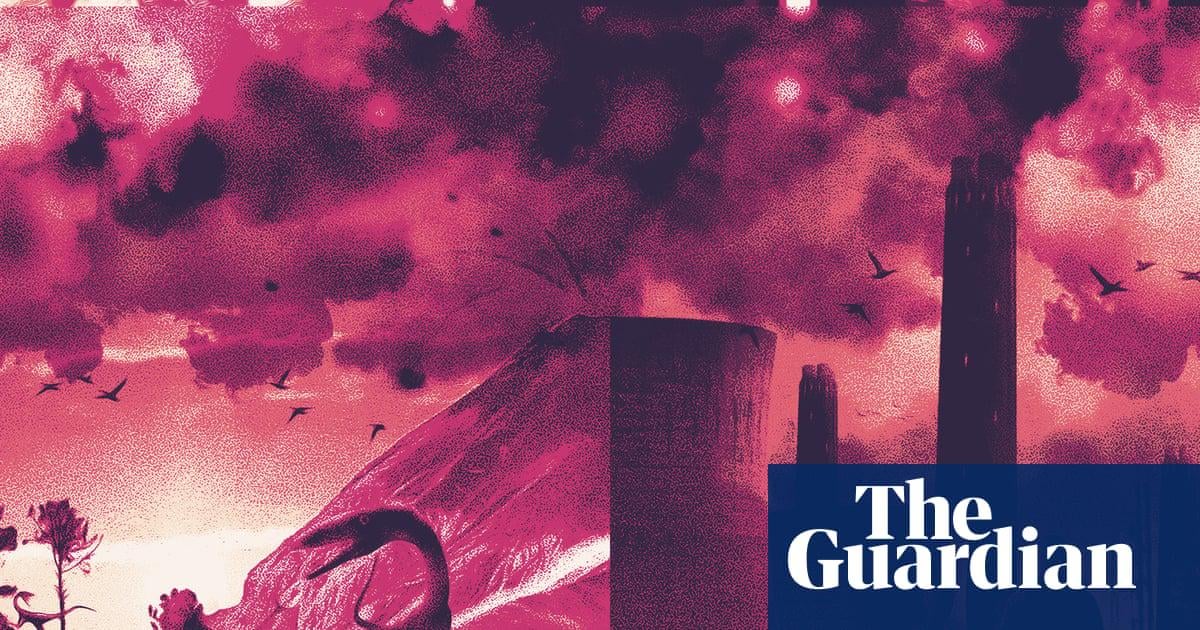
‘A climate of unparalleled malevolence’: are we on our way to the sixth major mass extinction?
https://www.theguardian.com/environment/2025/aug/19/a-climate-of-unparalleled-malevolence-are-we-on-our-way-to-the-sixth-major-mass-extinction?CMP=Share_AndroidApp_Other
by mhicreachtain
11 comments
On our way?
No, we are not _on our way_ to the 6th mass extinction.
We’re well past the beginning phase driven by human predation, overfishing, habit destruction, environmental poisoning, and the like. The phase we’re now entering is the ever-accelerating extinctions driven by climate breakdown, earth system regime shifts, and the coming breached tipping points, and cascading ecosystem failures.
Update: quibbles about the headline phrasing aside, this article is fascinating, well written, and describes just how hellish things can get if we release enough CO2 fast enough and long enough.
“On our way”???? We have wiped out well over 70% of the planet’s wildlife in just few decades.
It only took a couple of sociopathic human generations to destroy an entire planet’s biosphere. And still we do not stop. We deserve whatever nightmare not-so-distand future has for us all.
We’re in it, unfortunately.
Absolutely 8 billion and counting and everyone wants a lifestyle like ours, those metrics add up to mass extinction for sure. In two or three hundred years time we will be counting humans in millions.
let’s go! Get this thing done once and for all and turn this into a barren rock once and for all
We aren‘t on our way. We are in the sixth major mass extinction, but this time, it was caused by us humans. We are set to kill millions of species in a time span of 500 to 1.000 years.
The Amazon rain forest, home of millions of species, is only a couple percent of deforestation away from its inevitable decay over a period of a couple hundred years. The oceans are warming and souring, killing the reefs and thus many reef dwellers.
Someone please tell these normies
on our way?
[https://en.wikipedia.org/wiki/Holocene_extinction](https://en.wikipedia.org/wiki/Holocene_extinction)
We are way past on our way.
Fantastic article. Everyone should read it.
“This matters because it’s all about the rate. There’s almost no amount of carbon you can pump into the atmosphere that, given enough time, Earth couldn’t buffer itself against. Volcanic CO2 is supposed to enter the system. Without it, none of this works: the climate wouldn’t be habitable, life would run out of raw material, and oxygen would run out. But everything in moderation. To maintain its homeostasis, the planet continuously scrubs CO2 from the atmosphere and oceans so that it doesn’t build up and cook the planet. But this process is very slow on a human timescale. It buries this CO2 in coals, oil and gas deposits, and, most importantly, ocean sediments that turn to carbonate rock over millions of years. When more modest-sized eruptions inject a massive slug of CO2 to the atmosphere, threatening to overwhelm this process, the Earth has several emergency handbrakes.
The oceans absorb the excess carbon dioxide, becoming more acidic, but in their millennial overturn they bring these more acidic surface waters to the seafloor on the downdraft of the planet’s great ocean currents. There they dissolve the seafloor’s carbonate sediments – the massive carpeting of tiny seashells at the bottom of the ocean, laid down by life over millions of years – and buffer the seas in the exact same way that a Tums settles an upset, acidic stomach. This is the first line of defence in the carbon cycle, and it works to restore ocean chemistry over thousands of years. Eventually, these forces work to restore the carbon cycle and coax the Earth back from the edge. On a world without humans or especially catastrophic Lips, these feedbacks usually suffice to rescue the planet. The excess CO2 is removed and transmuted to rock; the temperature eventually falls; and the pH of the ocean is restored over hundreds of millennia.
So it’s not just the amount of CO2 that enters the system that matters, it’s also the flux. Put a lot in over a very long time and the planet can manage. But put more than a lot in over a brief enough period of time and you can short-circuit the biosphere.
Unfortunately, the rate at which humans are now injecting CO2 into the oceans and atmosphere today far surpasses the planet’s ability to keep pace. We are now at the initial stages of a system failure. If we keep at it for much longer, we might see what actual failure really means.
If you want to overwhelm the system in a shorter time frame and shove the carbon cycle dangerously out of equilibrium, you need a much more intense infusion of CO2 into the oceans and atmosphere – faster than biology or weathering can save you. The modern global industrial effort to find, retrieve and burn as much ancient carbon buried in the Earth’s crust as possible in a matter of mere centuries might be up to the task.”
We’re already there
Comments are closed.