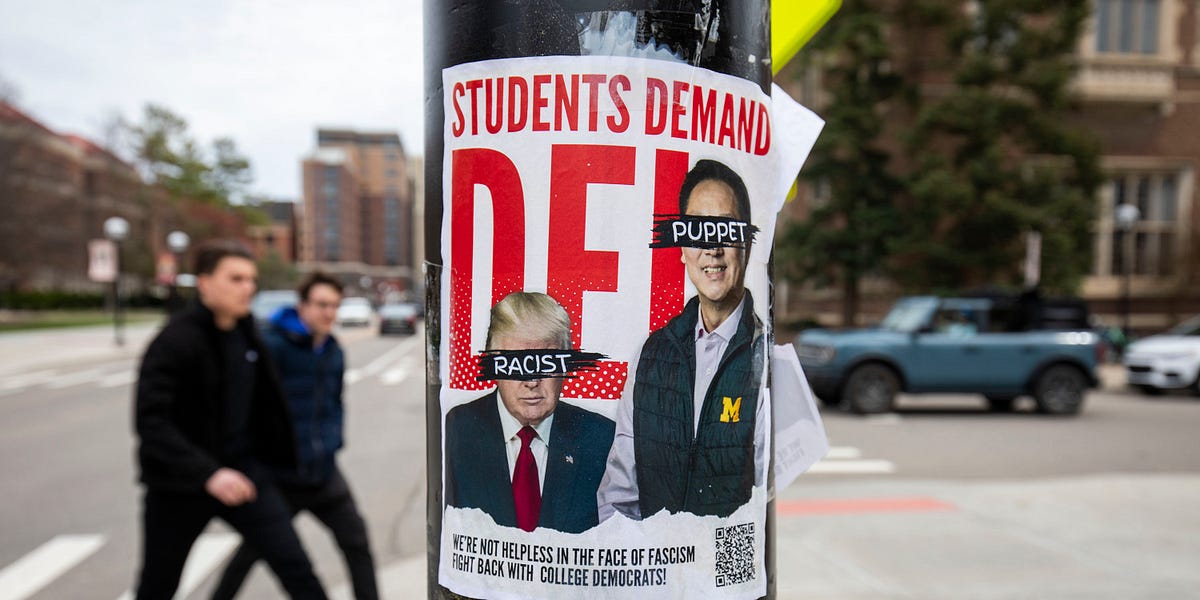
About a year ago, I began reporting on a story for The New York Times about the University of Michigan’s student government, which pro-Palestinian activists won and then, in accordance with their campaign promise, shut down. Since then, I’ve followed the career of Santa Ono, Michigan’s former president, whose career trajectory has been an example of the political volatility reshaping higher education leadership.
After a failed bid this spring to lead the University of Florida, Ono has resurfaced across the Atlantic. On Monday, the Ellison Institute of Technology (E.I.T.), a private research organization based in the United Kingdom, announced that Ono will serve as president of its global division. According to a press release, he will collaborate with Sir John Bell, president of E.I.T. Oxford, to develop and expand the campus’s scientific programs.
Ono’s story illustrates both the growing pressure U.S. academic leaders face and the alternative paths available for those sidelined by domestic political currents.
During his roughly two-and-a-half-year tenure at Michigan, Ono helped boost the university’s research standing, overseeing a $1.2 billion A.I. research initiative and championing ambitious climate and diversity programs. Chief among them was Michigan’s $236 million diversity, equity, and inclusion (D.E.I.) initiative, which, after its launch in 2016, was considered a national model.
In March, Ono ended all facets of the program after the Trump administration launched investigations into more than 50 universities as part of its anti-D.E.I. crackdown. While many in the Michigan community criticized Ono’s decision, a university 1,000 miles to the south viewed it favorably.
After Ono departed Michigan in May, he emerged as the sole finalist to replace former Senator Ben Sasse as president of the University of Florida (UF). Ono was unanimously selected by the board of trustees and offered a base salary of $1.5 million and a total package worth more than $3 million.
“His values align perfectly with ours here in the great state of Florida,” UF Board of Trustees Chair Mori Hosseini told a campus news outlet in May. “Dr. Ono will ensure that merit and scholarship, not ideology, are the gold standards for success.”
But that appointment never materialized. In a stunning reversal, the Florida Board of Governors, a politically appointed oversight body, voted 10 to 6 to reject his appointment. It was the first time in Florida’s history that the board overruled the trustees’ choice. Members cited Ono’s previous support for D.E.I. programs and his approach to student protests at Michigan as reasons for their opposition.
The rejection drew national headlines and renewed debate over political interference in university governance. Ono’s experience, caught between the ideological demands of conservative states and the expectations of progressive academic communities, left him with few viable options for campus leadership in the U.S.
His new role at the Ellison Institute is a notable pivot to a global stage. Founded by Oracle co-founder Larry Ellison, the institute specializes in interdisciplinary research in life sciences, artificial intelligence, and climate science. Its Oxford branch is undergoing rapid expansion, aiming to translate cutting-edge research into real-world impact.
In E.I.T. Oxford’s announcement, Ono said he was “honored” to join the institute and looked forward to helping advance its mission to “create solutions to humanity’s most pressing challenges.”
As of now, neither the University of Michigan nor the University of Florida has named a permanent successor.