Four out of five trees in Luxembourg are damaged as a result of climate change, pest infestation and game species grazing, Environment Minister Serge Wilmes said in answer to a parliamentary question this month, with the loss of forests jeopardising biodiversity but also carbon sequestration and flood protection offered by thriving ecosystems.
In a recent interview with the Luxemburger Wort, Martine Neuberg from the Diekirch forestry administration explained that 10% of the diseased trees are no longer able to recover on their own. “That’s when it’s heading towards death,” she said.
Despite this problem, the issue of forests is not explicitly addressed in the current coalition programme. Although the agreement places greater emphasis on climate protection, energy and infrastructure, it does not mention specific measures for forest management or the promotion of natural regeneration.
Nature and environmental experts have been warning of the dire state of the forests for years. “If we do not better protect the natural regeneration areas, we risk losing entire tree species and deteriorating the ecological function of our forests,” said Patrick Losch, president of environmental group Fondation Hëllef fir d’Natur, in a recent guest article in the Luxemburger Wort.
“The damage in our forests is alarming. We are seeing more and more dead or weakened trees, and natural regeneration is no longer working sufficiently in many places. Without targeted measures, our forest populations are at risk of declining in the long term,” said Neuberg.
Also read:Saving Luxembourg’s dying forests
Environmental protection organisations such as the Hëllef fir d’Natur foundation are working specifically on reforestation. Various measures are required, so that affected areas can develop back into a species-rich and resilient forest.
The Lëtzebuerger Privatbësch association, which assembled private forest owners, has also addressed the issue. On their website, those responsible emphasise that clear-cut areas (where most trees have been felled) should be planted with heat-loving and drought-resistant tree species as quickly as possible.
This will promote the natural regeneration of resistant species and help protect wildlife. The group has also weighed in on a controversial topic: hunting.
“The fact is that if there were no regulated hunting, other means would have to be used to enable regeneration,” a report by the group says about animals grazing on young shoots, hindering growth if unchecked.
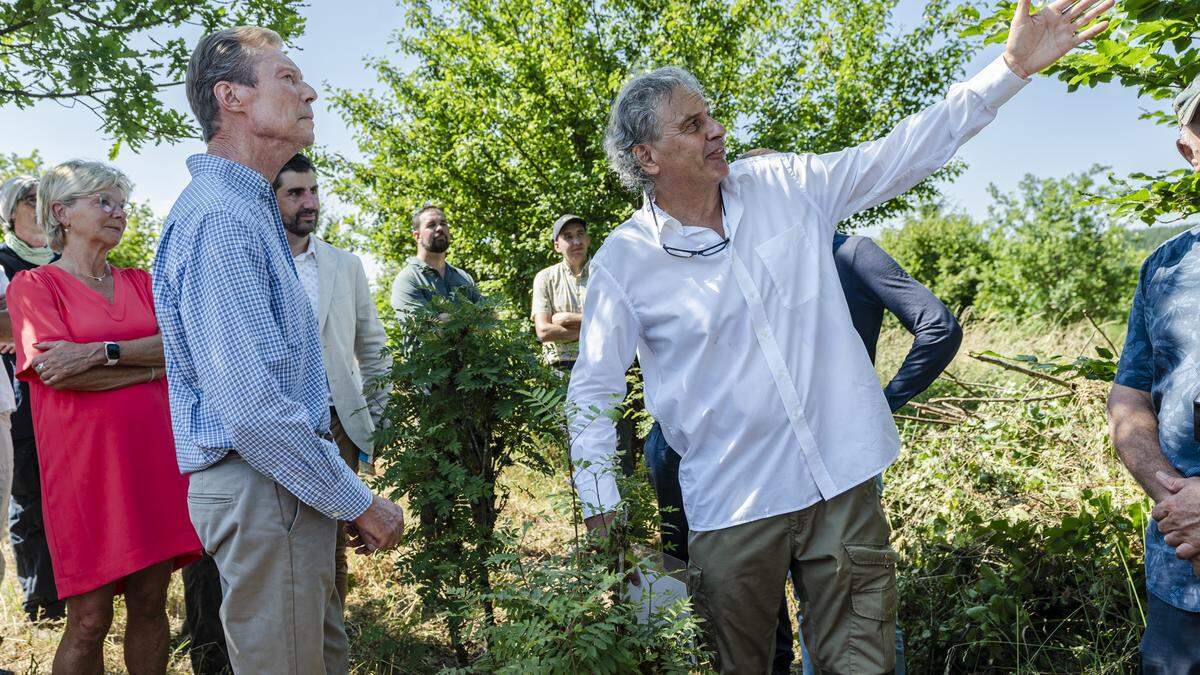
In July, Grand Duke Henri visited the reforestation project in Syr, pictured here with Patrick Losch, president of the Hëllef fir d’Natur Foundation © Photo credit: Caroline Martin/LW-Archiv
“Over the next ten years, around €250 million will be needed for planting, soil preparation, follow-up maintenance and replanting and €500 million for browsing protection measures for both natural regeneration and planting,” the association has calculated.
If the game population is not reduced, more than 10,000km of additional game protection fencing and several million individual tree protections would have to be installed in the coming years in order to reasonably guarantee the growth of a species-rich, resilient natural forest, the report continues.
According to current figures, four out of five trees show damage due to climate change, pest infestation and excessive game browsing
The Mouvement écologique environmental organisation is calling for increased measures, including holistic forest management that favours natural regeneration and is supplemented by targeted reforestation.
Over 30,000 hectares of forest need to be replanted with adapted tree species over the next ten years, whether through natural regeneration or new planting, which will require at least 100 million young trees, the group says. Regulating the high population of hoofed game is a prerequisite, the group has said, as roe deer, red deer, fallow deer and mouflon eat the buds and leaves of young trees, leaving them little chance of developing into healthy trees.
Support programmes
Although forest protection is not explicitly mentioned in the coalition programme, the government is taking the first concrete steps. In mid-May, Environment Minister Wilmes presented the updated version of the Klimabonus Bësch, a support programme for private forest owners that provides incentives for sustainable forestry.
Clear crowns are just one sign of diseased trees © Photo credit: Nadine Schartz
The programme currently supports roughly 6,500 hectares, including about 3,700 hectares in protected areas. The minimum subsidised area has been reduced from 0.5 to 0.3 hectares and the scale for larger areas has been adjusted. A commitment period of ten years applies, which means that smaller forest owners in particular can benefit from the funding and large-scale, nature-based development – including natural regeneration – can be strengthened.
‘Planzt Mat!’ campaign – You can help the forest too
Anyone interested can make a donation to help rejuvenate the forest area in Niederfeulen. These donations are tax-deductible and can be made via Payconiq or via the donation account of the Hëllef fir d’Natur Foundation – LU89 1111 0789 9941 0000 with the note “Planzt mat!”. In both cases, the transfer is made directly to the foundation’s account. A donation of €100 or more will help to restore a 100 square metre plot of land in the woodland in Niederfeulen.
In addition, the Mouer a Wiss (wall and meadow) climate bonus has been introduced, which supports open biotopes such as wetlands and flowering meadows. Private landowners with ecologically valuable green spaces of 0.3 hectares or more can claim this bonus.
Open areas connect forested areas, stabilising the microclimate and promoting biodiversity, as they are home to pollinators and birds that carry seeds. Such near-natural transitions from meadows to forests, so-called forest edge zones, are particularly species-rich and favour self-regeneration, as light, seeds and nutrients are in balance.
Forlux research project collects data
The state-subsidised research project “Forlux”, which was presented in April in Bambësch in the capital, is also set to provide new details.
It’s not too late
Serge Wilmes
Environment minister
In cooperation with the Luxembourg Institute of Science and Technology (List), the project aims to provide answers and develop strategies for adapting forest management.
An observatory was set up in July 2022 to collect data on tree health, weather conditions, air quality, water balance and carbon storage. Special measuring devices and infrared cameras will be used to detect drought stress and damage at an early stage, even before trees shed their leaves prematurely or die. The researchers are also investigating how tree species react to changed climate conditions and which measures can strengthen the resilience of the forests.
“It’s frightening to see how many trees are affected. We need to raise awareness of what the consequences are,” said Wilmes at the presentation of the project. “Our forests urgently need support to be able to rejuvenate. Together we can make a difference. It’s not too late.”
(This story was first published in the Luxemburger Wort. Translated using AI, edited by Cordula Schnuer.)