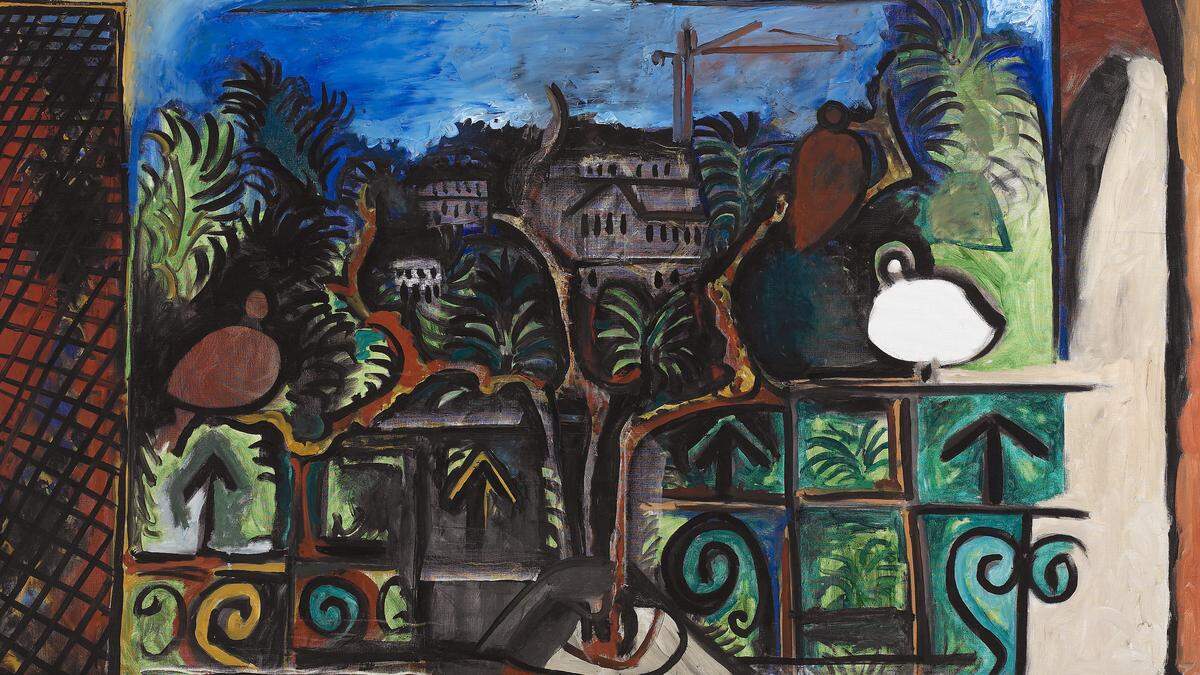
Suddenly there it was, a scratch in the masterpiece. Or was it more than just a scratch?
More than a quarter of a century ago, the details of what was probably the most publicised damage to an artwork in the country were barely investigated. Images of the damage were not available to the public. And politicians did not push for answers.
What had happened to the work Paysage de Cannes au crépuscule by Pablo Picasso?
The exhibition catalogue is still available today from second-hand bookshops. © Photo credit: Abebooks.fr
The Fondation du Musée d’art moderne Grand-Duc Jean, which anticipated the launch of the Mudam, joined forces with the National Museum for the temporary exhibition L’Ecole de Paris? 1945-1964, which ran from 12 December 1998 to 21 February 1999. Organisers had opted for high-profile names and brought together 250 works by 100 artists for the display dedicated to the School of Paris.
Works by Yves Klein, Alberto Giacometti, Jean Tinguely, Pierre Soulages, Henri Matisse and Fernand Léger were among those included. And also pieces by Picasso. His Paysage de Cannes au crépuscule – a 1960 oil painting depicting the landscape around Cannes at twilight – suddenly became the centre of attention.
A costly scratch
On 27 January 1999, the Luxemburger Wort reported the following: “The damage, a barely visible scratch on the right edge of the picture, was discovered on Monday last week (18 January 1999). It is not yet clear when and how the scratch on the oil painting, which was created in 1960, occurred. However, an act of vandalism has been ruled out.”
There are no press releases or other written statements from the exhibition organisers.
Later sources stated that the work was damaged when it was taken down. Others claimed that the scratch was made on the last days of the exhibition, around 21 February 1999. Could it be that someone pointed their umbrella at the master’s signature during those wet January days? This is where the historical inaccuracies and rumours about the case begin.
As the question of guilt remained open, the state got involved. There was a damage assessment and the Swiss gallery which had loaned the work demanded compensation. The gallery was acting on behalf of the painting’s owner, who remained nameless.
The solution proffered by the Luxembourg government: instead of paying compensation, the work was simply bought for $6 million, as was later revealed. The aim: to restore it and then sell it again for as much profit as possible. The Luxembourg Ministry of Finance, then under Jean-Claude Juncker, became the official owner.
Also read:When Deborah de Robertis’ vulva aroused public attention
How valuable is this Picasso?
But the plan fell through. Although the painting was restored, no buyer was found, even at a public auction.
At least that’s what Michel Polfer, later director of the National Museum, said in a statement on the history of the work. In 2002, after a long period of storage in Geneva, the work was put on permanent loan from the finance ministry to the National Museum, probably thanks to Juncker.
The work – unloved by art dealers and collectors – gradually became “our Picasso” and part of the modern and contemporary art section of the National Museum, seen by hundreds of schoolchildren over a decade, and recognised by tourists as a highlight of the museum.
And this Picasso actually has more to offer than first meets the eye. In this work, he addresses his aversion to heavy construction and urban development in Cannes. There is a construction crane in the painting’s background, ruining this view from Picasso’s home, the Villa La Californie.
In 1961, the artist moved away from the booming city. The painting is therefore a powerful document of a milestone in the artist’s career.
Filling state coffers
As part of the modern and contemporary art section, Picasso is one of the eye-catchers in the National Museum © Photo credit: MNAHA
More than a decade later, in October 2014, Finance Minister Pierre Gramegna was rumoured to be considering a sale of the artwork to boost state coffers.
“What are we to make of a government that wants to sell the only Picasso that the state has been able to acquire in its centuries-long history of cultural philistinism in order to balance the state budget, to the laughter of the civilised world?” railed lawyer Gaston Vogel in response.
Already in 2012 – under then-Finance Minister Luc Frieden – Luxembourg art expert Guy Decker had offered to act as an intermediary to facilitate a sale. Journalist Josée Hansen at the Lëtzebuerger Land newspaper had uncovered the deal that never happened. Again, the work was expected to fetch just €3-5 million.
Regardless of price, the thought of selling a piece of cultural heritage seemed unthinkable to many and raised questions about how the state should deal with its cultural assets. Prime Minister Xavier Bettel in 2014 put a stop to the speculation. His cabinet voted for the painting to become part of the National Museum’s collection, preventing its sale.
More secrets about the work
Today, things have gone quiet around the Picasso. After travelling on loan to museums in the US, it is now once again one of the city museum’s main eye-catchers.
But some questions remain unanswered.
There are no documents on its restoration, for example. And where are the Ministry of Finance’s files on the purchase? There is only a general internal report on the condition of the work when it was transferred to the collection. There are traces of the very good quality restoration work on the painting, but no photographs of the actual damage.
(This story was first published in the Luxemburger Wort. Translated using AI, edited by Cordula Schnuer.)