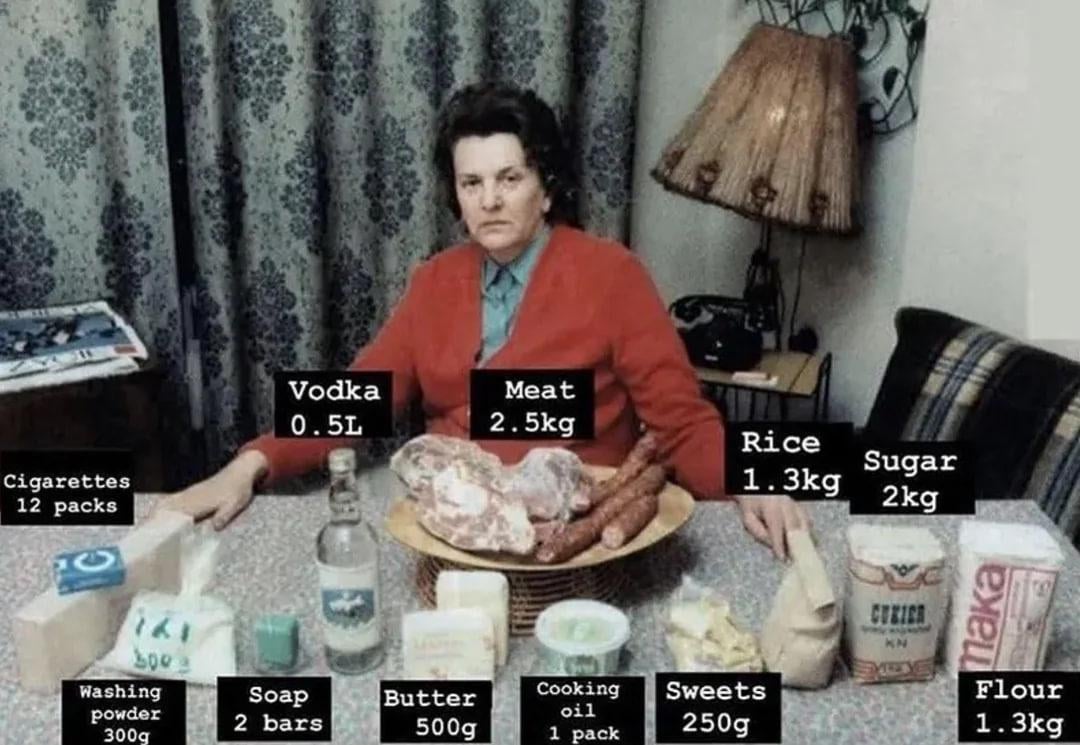
Not a “ration” but “purchase limit”. This was just how much you legally could buy from the stores. Just the numbers don’t add up to what I remember from when I was a kid.
In such posts they should always give necessary context – this the regulated ammount of what you could **buy**, so it wasn’t given for free as some people would like to think
ale tak bez sera? kurwa…
That was not even the worst period. In Ukraine, sometimes there was no meat or butter, I think the same was in Poland.
Yeah, good luck buying those in the 80s.
I love how tankies romanticize PRL, being born ~20 years after its collapse.
This is limit per person, you could buy that amount not get it for free. And most of the time you would still have to smuggle meat from uncle living in rural areas.
0,5kg of butter?! The fucking king in a castle there. Komuno wróć.
Assuming that you would be able to get all of these products, it doesn’t look bad… Until you realise that this wasn’t a time of war or other crisis.
Yes I know this wasn’t given for free but rationing served a purpose, in fully capitalist countries they would let prices go so high that the poor would starve.
Gasoline was also rationed (na kartki)
Poles from the 80s are so proud that they won’t eat potatoes and cabbage, they’ll kick carrots and beets, they’ll spit on tomatoes. Give them ham on sausage. Am I right?
Not very accurate.
1. These weren’t exactly rations, since you actually had to pay for the food on top of giving the coupons. These were only purchase limits.
2. This photo only shows products that were rationed. Items such as bread or potatoes were not subjected to limits.
So, do I think it is a good depiction? Not exactly.
Why? There was no war?
What comes to mind when I see something like this is that the 0.001 percent of the population who weren’t smokers had a great tool for bartering with everyone else.
Here peasants, drink your self to happiness
What you see in the photo is a monthly allotment of coupons for scarce goods. These coupons allowed you to buy a particular item more easily, but you still had to pay for it with money. If you didn’t have a coupon for meat, for example, even though you had money, the seller could refuse to sell it to you.
However, it was not hard to buy something else, even someone did’t have coupons. There were also other products, like vegetables and fruits available at local markets, which could be bought easly. Of course, these were mostly vegetables and fruits grown in Poland or in the communist Balkan countries, so sometimes besides potatoes, apples, and tomatoes, you could also get peppers, zucchinis, or cucumbers, although the latter were often only seasonal. In shops, there were also grains, bread, cereals, cheaper flours, and preserves. At the butcher’s, it was hard to get meat without ration cards, but almost everyone had relatives in the countryside, and people exchanged goods. For example, a pair of jeans for a few kilos of sausage. Or a cousin from Warsaw would somehow get a washing machine and give it to the family in the village in exchange for jars of meatballs to last the whole winter.
People in the later communist years did not starve (they did during Stalin’s times, but after his death, it was much better). Still, the products were quite repetitive, and many things had to be waited for. That is why Polish pierogi are so popular, because 90% of a Pole’s diet at that time was vegetarian. People ate a lot of soups, dumplings, pancakes. Meat was used mainly only for flavor. For example, pierogi with potatoes and cheese were topped with a fried roux with a single chopped sausage for the whole family. Nobody in Poland wasted offal. Liver, stomachs, roasted brains turned into pâtés, this was valuable protein that no one dared to throw away. That is why so many Polish recipes are based on offal. Personally, I love offal.
For me, the only true advantage of communism was the fact that people wasted nothing. The fridges that were produced, everyone knew they were hard to get (My mother waited several years to get a coupon for a washing machine) so producers made it from hard steel, and it was unbreakable, or really easy to repair. Seriously, my grandparents still have a fridge that is 40 years old. When it came to food, everything was used. From a chicken you made broth, from its stomach and heart, to make sauce. From duck’s blood to a soup. From pig’s blood, to a sausage with groats. There was also no plastic waste. If you wanted to buy meat, it was wrapped in old newspapers. If you didn’t like that, you had to bring your own container. People also appreciated small pleasures. Real chocolate was so hard to get that when someone brought it, the whole family sat together, and eating it became a ritual. Every bite tasted like ambrosia, it would even appear in dreams. It’s hard to say what’s worse: the lack of chocolate in communist Poland, or the fact that today people eat sweets every day, leading to obesity and dental problems. In communist Poland, obesity truly affected only a small group of people.
I think it would be wonderful to bring back very durable and easy-to-repair household appliances. I would love to see glass recycling return, I wish plastic waste would disappear, and that products did not come in tempting packaging. I would like to go back to times when a quality product had to truly be of quality, so that people knew what they were buying, and not like now, when every cheese, ham, or bread is full of fillers. I wish there were limits on advertising useless junk, whose only purpose is to make some businessman richer while landfills are covered with yet another layer of something that will take a hundred thousand years to decompose, all in the name of his wealth.
But the control of people, the sick politics where people would jump at each other’s throats, the hatred, where a neighbor could sell out to the authorities his neighbor for a vodka ration, it was unbearable for people. The fact that in an art supply store only artists were allowed to buy, or that to build an extra room for a grandfather in a ten-person household you had to lie that fifteen people lived there, if you wanted to get permission to buy bricks, that was sick. If you were an artist who did not paint as the authorities wanted, you was forced to work as a creator of propaganda posters for the rest of your life or they took you to the prison. One giant system of control over people. Absolutely no possibility of having any complicated hobby. If you wanted to climb rocks, you had to belong to the Tatra climbing association, and if you had ever made anti-communist remarks in the past, they could deny you to give you permission for being a member of this association. Or my grandmother was assigned a job at 18. No one cared that she didn’t want to leave her village because she had personal plans. She was forced to leave for a big city because seamstresses were needed there. Of course, she could return after a few years, but only after a few years do plans really change. Communism is really a fucking shit.
B-but communism is amazing! – some western people nowadays
That’s so little, how can you survive on this little vodka?
In all seriousness both my parents and school told me about those purchase limits and i am so happy that in current times you can buy anything you have money for.
Yeah, but they never got to enjoy that late night cig alone in the balcony. /s
20 comments
Seems VERY made up.
Not a “ration” but “purchase limit”. This was just how much you legally could buy from the stores. Just the numbers don’t add up to what I remember from when I was a kid.
In such posts they should always give necessary context – this the regulated ammount of what you could **buy**, so it wasn’t given for free as some people would like to think
ale tak bez sera? kurwa…
That was not even the worst period. In Ukraine, sometimes there was no meat or butter, I think the same was in Poland.
Yeah, good luck buying those in the 80s.
I love how tankies romanticize PRL, being born ~20 years after its collapse.
This is limit per person, you could buy that amount not get it for free. And most of the time you would still have to smuggle meat from uncle living in rural areas.
0,5kg of butter?! The fucking king in a castle there. Komuno wróć.
Assuming that you would be able to get all of these products, it doesn’t look bad… Until you realise that this wasn’t a time of war or other crisis.
Yes I know this wasn’t given for free but rationing served a purpose, in fully capitalist countries they would let prices go so high that the poor would starve.
Gasoline was also rationed (na kartki)
Poles from the 80s are so proud that they won’t eat potatoes and cabbage, they’ll kick carrots and beets, they’ll spit on tomatoes. Give them ham on sausage. Am I right?
Not very accurate.
1. These weren’t exactly rations, since you actually had to pay for the food on top of giving the coupons. These were only purchase limits.
2. This photo only shows products that were rationed. Items such as bread or potatoes were not subjected to limits.
So, do I think it is a good depiction? Not exactly.
Why? There was no war?
What comes to mind when I see something like this is that the 0.001 percent of the population who weren’t smokers had a great tool for bartering with everyone else.
Here peasants, drink your self to happiness
What you see in the photo is a monthly allotment of coupons for scarce goods. These coupons allowed you to buy a particular item more easily, but you still had to pay for it with money. If you didn’t have a coupon for meat, for example, even though you had money, the seller could refuse to sell it to you.
However, it was not hard to buy something else, even someone did’t have coupons. There were also other products, like vegetables and fruits available at local markets, which could be bought easly. Of course, these were mostly vegetables and fruits grown in Poland or in the communist Balkan countries, so sometimes besides potatoes, apples, and tomatoes, you could also get peppers, zucchinis, or cucumbers, although the latter were often only seasonal. In shops, there were also grains, bread, cereals, cheaper flours, and preserves. At the butcher’s, it was hard to get meat without ration cards, but almost everyone had relatives in the countryside, and people exchanged goods. For example, a pair of jeans for a few kilos of sausage. Or a cousin from Warsaw would somehow get a washing machine and give it to the family in the village in exchange for jars of meatballs to last the whole winter.
People in the later communist years did not starve (they did during Stalin’s times, but after his death, it was much better). Still, the products were quite repetitive, and many things had to be waited for. That is why Polish pierogi are so popular, because 90% of a Pole’s diet at that time was vegetarian. People ate a lot of soups, dumplings, pancakes. Meat was used mainly only for flavor. For example, pierogi with potatoes and cheese were topped with a fried roux with a single chopped sausage for the whole family. Nobody in Poland wasted offal. Liver, stomachs, roasted brains turned into pâtés, this was valuable protein that no one dared to throw away. That is why so many Polish recipes are based on offal. Personally, I love offal.
For me, the only true advantage of communism was the fact that people wasted nothing. The fridges that were produced, everyone knew they were hard to get (My mother waited several years to get a coupon for a washing machine) so producers made it from hard steel, and it was unbreakable, or really easy to repair. Seriously, my grandparents still have a fridge that is 40 years old. When it came to food, everything was used. From a chicken you made broth, from its stomach and heart, to make sauce. From duck’s blood to a soup. From pig’s blood, to a sausage with groats. There was also no plastic waste. If you wanted to buy meat, it was wrapped in old newspapers. If you didn’t like that, you had to bring your own container. People also appreciated small pleasures. Real chocolate was so hard to get that when someone brought it, the whole family sat together, and eating it became a ritual. Every bite tasted like ambrosia, it would even appear in dreams. It’s hard to say what’s worse: the lack of chocolate in communist Poland, or the fact that today people eat sweets every day, leading to obesity and dental problems. In communist Poland, obesity truly affected only a small group of people.
I think it would be wonderful to bring back very durable and easy-to-repair household appliances. I would love to see glass recycling return, I wish plastic waste would disappear, and that products did not come in tempting packaging. I would like to go back to times when a quality product had to truly be of quality, so that people knew what they were buying, and not like now, when every cheese, ham, or bread is full of fillers. I wish there were limits on advertising useless junk, whose only purpose is to make some businessman richer while landfills are covered with yet another layer of something that will take a hundred thousand years to decompose, all in the name of his wealth.
But the control of people, the sick politics where people would jump at each other’s throats, the hatred, where a neighbor could sell out to the authorities his neighbor for a vodka ration, it was unbearable for people. The fact that in an art supply store only artists were allowed to buy, or that to build an extra room for a grandfather in a ten-person household you had to lie that fifteen people lived there, if you wanted to get permission to buy bricks, that was sick. If you were an artist who did not paint as the authorities wanted, you was forced to work as a creator of propaganda posters for the rest of your life or they took you to the prison. One giant system of control over people. Absolutely no possibility of having any complicated hobby. If you wanted to climb rocks, you had to belong to the Tatra climbing association, and if you had ever made anti-communist remarks in the past, they could deny you to give you permission for being a member of this association. Or my grandmother was assigned a job at 18. No one cared that she didn’t want to leave her village because she had personal plans. She was forced to leave for a big city because seamstresses were needed there. Of course, she could return after a few years, but only after a few years do plans really change. Communism is really a fucking shit.
B-but communism is amazing! – some western people nowadays
That’s so little, how can you survive on this little vodka?
In all seriousness both my parents and school told me about those purchase limits and i am so happy that in current times you can buy anything you have money for.
Yeah, but they never got to enjoy that late night cig alone in the balcony. /s
Comments are closed.