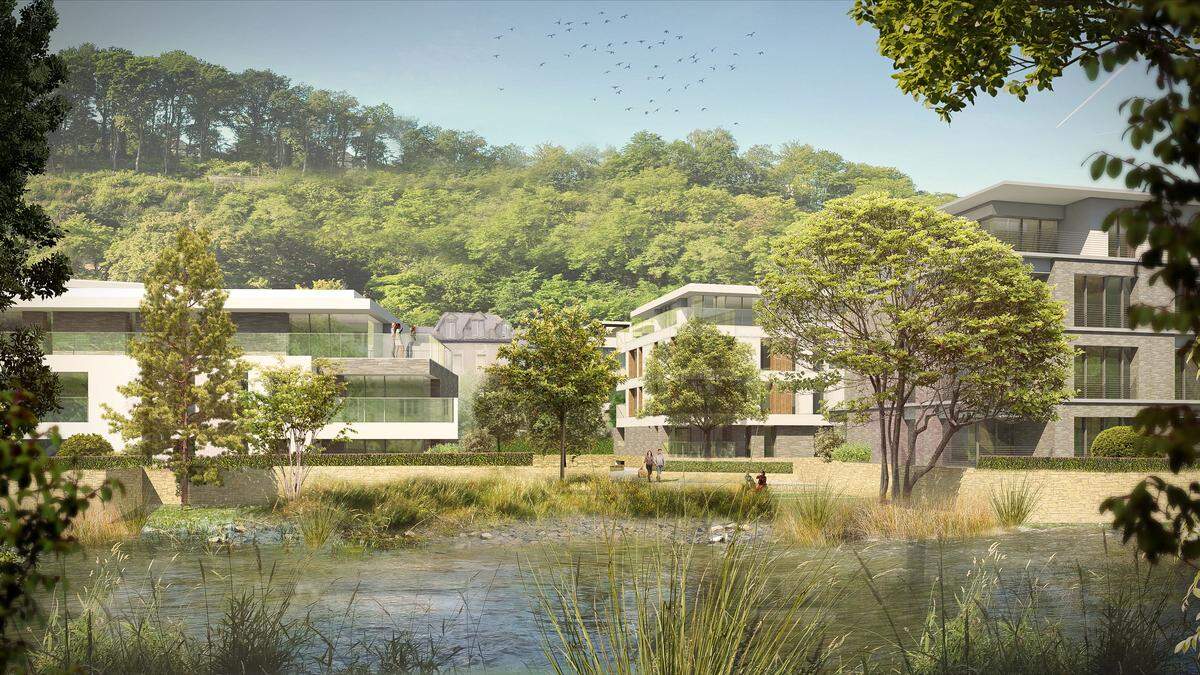
After seven years of clean-up works at the industrial site, developers of the Pulvermuhl district in Luxembourg City have finally filed for planning permission and works could begin next year on more than 200 housing units, offices, shops and more.
With a population of 384 at the end of last year, Pulvermuhl (Polvermillen in Luxembourgish and Pulvermühle in German) is by far the most intimate and discreet of the capital’s districts.
Nestled between the Grund, Bonnevoie, Hamm, Cents, Clausen and the foothills of the Kirchberg plateau, it is a pleasant, mostly wooded area famed mostly for the Cours de l’Alzette railway viaduct, the Michelin-starred restaurant Villa de Camille et Julien, as well as for the road leading east to the Irrgarten roundabout and Luxembourg airport.
Developer Immobel (then called Allfin) set out just over ten years ago to breathe new life into a disused former industrial site. “We had read that the Polvermillen was used as early as the Middle Ages for a mill,” said Muriel Sam, managing director of Immobel Luxembourg. The name means powder mill and refers to the gunpowder produced at the site.
In the 19th and 20th centuries, cotton spinning, drapery, traction and lifting equipment production, and finally industrial laundry activities flourished on the block, which still bears precious traces of its past, such as the management house with its bell tower, the old square boiler house chimney and the large derelict industrial site.
“From the outset, we set ourselves the goal of enhancing this heritage by renovating it and integrating it into its very natural environment,” said Sam. The district will give pride of place to soft mobility, diversity and quality of life, the developer said.
Also read:Luxembourg City neighbourhood housing plan on schedule
Allfin (which merged with Immobel in 2016) acquired the land, while in December 2015 the City of Luxembourg adopted the related PAP (special development plan), a document that specifies the technical outlines and spirit of the project. The government then approved it in March 2016.
The rich industrial history of Pulvermuhl had to be preserved. Five listed buildings are essential elements of the concept described to Virgule by the head of Immobel and Julie Sacré, senior developer in charge of the Pulvermuhl project. All will be restored and fully integrated in the development.
Seven years to clean up the soil
Over the last few years, the property developer has been working on cleaning up the soil on the site, which caused concern among local residents in 2017, as the Luxemburger Wort reported at the time. The site had been occupied by environmentally unfriendly industries and complex remediation and soil preparation work was carried out.
In its ESG report, Immobel explains the scale of the task: “The Polvermillen site underwent extensive decontamination due to high levels of chlorinated hydrocarbons (CHCs), polycyclic aromatic hydrocarbons (PAHs) and mineral oils. An investment of €10 million enabled 50,000 tonnes of contaminated soil to be treated and groundwater to be cleaned up to a depth of seven metres using the in situ chemical oxidation (ISCO) method. The process took seven years. Following remediation, an official decontamination certificate was issued by the Environmental Administration, confirming the complete restoration of the site. An environmental monitoring phase will continue until construction begins. This successful clean-up marks a crucial milestone in the project, removing a major environmental risk and paving the way for sustainable redevelopment.”
If Immobel obtains planning permission, work could begin immediately © Photo credit: Christophe Lemaire
For its part, the City of Luxembourg has undertaken the renovation of the bridge linking the entrance to the district with the neighbouring Boulevard d’Avranches, its main access point. All that remained was for Immobel to prepare the applications for planning permission.
The first applications were submitted recently, Immobel confirms, and the first documents were posted at the entrance to the 2.2 hectare plot. “We are working on the other permits and want to submit them in the next few months, by early 2026 at the latest. We hope to receive our first permits before next summer.”
From then on, work at Pulvermuhl could enter phase one of a construction project expected to last several years.
254 homes, offices and shops
At the end of 2024, the developer was talking about 201 homes to be built. Now there is talk of 254 housing units, while the PAP authorises up to 271 dwellings.
“There will be flats of all sizes, as well as houses and lofts,” said Sam. “We knew it would be complicated because such a large area of land has a heritage dimension and a significant degree of pollution, but we can see the great impact this development will have on Pulvermuhl, which could become the new heart of the village. With the residential mix and the diversity of the population envisaged, the range of services on offer and the bucolic setting just a ten-minute walk from the Grund lift, the potential is real. All of which adds up to a strong argument in favour of marketing the properties, which is not yet a reality.”
Immobel has commissioned Assar Architects and BalliniPitt to design the Polvermillen © Photo credit: Immobel Luxembourg
Immobel is currently designing 254 homes © Photo credit: Immobel Luxembourg
Flats of all sizes will be built, as well as houses and lofts © Photo credit: Immobel Luxembourg
In keeping with the soft mobility concept for the site, the entrance will have an underground car park for all residents, with 266 spaces planned. The roads above ground will be mainly pedestrian, though emergency services and waste removal vehicles will be able to use them.
“The development includes a designated green zone that will be transferred to the City of Luxembourg, offering public recreational spaces,” confirmed Immobel. “With an emphasis on soft mobility, the project incorporates pedestrian-friendly design and a central square surrounded by preserved historic buildings.”
Although it is largely residential, the block will also accommodate offices, shops and services (a multi-purpose hall) covering around 3,000 square metres of the planned 27,000 square metress of above-ground space. Immobel plans to deliver the first homes by 2029.
(This article was published by Virgule. Translated using AI, with editing and adaptation by Alex Stevensson.)