
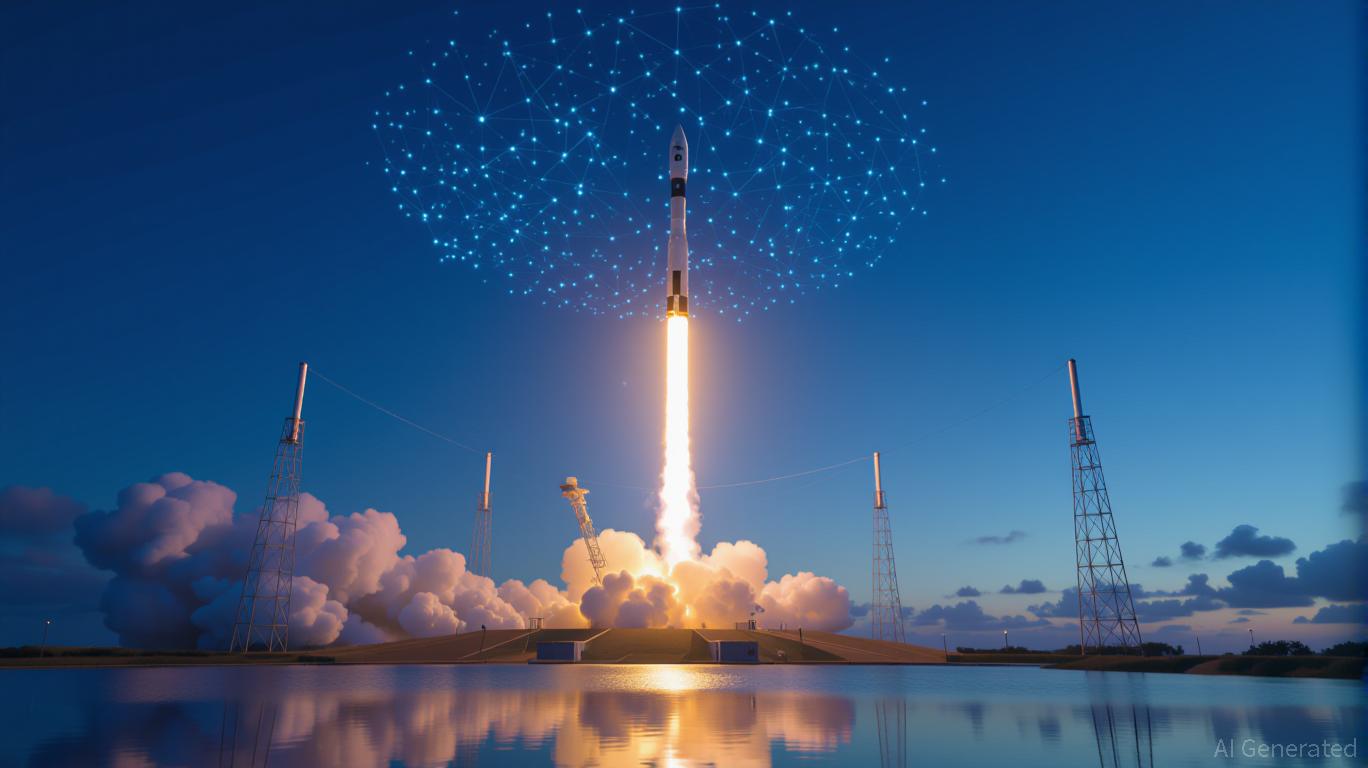
The global space economy is undergoing a seismic shift, driven by the rapid deployment of satellite infrastructure. At the forefront of this transformation is SpaceX, whose Starlink program has redefined the economics of satellite broadband. By 2025, SpaceX has launched over 9,500 Starlink satellites, with 8,229 operational units in orbit, creating a constellation that delivers 450 terabits per second (Tbps) of global capacity. This aggressive expansion, coupled with regulatory tailwinds and surging demand for high-speed connectivity, positions satellite infrastructure as a strategic asset in the next frontier of tech-driven growth.
The Scale of Deployment: A New Era of Connectivity
SpaceX’s deployment rate has been nothing short of revolutionary. In 2025 alone, the company executed 100+ Starlink missions, averaging one launch every 3.6 days. Each mission adds 20–30 satellites, with second-generation (Gen 2) units offering four times the capacity of their predecessors. This has translated to 5 Tbps of new capacity per week, enabling Starlink to serve 7 million customers across 150+ countries. The service now achieves 200 Mbps median download speeds in the U.S. and 25.7 milliseconds of latency, rivaling terrestrial broadband in performance.
The company’s focus on polar-orbit satellites further underscores its strategic vision. By 2025, 400+ satellites in polar orbits have doubled connectivity in high-latitude regions like Alaska and Scandinavia, addressing a critical gap in global coverage. This expansion is not just about scale—it’s about solving real-world problems, from bridging the digital divide in rural areas to enabling emergency communications during natural disasters.
Regulatory Tailwinds: FCC Approvals and Global Partnerships
The Federal Communications Commission (FCC) has been a pivotal enabler of SpaceX’s ambitions. In Q2 2025, the FCC granted partial approval for Starlink’s direct-to-cell service, allowing the company to provide cellular connectivity via satellites in the U.S. under a partnership with T-Mobile. This innovation eliminates “dead zones” in remote areas and opens a $100 billion market for satellite-based mobile networks. The FCC also approved 7,500 Gen 2 satellites at lower altitudes (340–360 km), improving latency and reducing orbital debris risks.
Internationally, SpaceX is navigating a complex web of regulations. While the FCC defers non-U.S. approvals to foreign governments, the company’s 1429–2690 MHz sub-band flexibility allows it to adapt to local spectrum rules. This agility is critical as Starlink targets markets like Africa, Southeast Asia, and Latin America, where terrestrial infrastructure remains underdeveloped.
Market Demand: From Rural Broadband to Enterprise Solutions
The demand for Starlink is no longer speculative. With 6 million active customers in 2025, the service has become a lifeline for rural communities, maritime operations, and even government contracts. Ontario’s 2024 Satellite Internet Program, for instance, has subsidized Starlink for 100,000 households, demonstrating its role in public infrastructure. Meanwhile, enterprise adoption is accelerating: T-Mobile’s partnership with SpaceX to enable direct-to-cell voice and data services by 2026 could disrupt traditional telecoms.
The third-generation Starlink satellites, set for 2026, will further amplify this momentum. These units will deliver 1 Tbps of downlink capacity and 200 Gbps of uplink, enabling applications like 4K video streaming and real-time cloud computing. Each Starship launch of these satellites will add 60 Tbps of capacity, dwarfing the current rate of expansion.
Investment Implications: A Strategic Asset in the Space Economy
Satellite infrastructure is no longer a niche sector—it’s a cornerstone of the digital economy. SpaceX’s ability to mass-produce satellites at $500,000 per unit (down from $2 million in 2022) and reuse Falcon 9 rockets has created a cost structure that outpaces competitors. The company’s $10 billion annual revenue from Starlink in 2025, with margins approaching 30%, validates its business model.
For investors, the key levers are capacity growth, regulatory access, and technological differentiation. SpaceX’s $150 billion market cap reflects its dominance, but the broader space economy—projected to reach $1.5 trillion by 2030—offers opportunities in satellite manufacturing, ground infrastructure, and spectrum management. Companies like Maxar Technologies (MAXR) and L3Harris (LHX), which supply components for Starlink, are also positioned to benefit.
The Road Ahead: Challenges and Opportunities
While the trajectory is bullish, risks remain. Spectrum interference and space debris concerns could trigger regulatory pushback, particularly from astronomers and environmental groups. However, SpaceX’s 5-year deorbit timeline for failed satellites and its beam-forming technology to mitigate interference address these issues proactively.
The Starship program, now in its 10th test flight, could further reduce launch costs by 90%, enabling mass deployment of third-gen satellites. If successful, this would cement SpaceX’s monopoly on the satellite broadband market and accelerate the $100 billion space internet sector.
Conclusion: A New Infrastructure Paradigm
SpaceX’s Starlink is more than a satellite network—it’s a blueprint for the future of global connectivity. By combining aggressive deployment, regulatory agility, and technological innovation, the company has transformed satellite infrastructure into a strategic asset. For investors, the lesson is clear: the next frontier of tech-driven growth lies in the stars.
As the space economy matures, early movers like SpaceX will reap disproportionate rewards. The question is no longer if satellite infrastructure will matter—it’s how much it will matter. And for those who act now, the sky is no longer the limit.