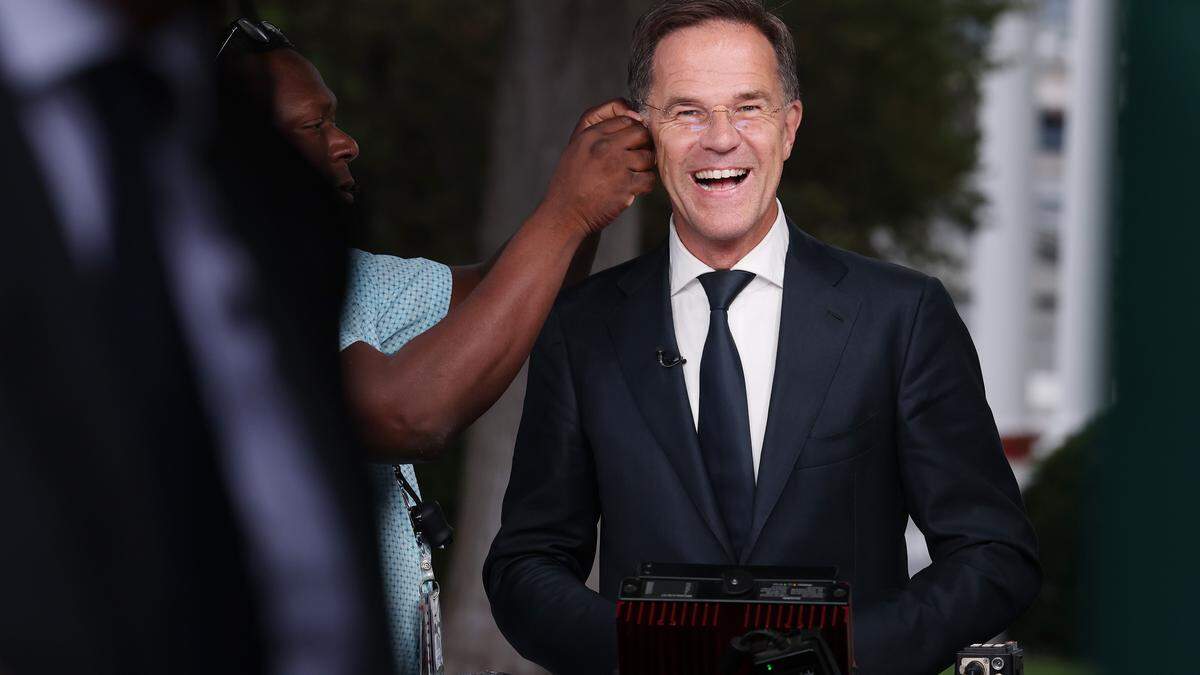
Nato Secretary General Mark Rutte arrives in Luxembourg on Tuesday for a working visit, his first to the Grand Duchy since taking office nearly a year ago.
Tasked with navigating a turbulent security landscape, Rutte faces the challenge of keeping the alliance united amid rising tensions in Europe, US unpredictability, and the ongoing war in Ukraine, while pressing member states – including Luxembourg – to meet ambitious defence spending targets.
From left to right: Nato Secretary General Mark Rutte, Jens Spahn, chairman of the CDU/CSU parliamentary group in the German Bundestag, and Alexander Hoffmann, chairman of the CSU regional group in the German Bundestag. © Photo credit: Daniel Karmann/dpa
“You are exactly the man Nato needs right now,” said Alexander Hoffmann, chairman of the CSU regional parliamentary group in the German Bundestag, at a press conference following a coalition meeting in Würzburg last Thursday. “You hold Nato together like no other.”
The 58-year-old Dutchman assumed office on 1 October 2024, succeeding Sweden’s Jens Stoltenberg.
Rutte stepped into office knowing that the next US president, Donald Trump, would bring a major shift in defence policy. Trump quickly signalled to European allies that they must contribute more to their own defence, particularly through purchases of US-made military equipment.
At the Nato summit in The Hague earlier this year, Rutte helped navigate these tensions. The summit agreed on a new 5% target for Nato members – 3.5% of GDP for defence and 1.5% for infrastructure. Spain was the only country to resist, preferring to maintain the previous 2% target for domestic political reasons.
“Normally, various member states and parts of the Nato bureaucracy want to include many things in the final declaration. This time they said: no, we’ll focus on one thing – and they achieved it,” said Professor Josip Glaurdic from the University of Luxembourg, who attended the summit as part of a delegation of Luxembourg scientists.
The Dutch Secretary General streamlined the programme and focused on the key points, preventing the alliance from fracturing and containing the disruptive stances of countries such as Hungary and Turkey.
Following the summit, Rutte has taken on the role of mediator between the United States, European Nato states, and Ukraine.
His ability to work with Trump has been crucial, enabling agreements on rapid transfers of US military equipment to Ukraine. The plan envisions European states bearing the initial costs, with the US replenishing stocks later.
Rutte stressed that the aim is to supply Ukraine with “truly massive quantities of military equipment, both for air defence and with missiles, ammunition, etc.” Packages are tailored to Ukrainian requirements and coordinated through Nato systems.
At the EU level, Rutte is a proponent of closer Nato-EU cooperation. A meeting with European Commission President Ursula von der Leyen on 29 October led to the creation of a new high-level working group to strengthen collaboration between the two organisations.
Luxembourg is playing a role in these efforts, with the country participating in the artillery coalition led by France and Germany and contributing at least €2 million to a Czech-led initiative to supply Ukraine with artillery ammunition.
This support is critical given Ukraine’s shortages, including the lack of air defence capacity and 155 million artillery shells.
Nato between Moscow and Washington
Luxembourg’s commitment to Nato is clear: the country has agreed to meet the new defence targets, aiming to reach at least 2% of gross national income (GNI) of spending on defence by the end of 2025.
By 2035, Luxembourg plans to invest 5% of GNI in defence and infrastructure, amounting to more than €3 billion annually, roughly one-tenth of the national budget.
“Justifying expenditure as military or contributing to resilience will be a constant battle and a constant challenge,” Glaurdic said. The current CSV-DP coalition has ruled out cuts in other policy areas to fund the defence budget, making careful financial planning essential.
For Rutte, the ultimate test remains whether Nato can maintain unity in the face of Russian aggression and sustain Ukraine’s sovereignty. Strong coordination with Washington is also essential for credibility in Moscow’s eyes.
Rutte’s visit to Luxembourg
During his Luxembourg visit on 2 September, Rutte will meet Prime Minister Luc Frieden to discuss the international security situation, Nato’s support for Ukraine, and Luxembourg’s role in the alliance. Defence Minister Yuriko Backes will also participate in the meeting.
The programme includes a working lunch at Senningen Castle, meetings with the Grand Duke and the President of the Chamber of Deputies, and visits to SES in Betzdorf and the Nato agency NSPA in Capellen.
For Nato’s Secretary General, the visit highlights Luxembourg’s growing importance in European defence planning and underscores the need for a united, coordinated response in an era of heightened security challenges.
(This article was originally published by the Luxemburger Wort. Machine translated, with editing and adaptation by Lucrezia Reale.)