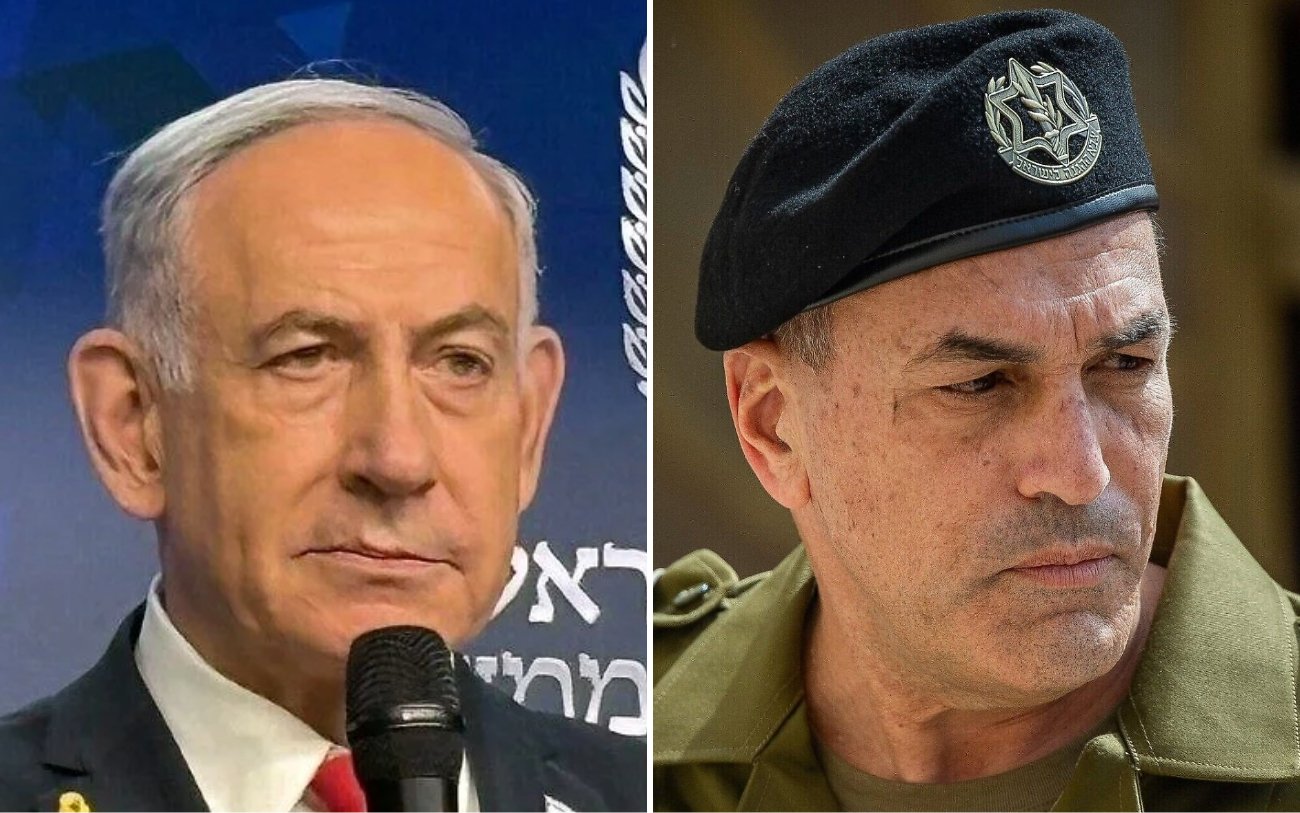
Prime Minister Benjamin Netanyahu reportedly refused to hold a vote on a proposed hostage-ceasefire deal at a stormy cabinet meeting that went on until the early hours of Monday morning, saying it was not on the table and that US President Donald Trump had pushed him not to accept a partial deal.
The premier’s dismissal of the topic came despite far-right ministers pressing him to hold a vote to officially reject the deal, while the chief of staff and some cabinet ministers pushed for it to be accepted, according to multiple leaks from the closed-door meeting that were published on Monday.
The security cabinet meeting in Tel Aviv, which lasted almost six hours, focused almost entirely on the Israel Defense Forces’ plans to take over Gaza City, according to reports in Hebrew media.
During the discussion, IDF Chief of Staff Maj. Gen. Eyal Zamir urged discussion of the deal and warned that the plan to conquer Gaza City would drag Israel into a full-fledged occupation of the Strip, according to leaked comments carried by the Ynet news site and other Hebrew outlets.
“You are heading to a military government,” Zamir reportedly said. “Your plan is leading us there. Understand the implications.”
Get The Times of Israel’s Daily Edition
by email and never miss our top stories
By signing up, you agree to the terms
Zamir, who has previously been widely reported to oppose the Gaza City takeover plan, argued to ministers that the scheme lacked a coherent exit strategy, and would instead pull Israel deeper into the Strip.
“Your decision to conquer Gaza City — and afterwards this will lead to the conquest of the refugee camps in central Gaza — and then it will be a military government, because there will be no other body that could take responsibility for the population,” Zamir was said to have warned.
His comments were reportedly rejected by cabinet secretary Yossi Fuchs, who insisted on the government’s official opposition to a military administration of the Strip, despite Jerusalem refusing to approve any alternative for the day after the war.
The government has advanced the takeover plan in recent weeks despite the Hamas terror group saying several weeks ago it had agreed to a phased hostage-truce deal almost identical to one Israel had previously approved. In the interim, Jerusalem had officially given up on phased deals, demanding a comprehensive agreement to return all the captives in one go and see Hamas surrender.
According to reports, Zamir insisted on raising the issue of the proposed deal even though it was not on the agenda.
The deal — which Hamas said it agreed to on August 18 — would see 10 living hostages released and the remains of 18 dead hostages returned, in exchange for the release of hundreds of Palestinian security prisoners and some 1,000 Gazan detainees, and a 60-day ceasefire, during which negotiations would be held for the return of the remaining 20 hostages, of whom 10-12 are believed to be alive, and a permanent end to the war.

Protesters gather outside the home of Strategic Affairs Minister Ron Dermer, calling for a deal to secure the release of hostages held in Gaza, September 1, 2025. (Chaim Goldberg/Flash90)
Zamir told cabinet members that “there is a framework on the table, [and] we must take it,” according to Channel 12, which said that, had Zamir not raised the issue, it would not have come up in the meeting.
The IDF chief of staff reportedly told ministers that Operation Gideon’s Chariots — the IDF offensive launched after the previous hostage-truce deal collapsed, which ended with the military in control of some 75% of the Strip — created the conditions for the hostages’ return.
Moreover, he said, the IDF is capable of returning to combat if the deal goes through and no resolution to the war is agreed to after the 60-day ceasefire ends.
According to reports, Foreign Minister Gideon Sa’ar and Intelligence Minister Gila Gamliel joined Zamir in supporting the deal, citing among other reasons the diplomatic headwinds that Israel is facing amid a wave of Western allies recognizing a Palestinian state.
PM: Deal agreed to by Hamas is ‘not on the table’
Netanyahu, however, was said by Hebrew media to have told Zamir, and the rest of those present, that “a partial deal is not relevant,” reiterating the stance he adopted last month after previously supporting phased hostage-truce deals throughout the war. After Netanyahu changed his position, Hamas said it accepted the phased-deal outline, after for months rejecting previous versions of it that Israel at the time had backed.

A man crosses a street in the Nuseirat camp for Palestinian refugees in the central Gaza Strip early on August 30, 2025 as behind smoke rises following Israeli bombardment. (Eyad BABA / AFP)
Far-right ministers Itamar Ben Gvir and Bezalel Smotrich have vocally opposed the proposal, as they have opposed previous hostage-truce deals, including the deals Israel agreed to in November 2023 and January 2025. After Zamir’s comments at the meeting Sunday, Ben Gvir and others reportedly pushed Netanyahu to hold a vote on the current deal proposal in order to officially strike it down.
“There is no need for a vote; it’s not on the table. Hamas must be destroyed,” Netanyahu responded, according to several Hebrew media outlets.
The premier was said to have explained his opposition to the deal by asserting that Israel’s diplomatic backing, including from the US, is “not limitless,” and that withdrawing from some of the territories captured in the Gideon’s Chariots operation would cost a “heavy price.” It would take six months to return to those military lines, under international pressure and with lost lives, he reportedly elaborated.
Likud minister David Amsalem reportedly warned that the planned expansion of the war could turn Gaza “into Israel’s Vietnam.”
Netanyahu reportedly responded: “If Israel makes do with a partial deal without defeating Hamas, this would mean that by kidnapping its citizens, Hamas brought Israel to its knees.”
PM tells cabinet Trump told him not to strike partial deal
Moreover, Netanyahu reportedly told cabinet ministers that US President Donald Trump has urged him not to accept any partial ceasefire and hostage-release deal with Hamas, because it will turn into a sequence of small “salami” mini-deals, and to instead fight the terror group “with full force.”
“Forget the partial deals… Go in with full force and finish this,” Netanyahu was quoted as saying Trump told him.
Before the security cabinet meeting, Channel 12 news cited unnamed sources as saying Trump was increasing pressure on Netanyahu to move more rapidly toward defeating Hamas, after losing faith in the efficacy of ceasefire and hostage release talks.

Prime Minister Benjamin Netanyahu answers a question, as US President Donald Trump looks on, during a dinner in the Blue Room of the White House on July 7, 2025. (Andrew Harnik / Getty Images via AFP)
Ben Gvir, who supports Israeli resettlement of the Strip, was said to have told Zamir that a Gaza without Palestinians could obviate the need for a military occupation, backing a Trump administration proposal.
“Instead of a military government, encourage voluntary emigration,” Ynet quoted him as saying. The Trump administration has at times spoken in support of resettling Gazans outside of the Strip and redeveloping it as an American commerce and tourism hub, though it is unclear how seriously the White House has taken the idea.
Trump on Wednesday hosted a meeting at the White House with officials — including Secretary of State Marco Rubio, special envoy Steve Witkoff, former British prime minister Tony Blair and the president’s son-in-law Jared Kushner — to discuss how to end the Gaza war and future steps.
According to Ynet, at the meeting Netanyahu also backed an argument made at the meeting by Smotrich and New Hope MK Ze’ev Elkin, who said the 60-day ceasefire would in practice set the military back six months, because it would have to recover ground that a deal would compel it to withdraw from.
Settlements minister accuses IDF chief of cowardice
Amid the debate, a heated confrontation broke out between Zamir and far-right Settlements Minister Orit Strock, with the latter accusing the IDF chief of staff of cowardice by way of a biblical quotation.
“Is there anyone afraid and disheartened? Let him go back to his home, lest the courage of his comrades flag like his,” Strock said, in response to Zamir’s support for a hostage deal, according to the Kan public broadcaster.
Hitting back, Zamir declared that he had two missions — “preventing a nuclear Iran and destroying Hamas,” leading Strock to once again recite the quotation, from the Book of Deuteronomy.
In response, Zamir said that he had called for the recent Israeli operation in Iran, declaring that he “approves strikes everywhere. No one is afraid and disheartened.”

Settlements and National Projects Minister Orit Strock attends a Religious Zionism faction meeting at the Knesset in Jerusalem, January 27, 2025. (Chaim Goldberg/Flash90)
“If you want blind discipline, bring somebody else,” he declared, prompting Netanyahu to interject, “I don’t want blind discipline, but also not someone who oversteps [his authority].”
Strock also took issue with the IDF’s practice thus far of avoiding operating in areas where hostages are believed to be held, telling the cabinet, “There can’t be no-go areas in Gaza, it endangers the residents of [Israel’s] Gaza border area and the south,” according to quotes published by Channel 12.
“To win the war we have to control all these areas, and not leave them as bubbles of terror above and below ground,” she added. With respect to concern over the hostages’ fate, Strock said: “We have to make a great effort not to harm them.”
In a post to X on Monday after quotes from the meeting leaked, Strock said that by invoking the verse about fearful soldiers, which is part of last week’s Torah portion, she meant to warn the cabinet about the danger of demoralizing troops — not to signal that any individual at the meeting was himself cowardly.
Despite the clashes, Zamir reportedly told the cabinet that the IDF will carry out whatever instructions it receives from the political echelon, even if it disagrees with them — winning him plaudits at the meeting, according to the Israel Hayom daily.
Netanyahu reportedly also upbraided Zamir for what he alleged were leaks to the media from closed-door consultations, saying this harmed unity and fighting spirit. Zamir made no response, Channel 12 said.
West Bank annexation plan said limited to Jordan Valley
Among the other topics discussed in the meeting was a plan to potentially annex the West Bank; Israel Hayom reported Sunday, citing a senior government official, adding that the plan, which is being pushed by Strategic Affairs Minister Ron Dermer, only deals with the Jordan Valley, not the West Bank as a whole, to the chagrin of the cabinet’s far-right flank.

A picture taken from the E1 corridor, a super-sensitive area of the West Bank that is not slated for annexation, looking eastward towards the Israeli settlement of Maale Adumim and the Jordan Valley in the background, June 30, 2020. (Photo by AHMAD GHARABLI / AFP)
After the Strock-Zamir incident was reported, Blue and White-National Unity leader MK Benny Gantz, himself a former IDF chief of staff, tweeted: “What have we come to? A cabinet that, at a time of war, supports draft evasion” — a reference to the government’s effort to exempt ultra-Orthodox men from mandatory military service — “is giving grades to the IDF chief of staff, who sends our heroic soldiers into battle every day, in Gaza, [the West Bank], Lebanon, Syria, Yemen and Iran?”
“The citizens of Israel don’t need a cabinet like this. They deserve a cabinet that backs the IDF, not one that puts spokes in its wheels,” Gantz wrote. “That must be a cabinet of servants — not a cabinet of whiners.”
Hostage Families Forum: PM ‘sacrificing the hostages’
The Hostages and Missing Families Forum responded to Netanyahu’s leaked statement that a phased deal is no longer on the table.
“Netanyahu, the father of phased releases, founder of the ‘selections’ method, opposes the method that he initiated and the agreement he already approved,” the forum said, employing an analogy frequently made by opponents of phased release deals that likens them to “selections” at Nazi death camps between those conscripted for forced labor and those sent directly to gas chambers.
“The truth has come out: This is not a negotiation strategy, it’s a ‘torpedo’ strategy and a burial of the deal. Netanyahu is sacrificing the hostages and the soldiers on the altar of his political survival, at a time when an actual deal is on the table, approved by Hamas, that could turn into a framework to return the last of the hostages and end the war.”
Sam Sokol contributed to this report.