Defense Minister Israel Katz boasted Tuesday that the remainder of the Houthi leadership was running away from Yemen’s capital following the Israeli strike that killed the terror group’s prime minister and other top officials.
“The remaining Houthi leadership is escaping Sanaa,” Katz posted on X on Tuesday night. “Like all leaders of extremist Islamist terror, they look after themselves and abandon the residents,” he said, writing that Hamas’s Qatar-based leadership does the same.
“We knew how to hunt them this time, and we will know how to do so in the future as well,” he added.
Katz’s post followed a report in Saudi newspaper Asharq Al-Awsat that said the remaining Houthi leadership was currently in an “unprecedented state of confusion and panic” after the IDF strike last week.
Several senior Houthi leaders have fled Sanaa to more rural areas in the north of Yemen, the report said, adding that their families have been transported to secure locations.
Houthi leaders also told all senior members not to use government buildings or gather in public places, fearing targeting by Israeli aircraft.

A man watches the news on TV, displaying footage of Ahmed al-Rahawi, the prime minister of the Houthi-controlled government, who was killed, along with others, on August 28, 2025, during Israeli strikes on the capital, in Sanaa, Yemen, August 30, 2025. (AP Photo/Osamah Abdulrahman)
The August 28 strike killed Houthi Prime Minister Ahmed al-Rahawi, along with several other ministers and top Houthi officials, while they attended a meeting in Sanaa, which is run by the terror group.
A Tuesday report said the precision airstrike followed weeks of intelligence gathering and operational preparation, and involved some 200 intelligence personnel working in a secret bunker.
According to Israeli security sources cited by the Kan public broadcaster, the operation targeted a secretive security meeting involving top Houthi government and military leaders, identified by the IDF Intelligence Directorate’s Research Division.
Kan reported that around 200 intelligence personnel — including members of IDF units 8200, 9900, and 504 — gathered in a classified bunker in central Israel to collect detailed intelligence on the Iran-backed terror group. Representatives from the US Central Command were also reportedly involved.
Ahead of the strike, Israeli intelligence determined the exact timing and location of the meeting. Several potential sites were considered, and once a villa in a residential neighborhood of Sanaa was confirmed, plans were quickly approved by IDF Chief of Staff Lt. Gen. Eyal Zamir and cleared at the political level, the report added.
According to Kan, the presence of senior Israeli military and political officials overseeing the operation ensured that it complied with international law.

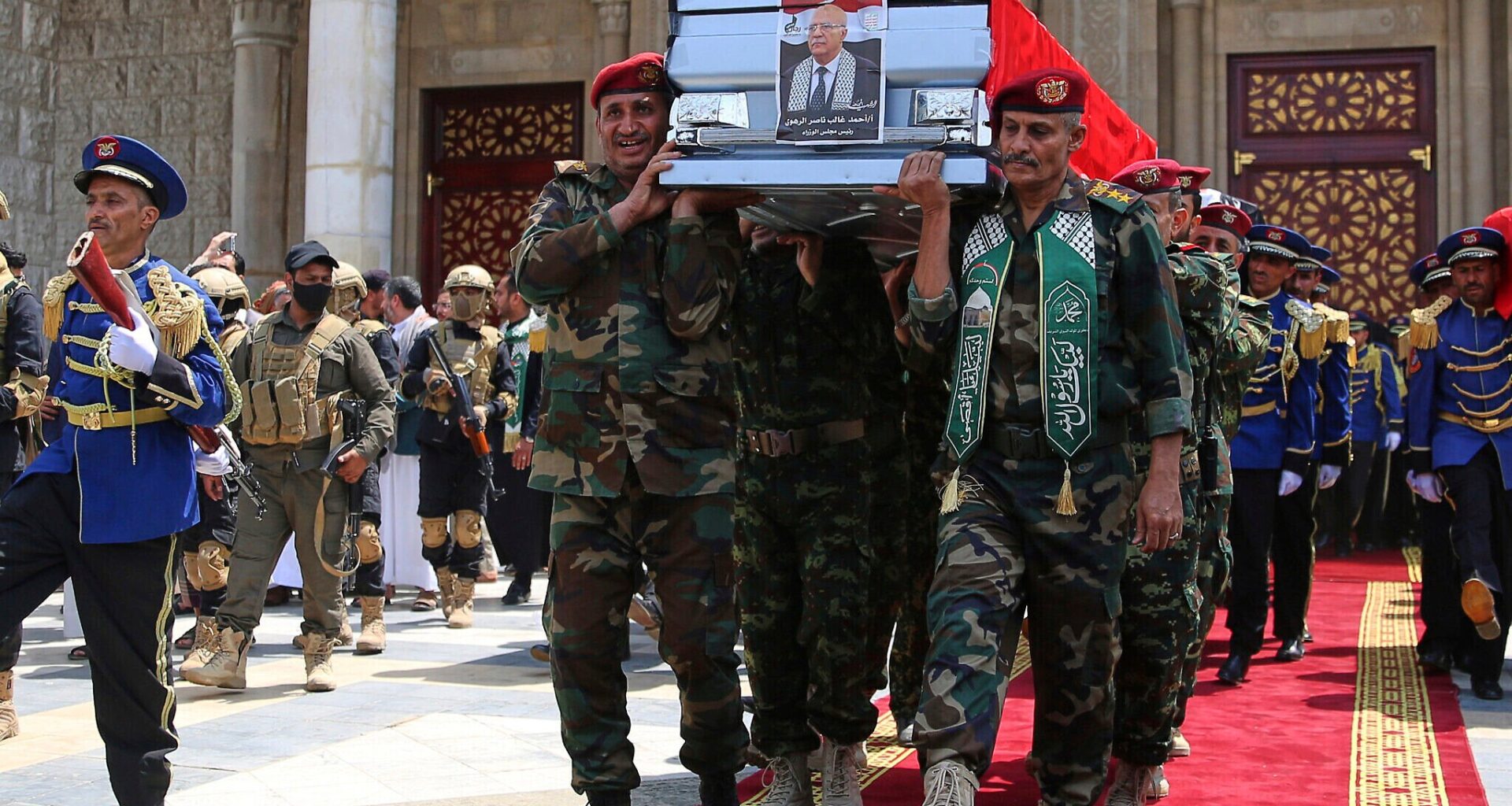
Interim Prime Minister of Yemen’s Houthi-led government Mohammed Miftah (C) attends the funeral of his slain predecessor Ahmed Ghaleb Al-Rahwi and other officials, killed in an Israeli strike days earlier, in Sanaa on September 1, 2025. (Mohammed HUWAIS / AFP)
Current estimates reportedly place more than 20 senior Houthi officials as having been inside the targeted villa, alongside aides, drivers, and security personnel.
Israeli authorities note that the Houthis deliberately held the meeting in a residential villa rather than an official government building, suggesting an attempt to conceal their movements.
Houthi leader Abdul Malik al-Houthi, who has remained in hiding for years, was not among the senior officials killed. In a televised speech on the Houthis’ Al-Masirah TV on Sunday following Israel’s attack, he vowed to continue “targeting Israel with missiles and drones” and to escalate these attacks, asserting that recent Israeli strikes on rebel-held areas of Yemen would not weaken the group or discourage its fighters.
Kan reported that al-Houthi remains a key IDF target for elimination due to his symbolic and operational significance, and that further operations are planned to deter ongoing missile and drone attacks from Yemen toward Israel.
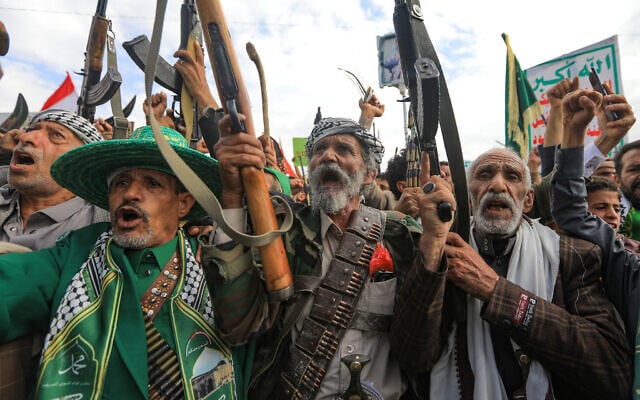
Supporters of the Iran-backed Houthi rebels rally in the Houthi-run capital Sanaa, Yemen, on August 29, 2025. (Mohammed HUWAIS / AFP)
Also on Tuesday, the Houthis announced that they attacked a ship in the northern Red Sea with two drones and a missile because of its alleged connection to Israel.
The group did not say when the attack happened. There was no immediate confirmation of the attack from maritime sources.
“The Yemeni armed forces carried out a joint military operation targeting the ship … for violating the [Houthis’] decision to ban entry to the ports of occupied Palestine,” the group’s spokesperson said.
The Houthis on Sunday claimed to have attacked the Israeli-owned tanker Scarlet Ray near Saudi Arabia’s Red Sea port city of Yanbu in a rare attack off the Saudi coast.
The Iran-backed rebel group also claimed Tuesday to have launched four drones at Israel, including toward Tel Aviv. Earlier, the IDF said the Israel Air Force intercepted an unmanned aerial vehicle launched from Yemen before it entered Israeli territory. No sirens were activated, in accordance with IDF policy.
The IDF also said that the Houthis fired two missiles at Israel early Tuesday morning, but that they disintegrated over Saudi Arabia.

Smoke plumes rising on the Greek-owned bulk carrier Magic Seas after an attack by the Houthis in the Red Sea, on July 8, 2025. (ANSARULLAH MEDIA CENTRE / AFP)
The Houthis — whose slogan calls for “Death to America, Death to Israel, [and] a Curse on the Jews” — began attacking Israel and maritime traffic in November 2023, a month after the October 7 Hamas massacre.
The Houthis held their fire when a ceasefire was reached between Israel and Hamas in January 2025. By that point, they had fired over 40 ballistic missiles and dozens of attack drones and cruise missiles at Israel, including one that killed a civilian and wounded several others in Tel Aviv, prompting Israel’s first strike in Yemen.
Since March 18, when the IDF resumed its offensive against Hamas in the Gaza Strip, the Houthis have launched 71 ballistic missiles and at least 23 drones at Israel. Several of the missiles have fallen short.