
Written by: Chainalysis
Translated by: Chopper, Foresight News
We are pleased to share the 2025 Chainalysis Global Cryptocurrency Adoption Index. In our annual report, we examine both on-chain and off-chain data to identify which countries are leading the world in grassroots cryptocurrency adoption. Our research highlights the countries where unique cryptocurrency use cases are taking root and explores why people around the world are embracing cryptocurrencies.
Top 20 Countries in the 2025 Global Cryptocurrency Adoption Index
 In 2025, the Asia-Pacific region further solidified its position as the global hub for grassroots cryptocurrency activity, with India, Pakistan, and Vietnam leading the way, driven by their populations’ extensive adoption of both centralized and decentralized services. Meanwhile, propelled by regulatory momentum, including the approval of spot Bitcoin ETFs and clearer institutional frameworks, North America climbed to the second position in the regional ranking, contributing to the legitimization of cryptocurrency participation within traditional financial channels and accelerating its development.

The Asia-Pacific region is the fastest-growing area.
In the 12 months ending June 2025, the Asia-Pacific region became the fastest-growing area for on-chain cryptocurrency activity, with a year-on-year increase in value received of 69%. The total cryptocurrency trading volume in the Asia-Pacific region rose from $1.4 trillion to $2.36 trillion, driven by strong participation from major markets such as India, Vietnam, and Pakistan.
Following closely is Latin America, where the cryptocurrency adoption rate grew by 63%, reflecting an increase in adoption rates among both retail and institutional levels. In contrast, the adoption rate in Sub-Saharan Africa grew by 52%, indicating that the region continues to rely on cryptocurrency for remittances and everyday payments. These figures highlight a broad shift in the momentum of cryptocurrency development towards the Global South, where practical applications increasingly drive cryptocurrency adoption.
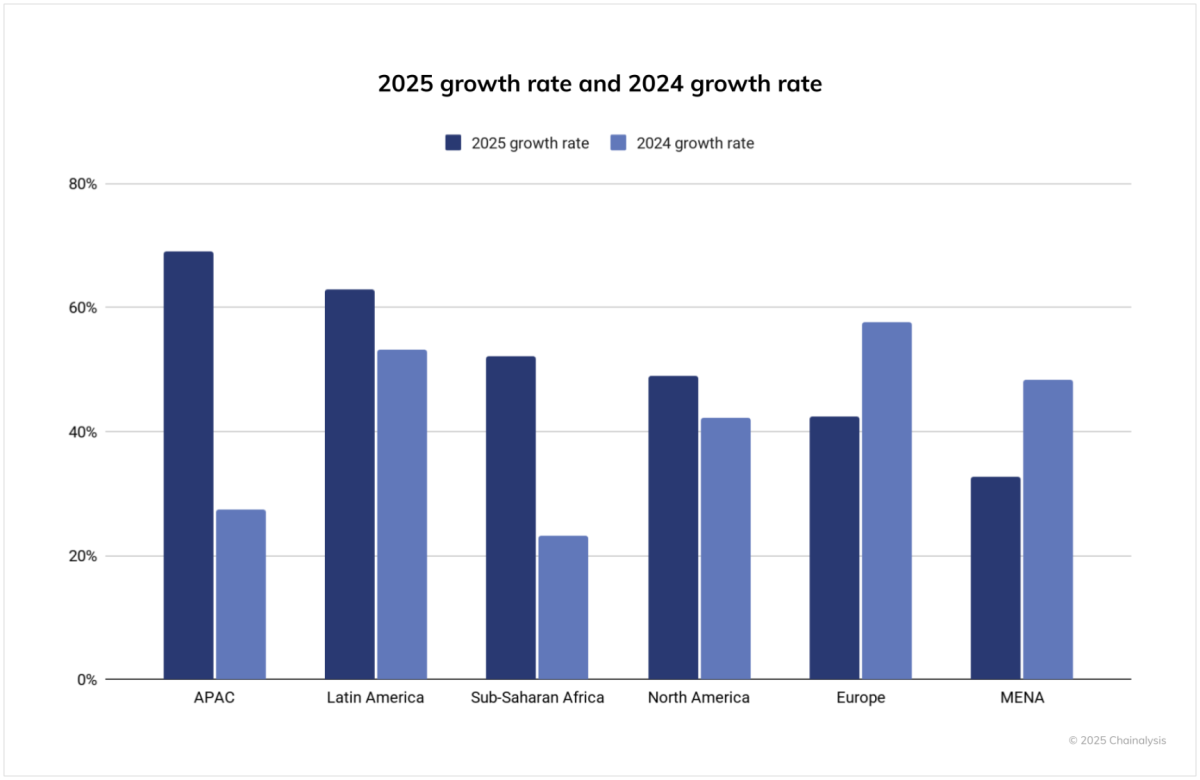
Meanwhile, in absolute terms, North America and Europe remain dominant, having received over $2.2 trillion and $2.6 trillion respectively in the past year. The 49% growth in North America reflects a renewed institutional interest in cryptocurrencies, spurred by the launch of spot Bitcoin ETFs and increased regulatory clarity. The 42% growth in Europe, while lower than other regions, still represents significant growth given its already high baseline, underscoring the continent’s ongoing institutional activity and expanding user base. In contrast, the growth in the Middle East and North Africa was more moderate at 33%, indicating a slower adoption rate compared to other emerging markets, although total trading volume still exceeded $500 billion.
Compared to the previous year, nearly every region experienced accelerated growth during this period, particularly notable in the Asia-Pacific and Latin America. Last year, the growth rate in the Asia-Pacific was only 27%, but in the recent period, this number more than doubled to 69%. Likewise, Latin America’s year-on-year growth rate surged from 53% to 63%, solidifying the region’s position as one of the fastest-growing centers for cryptocurrency. Rapid growth was also observed in Europe, the Middle East and North Africa, and Sub-Saharan Africa, indicating broad expansion globally. Interestingly, the growth rate in North America also increased from 42% to 49%, further indicating that regulatory clarity and institutional capital inflows in 2025 are beginning to manifest in trading-level data.
The new landscape adjusted for population: Eastern Europe dominates.
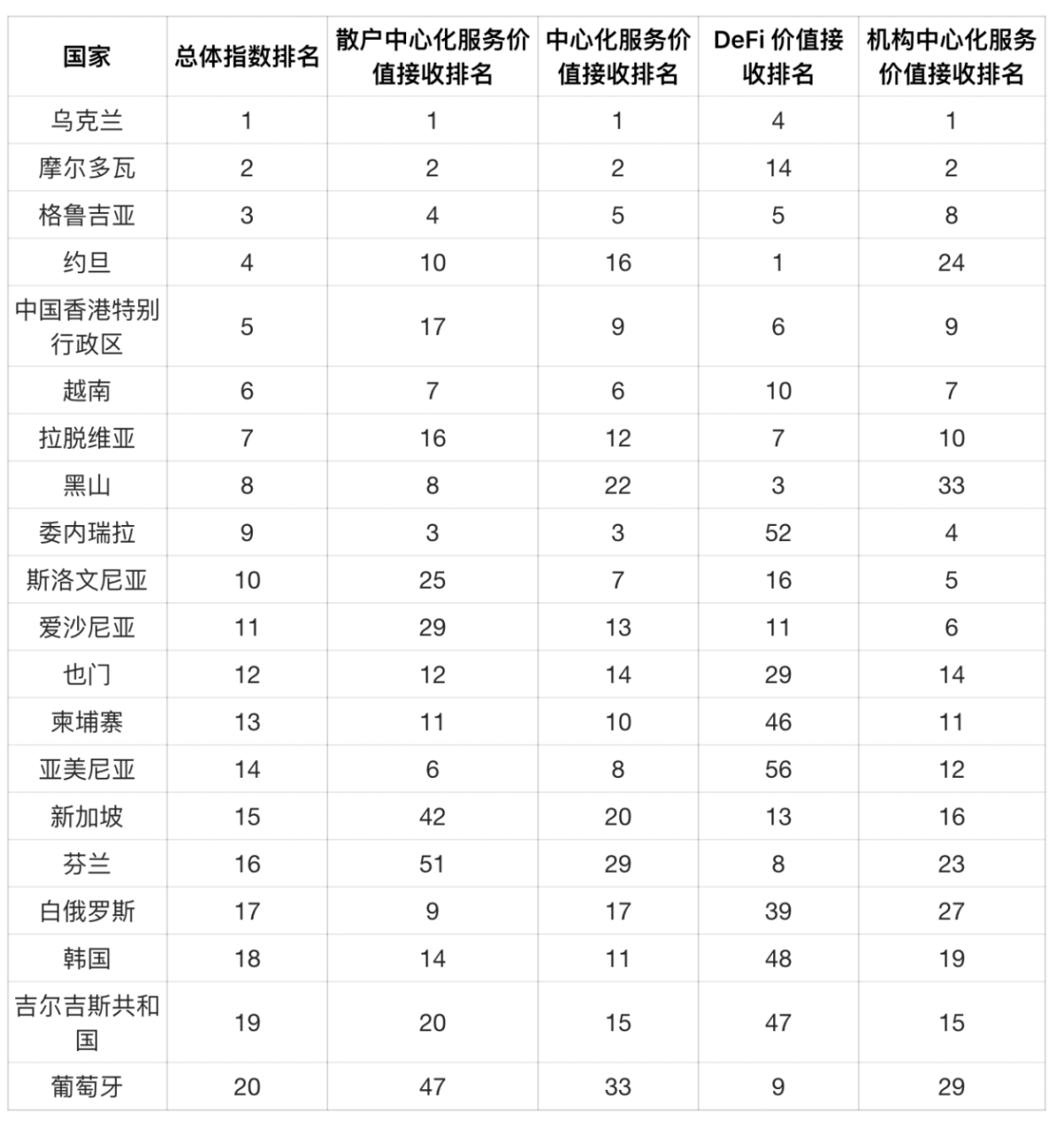
Our index has traditionally focused on activity adjusted for per capita GDP, which is most effective when cryptocurrency is niche and concentrated among high-volume users. However, as the scope of adoption broadens, population-adjusted metrics can more clearly illustrate where cryptocurrency gains real grassroots appeal.
When we adjusted our index for population, we discovered a very different set of leading countries. Eastern European nations, including Ukraine, Moldova, and Georgia, ranked at the top, reflecting a high level of cryptocurrency activity relative to their population size. Economic uncertainty, distrust of traditional financial institutions, and a strong technological proficiency in the region may drive the adoption of cryptocurrency in Eastern Europe. These factors make cryptocurrency an attractive alternative for wealth preservation and cross-border transactions, particularly in countries facing inflation, war, or banking restrictions.
The global surge of stablecoins.
In the past 12 months, the regulatory landscape for stablecoins has undergone significant changes. Although the U.S. ‘Genius Act’ has yet to take effect, its passage has already sparked strong institutional interest, while in the European Union, the ‘Markets in Crypto-Assets Regulation’ (MiCA) has paved the way for the launch of licensed euro-pegged stablecoins like EURC.
However, when we examine on-chain data, the trading volume of stablecoins is still dominated by USDT and USDC, which have consistently outperformed other stablecoins in scale. Between June 2024 and June 2025, USDT processed more than $1 trillion in transactions per month, peaking at $1.14 trillion in January 2025. Meanwhile, USDC’s monthly trading volume ranged between $1.24 trillion and $3.29 trillion, with particularly high activity in October 2024. These trading volumes underscore the continued core position of Tether and USDC in the cryptocurrency market infrastructure, especially in cross-border payments and institutional activities.
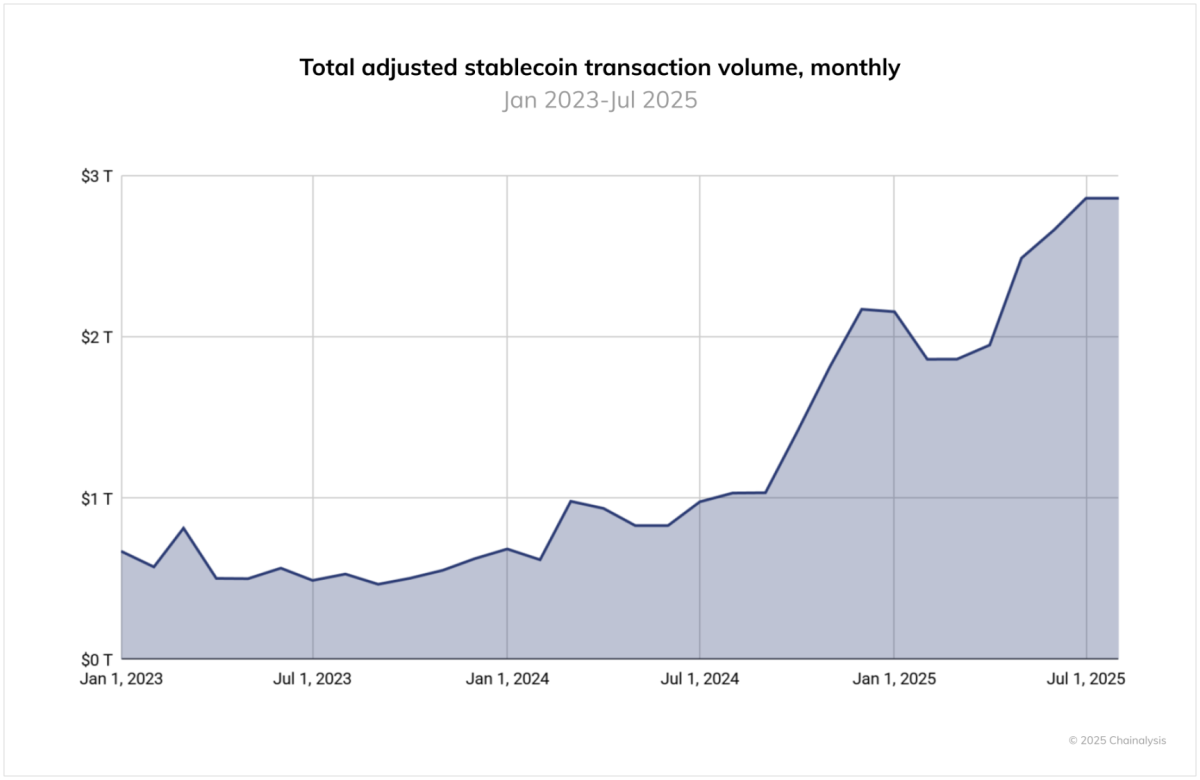
However, observing the growth trends reveals different dynamics. While Tether and USDC have experienced some volatility, smaller stablecoins like EURC, PYUSD, and DAI have seen rapid growth. For instance, EURC has achieved an average month-on-month growth of nearly 89%, with its monthly trading volume increasing from approximately $47 million in June 2024 to over $7.5 billion by June 2025. PYUSD has also shown sustained accelerated growth, rising from about $783 million to $3.95 billion during the same period.
These changes align with the increased institutional activity surrounding stablecoins. Companies like Stripe, MasterCard, and Visa have launched products allowing users to spend stablecoins through traditional channels, while platforms like MetaMask, Kraken, and Crypto.com have introduced stablecoin payment functionalities linked to bank cards. On the merchant side, collaborations among companies such as Circle, Paxos, and Nuvei aim to simplify the settlement of stablecoins. Meanwhile, traditional financial institutions like Citi and Bank of America have announced their intentions to explore expanding their product offerings, even hinting at the potential launch of their own stablecoins.
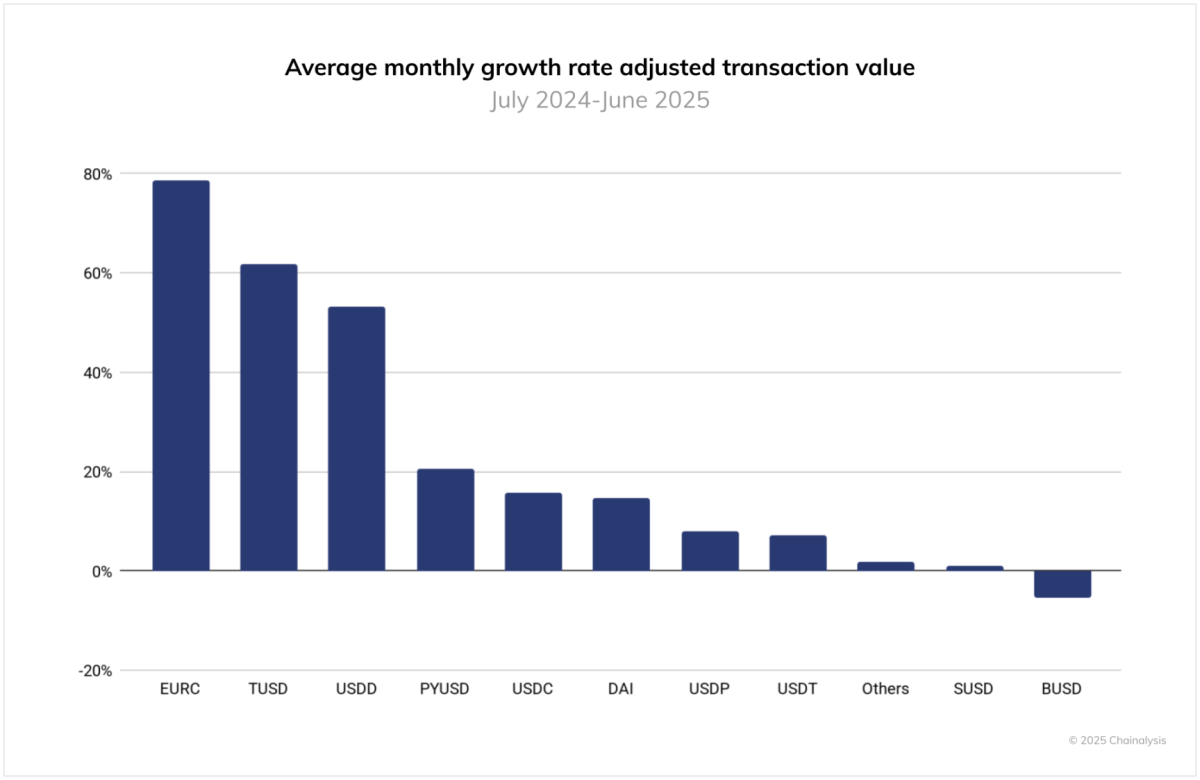
From a regional perspective, these differences may indicate that the usage patterns of stablecoins are undergoing changes. The growth of USDC appears to be closely linked to institutional channels and regulated corridors in the United States, while the rise of EURC suggests an increasing interest in euro-denominated digital assets, potentially driven by platforms compliant with MiCA standards and the adoption of European fintech. The growth of PYUSD may indicate a broader demand for other highly regulated stablecoins in retail and payment environments. These developments suggest that the landscape of stablecoins is diversifying yet also expanding, with local use cases increasingly influencing global transaction volumes.
Fiat Currency Entry: Bitcoin Remains the Primary Gateway
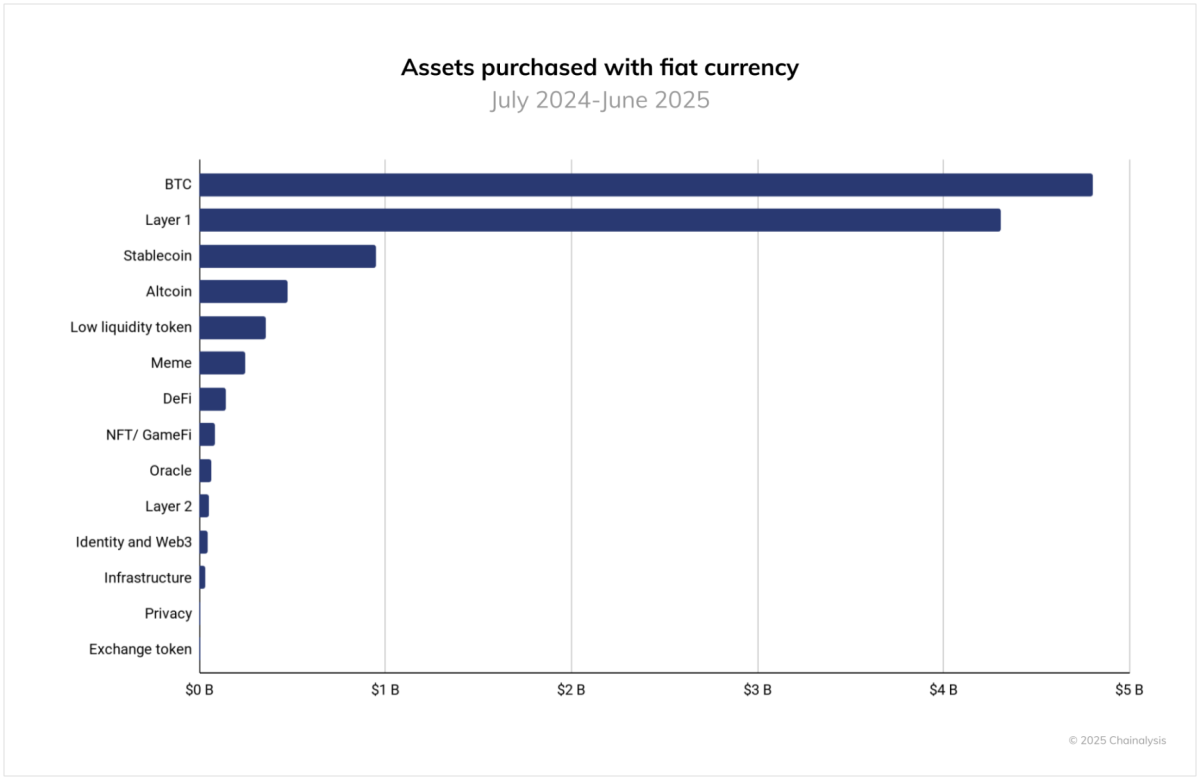
To assess fiat currency entry behaviors, we examined purchases made on centralized exchanges from July 2024 to June 2025, where users traded fiat currencies to acquire cryptocurrencies. Each transaction was categorized based on the high-level classification of the purchased assets, allowing us to evaluate which types of tokens serve as the primary gateways into cryptocurrency.
Bitcoin leads by a significant margin, accounting for over $4.6 trillion in fiat inflows during this period. This is more than double the inflow of the second-ranked Layer 1 tokens (excluding BTC and ETH), which totaled approximately $3.8 trillion. Stablecoins rank third with $1.3 trillion, followed by altcoins at around $540 billion. Other categories, including low liquidity tokens, meme coins, and DeFi, each saw fiat inflows of less than $300 billion.
Geographically, the United States remains the largest fiat currency entry point globally, with total trading volume exceeding $4.2 trillion, more than four times that of the second-largest country. South Korea follows with over $1 trillion in trading volume, while the European Union’s trading volume is slightly below $500 billion. Bitcoin’s dominance (i.e., the percentage of total fiat purchases allocated to BTC) is particularly high in the United Kingdom and the EU, at approximately 47% and 45%, respectively. In contrast, South Korea’s entry is more diversified, with a lower share of trading volume attributed to Bitcoin.
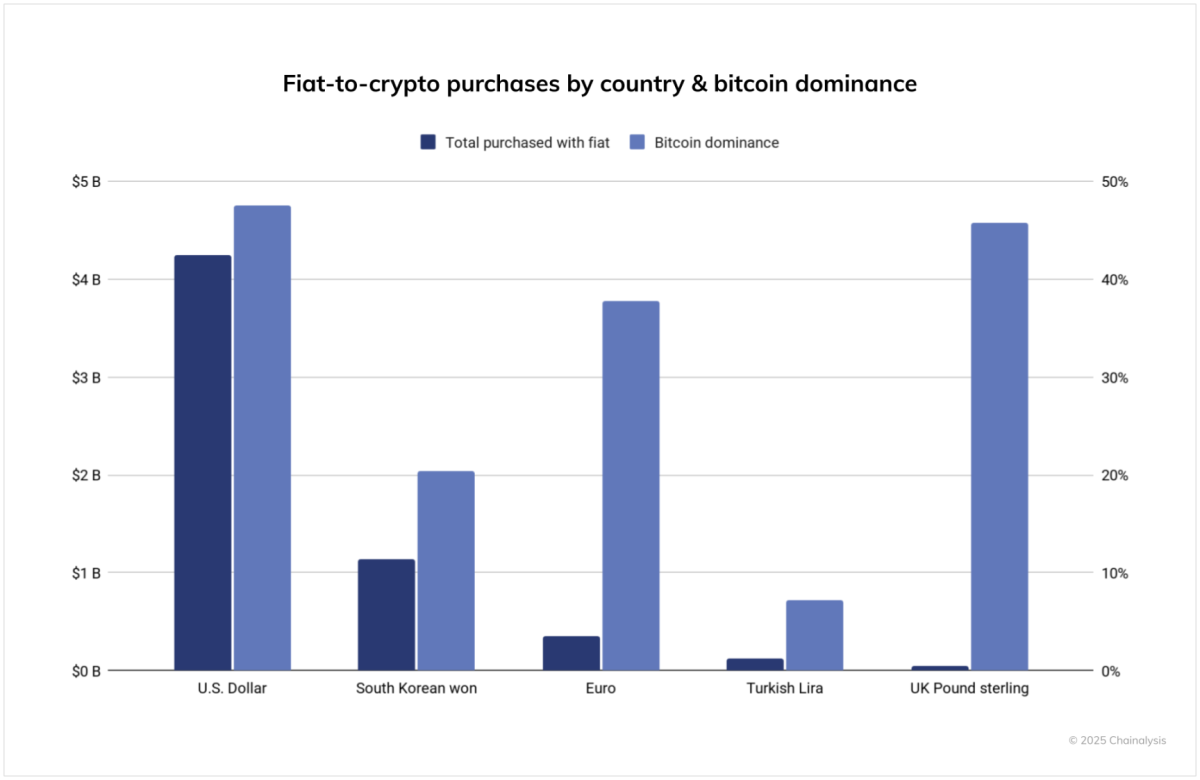
It is important to note that this analysis only includes fiat currency entry data from tracked centralized exchanges and does not cover activities through over-the-counter trading, informal markets such as Hawala, or cash-based cryptocurrency stores.
The adoption situation nearly covers all income strata.
If we decompose the global adoption index into quarterly time series and segment it by income strata as defined by the World Bank, a clear picture emerges: high-income, upper-middle-income, and lower-middle-income groups all reach peaks simultaneously in this report. This synchrony indicates that the current wave of cryptocurrency adoption is broad, rather than isolated, benefiting both mature markets with clearer rules and institutional frameworks, and emerging markets experiencing accelerated adoption through remittances, access to dollars via stablecoins, and mobile-first finance. In other words, cryptocurrency adoption is genuinely global.
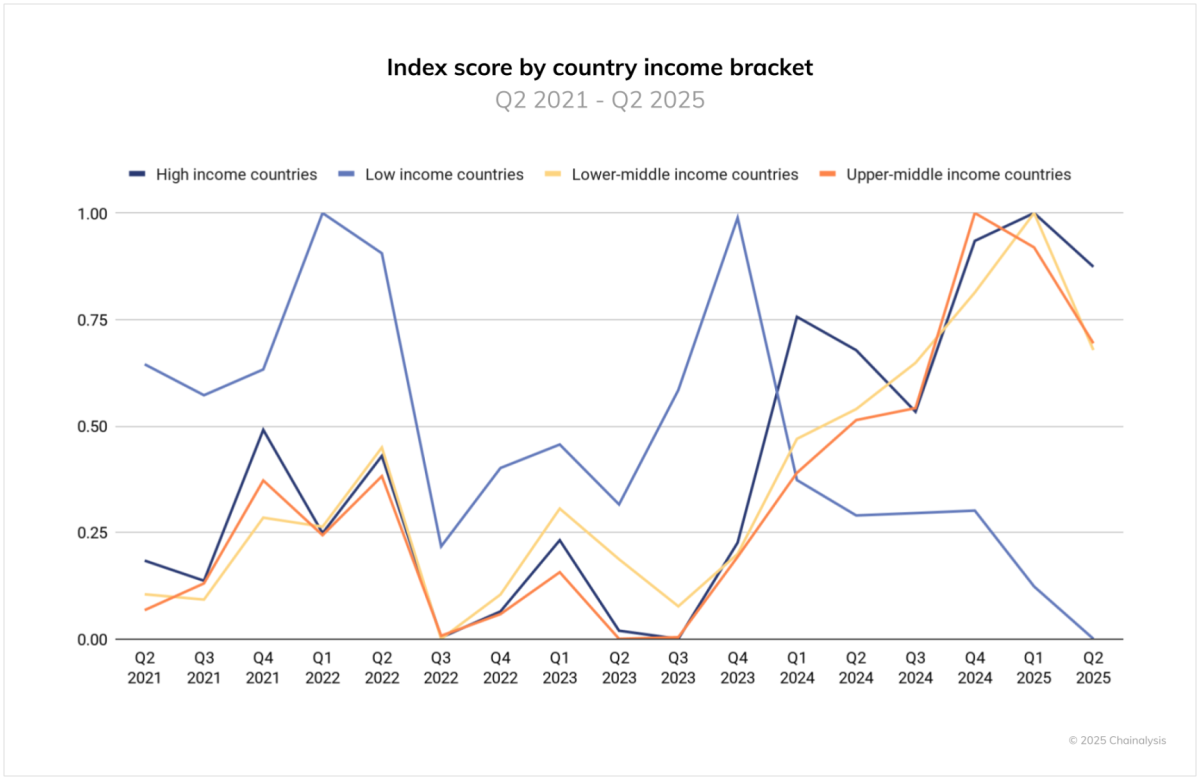
There is a significant warning among the low-income country group. This group includes several countries where one would not typically expect sustained high levels of cryptocurrency usage, and this composition results in greater volatility: a brief surge followed by a decline. This is driven by factors such as policy shocks, liquidity constraints, and disruptions related to conflict. For instance, Afghanistan is a low-income country where Chainalysis found that, following the U.S. withdrawal in 2021, the country temporarily lost all cryptocurrency activity. The global peak signals are real, but the trends in low-income countries are more fragile and unstable; sustainable growth there will depend on improvements in access, regulatory transparency, and fundamental financial and digital infrastructure.