Why Steel Dome matters
Reflecting on the roots of Türkiye’s air defence evolution, Prof Casin frames the Steel Dome within a historic continuum.
“In the Cold War era, NATO and the Warsaw Pact prioritised protection against nuclear warheads and ballistic missiles. As a NATO member, Türkiye deployed Nike Hercules missiles to defend Istanbul and the Marmara region, Rapier air defence missiles for strategic sites, American Hawk systems, and Stinger point-defence missiles.”
Yet, as Casin emphasises, the landscape shifted profoundly after the Gulf War.
“When the US-led coalition established absolute air superiority, Iraq’s radar and defence networks collapsed in just six days. Pilots, tanks, and ground forces were effectively blinded and deafened. From that war,” he notes, “militaries worldwide learned a critical truth: without effective radar and layered defences, even the strongest armies become vulnerable.”
In the decades that followed, Türkiye faced a new and complex threat profile.
Precise cruise missiles, suicidal UAVs, and hypersonic projectiles—capable of Mach 7 speed and near-undetectable by traditional radars—forced a comprehensive strategic reevaluation.
“These emerging technologies exposed critical gaps in NATO’s collective air defence umbrella,” Casin says. “Our strategy had to integrate multi-layered interception systems, advanced radar networks, and AI-powered decision-making.”
The geopolitical impetus for Türkiye’s autonomous programme was further driven by Western limitations.
Frustrated by repeated denials of US Patriot system requests, Ankara turned to Russia’s S-400 system. “The S-400 remains one of the most advanced air defence systems in the world,” Casin says, but adds that acquiring it also led to an unanticipated cost: removal from the US F-35 jet programme.
“This underscored the critical need for domestic production. Relying on foreign suppliers left us vulnerable to embargoes. We needed to control our own defence destiny.”
Under President Erdogan’s directive, Türkiye initiated an ambitious domestic defence campaign, pulling together the capabilities of homegrown defence firms such as Aselsan, Roketsan, Havelsan, Tubitak Sage, and MKE.
Türkiye’s path towards defence dominance further accelerated with the establishment of the Research and Development Center in August 2020, backed by a $1.5 billion investment in missile and countermeasure technologies.
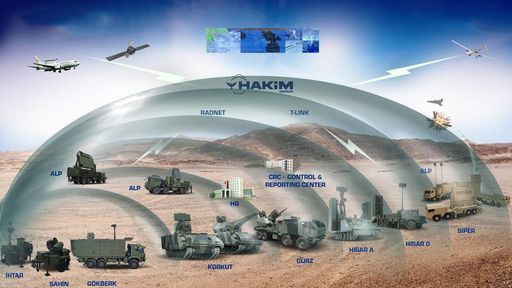
Now with Steel Dome, Türkiye enters the elite circle of global air defence powers. Yet unlike many, Türkiye’s system is domestically developed, costs one-tenth as much as comparable Western solutions, and removes the risk of foreign dependency or strategic choke points.
As Professor Yayci says, “This is not just a set of independent weapons, it is a living, breathing ecosystem where radars, missiles, sensors, and AI-based decision systems act in harmony.”
“A single radar cannot defend a nation, nor can a single missile. But when everything is integrated intelligently, you create a shield of steel—a defence network that protects Türkiye from every altitude and every direction.”