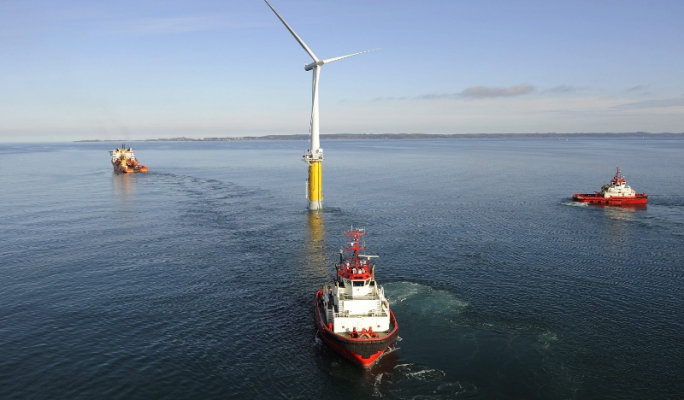
Dragging a floating wind turbine out to sea is a daunting task that requires large tugboats which ironically burn tonnes of fuel and generate high emissions.
Such deep-sea turbines are often assembled onshore and towed over long distances to the installation site. This process is not only a logistical challenge but also costly and is likely to be repeated multiple times throughout the turbine’s lifetime for major maintenance tasks.
But now researchers from the University of Malta have teamed up with leading Chinese institutions to develop what they describe as a “novel drag reduction fairing”.
The project called TowFOWT—an acronym for towing floating offshore wind turbine towing—aims to develop a streamlined device that reduces the hydrodynamic resistance experienced during towing, according to lead researcher Christopher Micallef.
“By lowering the towing drag, the project aims to cut fuel consumption and associated emissions, contributing directly to Malta’s decarbonisation efforts and transition to a green and blue economy,” Micallef, head of the UOM’s Mechanical Engineering Department, told MaltaToday.
Floating wind turbines are predominantly located in waters that are too deep for fixed-bottom turbines.
Malta is still at tendering stage in its quest to develop its first offshore floating wind farm just outside the 12-mile nautical zone. China, on the other hand, is developing gigawatt-scale floating wind farms far offshore. Nonetheless, the challenge of deploying deep-sea wind farms sustainably by reducing the environmental impact of towing is the same for both countries.
The research will combine high-fidelity numerical simulations—very realistic and complex simulations—using computers to predict the flow of seawater and air with scaled experimental testing.
“A key focus will be ensuring that the new device does not compromise towing stability, especially under challenging metocean conditions,” Micallef said.
Energy Minister Miriam Dalli told parliament before the summer recess that Malta is expected to select a contractor for its first offshore wind farm by the start of 2028.
The wind farm will be located outside territorial waters and within Malta’s Exclusive Economic Zone and is expected to have an installed capacity of around 300MW. The two areas identified for such a development are to the east and south of Malta.
Two consortiums and a Greek company have shown an interest in developing Malta’s first offshore renewable energy project.
The first consortium is Code Zero Consortium, led by SEP (Malta) Holding Ltd, with partners Kornelio Energy 1 Ltd, M. Demajo (Holdings) Ltd, and NMK Renewables Ltd.
A second submission was made by the consortium Atlas Med Wind, led by GreenIT SpA, partnered with Seatrans Shipping Ltd, Central European Advisors Limited, and CI V Transfer Coöperatief U.A.
The third submission was by MCKEDRIK Sole Member Ltd, a sole applicant from Greece.
The TowFOWT research project is financed by Xjenza Malta and China’s Science and Technology Ministry through the Sino-Malta Fund 2025 call.
The UOM is collaborating with the Beijing Institute of Technology, Tianjin University and the China Ship Scientific Research Centre.
Apart from Christopher Micallef, the University of Malta research team includes engineers Tonio Sant and Jean Paul Mollicone and researchers Martina Zammit and Nathaniel Scerri.