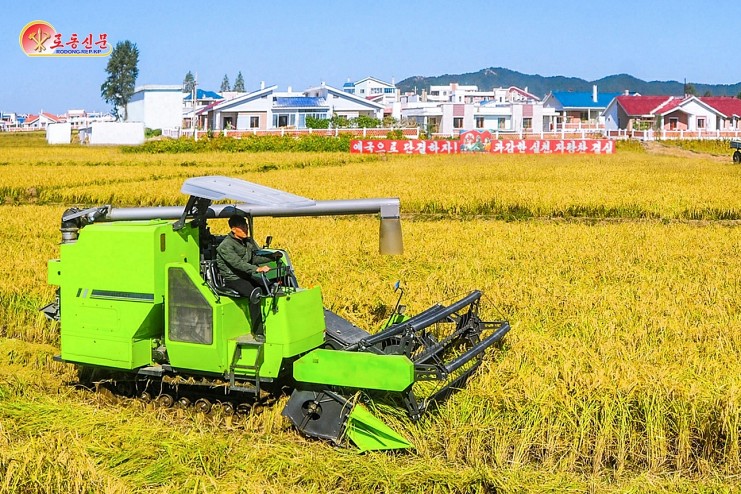
 North Korea’s Rodong Sinmun newspaper reported on Oct. 8, 2024, that this year’s rice harvest was expected to exceed plans by more than a ton on average and that threshing began one week earlier than last year due to applying scientific farming techniques per the Juche farming method. (Rodong Sinmun, News1)
A grain management center under construction in Hwangju county, North Hwanghae province, since February will be completed this fall. Inside North Korea, concern is growing that authorities plan to intensify control over grain production, distribution and sales in line with recent revisions to the country’s grain law.
According to a Daily NK source in North Korea recently, builders have erected roughly half the framework of the grain management center in Hwangju. Not only have regional construction companies been mobilized for the project, but army engineers have also been deployed.
Construction costs are being shared by the central government, province and county on a 1:2:7 ratio, with authorities working diligently to avoid poor-quality construction—they even use the phrase “a plan that lasts 10,000 years” to emphasize precision.
Grain management centers are under construction in six locations across North Hwanghae province this year alone, including in Unpa county and Yontan county.
Modern complexes, not simple warehouses
These grain management centers are not merely storage warehouses. They are designed as modern facilities that will select and process grain for long-term storage, as well as directly distribute grain after packaging it hygienically, the source explained.
North Korean leader Kim Jong Un toured construction sites for provincial factories in late August 2024, during which he ordered the simultaneous construction of public health facilities, technology provision offices and grain management centers. He emphasized, “Do not simply renovate existing facilities, but build new management centers to store grain and ensure food quality.”
While Kim ostensibly called for modernizing grain distribution, people believe his real objective is for the state to completely control grain distribution. Behind the slogan to “improve people’s lives” lies the political calculation to control citizens by exercising a monopoly over food distribution.
“For people, eating is the most important issue, and for the state to take responsibility for this is extremely significant from the supreme leader’s perspective,” the source said. Accordingly, Kim “appears strongly determined to monopolize food distribution.”
This goal aligns with North Korea’s legal framework. The country’s grain law, amended in 2022, added “sales” to existing provisions covering the “procurement, storage, processing, distribution and consumption” of grain. This legally restricted autonomous grain sales in markets, granting the state authority to sell grain.
In Article 1 of the amended grain law, North Korea stated it would “strictly establish a system and order in the procurement, storage, processing, distribution, sale and consumption of grain.” Regarding grain procurement, the law replaced language about “timely acquisition” with specific wording on “seamlessly organizing harvests, threshing, drying, packaging and transport.”
Completing the control framework
With the construction of grain management centers, North Korea will have completed its roadmap for strengthening centralized control through interconnected laws, policies, and physical infrastructure. North Korea established the legal foundation with its 2022 law revision, consolidated its policy direction with Kim’s 2024 order, and entered the implementation phase with grain management center construction in 2025.
Overall management of these centers will be handled by the Ministry of Grain Management, while the centers’ directors, technical heads, party secretaries and procurement managers, along with processing teams, storage teams and security teams, will operate under a management system spanning both provincial and city or county people’s committees.
“The system looks comprehensive on paper, but practical problems could emerge, such as electricity shortages, lack of technical personnel and logistical deficiencies,” the source said. “The centers have the organizational structure, but they face serious risks of being less effective in reality.”
“The government promotes this project as a ‘policy for the people,’ but it remains unclear whether the state’s centralization of food distribution will lead to concrete improvements in citizens’ lives,” the source added. “If they simply restrict grain sales that were previously handled in markets, it could create negative effects such as soaring food prices due to supply shortages.”