
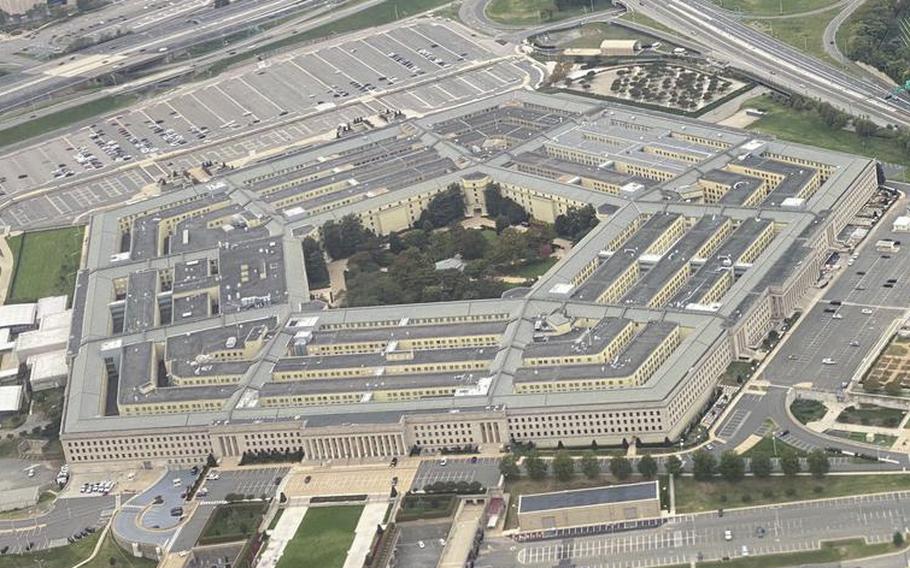
The Pentagon is seen in October 2021. (Robert H. Reid/Stars and Stripes)
WASHINGTON — President Donald Trump signed an executive order Friday afternoon to rename the Defense Department the Department of War.
The president likely lacks the authority to formally change the name without legislation from Congress. In the meantime, Trump authorized the Pentagon to use secondary titles such as “secretary of war” and “Department of War” in official correspondence and public communications so the department can go by its original name.
The administration has teased the change for a while. Defense Secretary Pete Hegseth even created a social media poll on the topic in March.
Hegseth during a commencement speech to new military officers Thursday at Fort Benning, Ga., said his job title “may be a slightly different title tomorrow.”
“I would say standby tomorrow,” Hegseth said when asked about a potential change. “It’s something that — words matter. Titles matter. Cultures matter. And George Washington founded the War Department. We’ll see.”
Last month in the Oval Office, Trump told reporters that “everybody likes that we had an unbelievable history of victory when it was Department of War. Then we changed it to Department of Defense.”
When confronted with the possibility that making the name change would require an act of Congress, Trump told reporters that “we’re just going to do it.”
“I’m sure Congress will go along if we need that,” he added.
Three Republican lawmakers — Rep. Greg Steube of Florida and Sens. Mike Lee of Utah and Rick Scott of Florida — introduced legislation this week to redesignate the Defense Department as the Department of War and rename the position of Defense Secretary to Secretary of War.
“For the first 150 years of our military’s history, Americans defeated their enemies and protected their country under the War Department,” Lee said in a statement. “I’m proud to introduce the Department of War Restoration Act to make President Trump’s return to tradition permanent in federal law. It should always be clear to anyone who would harm our people: Americans don’t just play defense.”
Shortly after reports surfaced Thursday that Trump would sign the executive order, Scott called on his colleagues in a post on X to pass the “bill to make this change the law of the land.”

Sen. Rick Scott (R-Fla.) speaks with reporters at the U.S. Capitol in Washington, Dec. 17, 2024. (Eric Kayne/Stars and Stripes)
President George Washington created the War Department in 1789. It oversaw the Army, while the Navy and Marine Corps were overseen by a separate Department of the Navy starting in 1798. This structure remained until 1947, when President Harry Truman received Congress’ approval to create a National Military Establishment to oversee the Army, Navy and the newly formed Air Force. The National Security Act of 1947 also established the Joint Chiefs of Staff as an organization to advise the president on military planning and strategy.
In 1949, the National Military Establishment became today’s Department of Defense.
When Truman signed the act into law, he believed it would “permit us to make real progress toward building a balanced and effective national defense.”
There were several reasons why the Pentagon became the Defense Department, said Charles Bowery, the executive director of the U.S. Army Center of Military History. The U.S. was growing as a world power in the 1940s. The president at the time, who was commander in chief, was “really unable” to exercise the duties of commander in chief, along with all of his other duties as the elected leader.
After World War II, the demobilization of U.S. forces created some concern. By the end of the war, the U.S. had about 12 million people under arms. Demobilization took place from 1945 to 1947, and the U.S. had about one twelfth the force it had in the early days of the Cold War, Bowery said.
“The military is like, ‘Wait a minute. The nation is trying to demobilize and put millions of people back into civilian life. And then all of a sudden, oh, no, hold on. Now we have to ramp back up again,’” Bowery said.
It was determined that a national institution was needed to account for the complexity of national defense in the atomic age.
“The spirit and the intent behind a defense establishment, a national security establishment, is that the nation’s security and the nation’s defense are about a universe of things. Lethality is just one of those things,” Bowery said. “It’s easy to criticize this decision of creating a Department of Defense as well. What I see in the history of this was, was a very thoughtful attempt to deal with problems that they saw in the past — in World War II, in the Cold War, in the current environment — and to create a structure that would best account for them and to keep the United States safe.”
The effort to rename the Defense Department follows a number of similar steps by Hegseth to change the names of bases and ships. When Trump returned to office, the administration reversed a Biden-era decision that had removed Confederate-era names of bases by restoring the original names with new namesake service members that have the same last names as the Confederate honorees.
In June, Hegseth also ordered the renaming of an oiler ship named after gay rights activist and Navy veteran Harvey Milk.
The last renaming of a major military command also occurred under Trump, when then-Defense Secretary Jim Mattis announced in 2018 that U.S. Pacific Command would be renamed U.S. Indo-Pacific Command, to better reflect the importance of India’s role in U.S. defense strategy in the East.