By Jonathan Bak
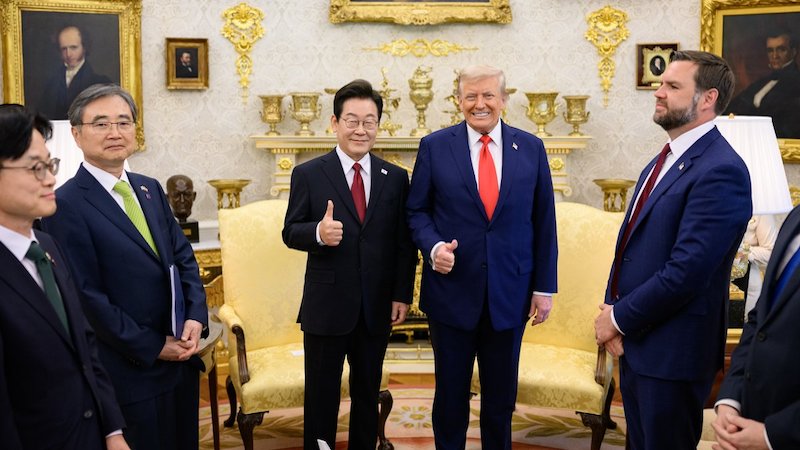
Just days after high-level summits on the Ukraine war, US President Donald Trump and South Korea President Lee Jae-myung held their first meeting in Washington. In the months leading up to the summit, both leaders expressed foreign policy views that aligned on several key areas, even though Trump and Lee come from opposite ends of the political spectrum. Areas of agreement include the need to bring the Ukraine war to an end, support for Ukraine’s reconstruction, and a resumption of dialogue with North Korea.
Ending the War and Rebuilding Ukraine
While on the campaign trail as well as once in office, both leaders have expressed positions implying that the conflict in Ukraine must stop. Trump, who has been very open about the need for the conflict to end, has significantly shifted the US position, which is now complex and evolving. At the same time, the administration pressed for the US–Ukraine critical minerals deal to support economic recovery after the war, linking post-conflict aid to long-term US economic interests. The deal establishes a joint investment fund between the two countries that both sides maintain will be used to aid Ukraine’s economic recovery after Russia’s invasion.
Though South Korea was not present at these summits, Lee has also called for peace and rebuilding Ukraine through his engagements with Zelensky and other European leaders. On Ukraine, Lee has asserted that Seoul should refocus its role on the reconstruction of Ukraine, likely to distance itself from the Yoon administration’s Global Pivotal State (GPS) strategy that saw South Korea seeking a larger role on the international stage.
Similar to Trump, Lee asserts that his diplomacy will be pragmatic and national interest-centered, ensuring that foreign policy decisions will create “opportunities to maximize national interests.” Lee has pledged to push Korean businesses to “freely start, grow, and compete globally.” Some accomplishments have already been made in this direction regarding Ukraine, such as the memorandum signed by the Ukrainian Ministry of Economy and the Korean Business Council in May 2025 to strengthen economic and bilateral relations. Additionally in July, an Economic Innovation Partnership Program was launched by South Korea’s Ministry of Economy and Finance and Ukraine’s Ministry of Economy, committing $10 million over four years to support up to 25 infrastructure recovery projects through consulting, project development, and investment facilitation.
Engagement with North Korea
Since re-entering office, Trump has underscored that he wants to resume diplomatic engagement with Supreme Leader Kim Jong Un. Trump emphasizes his previous meetings and personal relationship with Kim as the basis for renewed diplomatic efforts. During Trump’s first term, the high-profile summits with North Korean leader Kim Jong-un stalled due to disagreements over denuclearization and sanctions relief, leaving key issues unresolved and diplomatic relations uncertain.
Lee has also pushed for dialogue after years of inter-Korean tensions under the Yoon administration. He publicly stated in June that “it is important to restore trust between South and North in a peaceful atmosphere,” following a rejection from the North for dialogue. Since the beginning of Lee’s term, the government has implemented diplomatic moves to encourage inter-Korean diplomacy, ease tensions, and restore trust.
In a further display of determination, the Lee administration announced in late August that a new plan has been approved that includes defense budget increase of $740 million for the Inter-Korean Cooperation Fund. The fund has been described as a foundation for reviving dialogue and possible cross-border exchanges. The administration is confident that this strategy to “restore dialogue, reciprocate cooperation, build policy and foundation for a peace economy” has potential for success.
Although these areas of agreement may appear distinct, they are interconnected. While Seoul and Washington have invested in reconstruction efforts in Ukraine these initiatives could take time to yield a return on investment. South Korea’s economic agreements with Ukraine are designed for long-term development. However, the US minerals deal may take longer than anticipated, as surveying the mineral reserves and conducting mining operations are labor-intensive processes. Additionally, US business ventures in Ukraine will face challenges until the conflict is resolved, especially since there are large deposits of rare earths in Russian-occupied territory. While these efforts represent a necessary starting point for Ukraine’s rebuilding effort, it will require a significant amount of time to achieve meaningful progress.
Overlapping Challenges in US-ROK Relations
North Korea was a key topic during the meeting between the two leaders. Lee is believed to have raised the topic of North Korea because it is a subject Trump enjoys discussing and to capture Kim’s attention. While both Lee and Trump have expressed an interest in reopening dialogue with North Korea, achieving that goal may prove challenging. Pyongyang has been dismissive and critical of diplomatic efforts made by both countries. Just days after Lee’s trip, North Korean state media issued a statement that criticized his speech in Washington, calling him a hypocrite and labeling his comments on denuclearization as “sheer sophism.”
North Korea has remained firm in its stance on not withdrawing from Ukraine. A month after Russian security official Sergei Shoigu was informed by Kim Jong-un that 6,000 military construction and demining specialists were ordered to be deployed to Kursk, Kim conveyed to Russian Foreign Minister Sergei Lavrov that North Korea will“unconditionally support” Russia’s invasion of Ukraine, further strengthening their strategic partnership. Kim reiterated his commitments to Putin during the Victory Day celebrations in China, stating that his country “will do everything to help Russia.” In fact, North Korea is already seeing a return of investment for its assistance: the Korea Institute for Defense Analyses (KIDA) reported that in April that North Korea amassed economic benefits worth around $20.6 billion from the Russian aggression. Additionally, North Korea may be acquiring the technology needed to advance its nuclear capabilities, training, and upgrades in other defensive capabilities through its relationship with Russia.
Following US involvement in the 12-day war between Israel and Iran, North Korea now has even more reason to maintain its nuclear capabilities and reject any diplomatic advances from the United States or South Korea, especially on sensitive topics like denuclearization. An end to the Ukraine war would open the door for possibledialogue with North Korea, but the initiative currently lies with Kim.