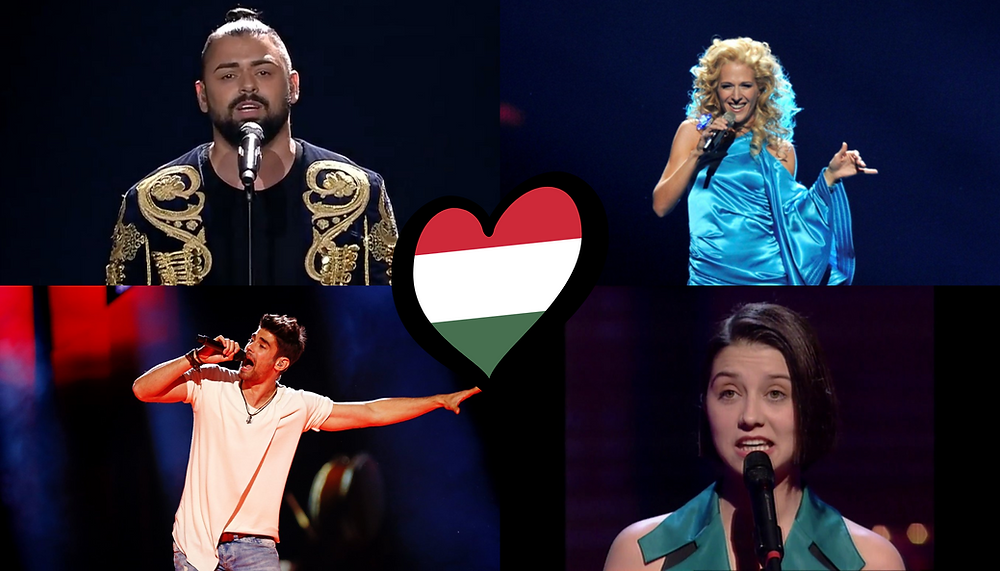

Hungary has been absent from Eurovision since 2019, after its broadcaster Médiaszolgáltatás-támogató és Vagyonkezelő Alap (MTVA) withdrew.
Since then MTVA has not even broadcast the contest, let alone reconsidered participation.
That may all change after next year’s Hungarian parliamentary elections in April.
Let’s unpack Hungary’s participation, withdrawal and possible return to Eurovision.
Hungary’s Eurovision participation
Hungary was arguably one of the most eclectic countries when it came to Eurovision.
Over the years they have sent many unique entries spanning the genres of heavy metal, blues, folk and dance.
The country made its debut at Eurovision in 1994, with Friderika performing Kinek mondjam el vétkeimet? (English translation: To whom shall I tell my sins?)
This beautiful ballad remains Hungary’s best Eurovision placing, reaching 4th position.
Hungary has competed at Eurovision 19 times. Its participation has been rather erratic, with the country withdrawing from the contest several times, including a significant absence from 1999 to 2004.
Joci Pápai is currently the last Hungarian Eurovision participant.
In 2019 he competed with the Hungarian folk-inspired song Az én apám (English translation: My Father) which failed to qualify for the Grand Final.
Withdrawal
In 2020, before the contest was cancelled that year due to the COVID pandemic, Hungary’s Eurovision broadcaster MTVA decided to no longer participate.
The official reason stated by the broadcaster was that they wanted to invest more money in promoting local talent domestically, rather than paying the costs of competing at an international competition.
The competition used to select Hungary’s Eurovision entrant A Dal (English translation: The Song), has continued to be broadcast on MTVA’s main TV channel Duna since the country’s Eurovision withdrawal.
However many international news outlets speculated that the real reason for Hungary’s withdrawal was that Eurovision was viewed as “too gay” by the Orbán government. This was denied by a government spokesperson.
Hungary’s withdrawal from the contest coincided with a rise in anti-LGBT+ rhetoric in the central European country. Several conservative commentators applauded their country’s decision to no longer participate.
Hungary has been sorely missed by many Eurovision fans who appreciated the diversity and quality the country brought to the contest.
Possible return?
To channel another central European country, Hope Never Dies, that Hungary will return to Eurovision.

Péter Magyar, leader of the opposition Tisza party, at a Q&A at a campaign rally in late August, made extremely positive comments regarding Eurovision.
“I don’t know if it’s the government’s responsibility, but if it is we will do it … it’s wrong that we do not participate and we shouldn’t have withdrawn.”
The young man who asked Magyar the question also noted that Hungary is not excluded from the contest by the EBU like Russia or Belarus, nor has it withdrawn due to financial reasons like many other countries.
This response by Magyar is remarkable as opinion polling suggests that he is likely to form a government when Hungary holds its parliamentary elections in April next year.
Opinion polling in Hungary can be unreliable given that several of the polling companies have strong ties with Fidesz – Orbán’s party.
However, pollsters that are considered independent or opposition-aligned give Tisza an average 15% lead over Fidesz over the past few months.
If Magyar were to become Prime Minister in April 2026, Hungary would likely return to Eurovision in 2027.
This is because with next year’s contest in May, a change of government in April would be well behind the EBU’s deadline to select a Eurovision entry let alone confirm participation.
Generally as well a country has to broadcast Eurovision the previous year to be allowed to participate.
So what this author thinks is likely is Hungary would broadcast in the contest in 2026, and return to compete in 2027.
Could Hungary return?
Magyar’s comments and current performance in the opinion polls, gives hope that Hungary will return to the contest in the near future.
The worlds of many Eurovision fans would spin if Hungary made its glorious return to the competition.
On that note, we leave you with Hungary’s similarly titled and iconic 2005 entry Forogj, világ! (English translation: Spin, world!)
For continued updates on all Eurovision Song Contest news, follow us on Facebook, Twitter, TikTok, YouTube, Threads, Bluesky and Instagram. All the links can be found at: https://linktr.ee/aussievisionnet