
51614.jpeg None
As the great and the good filed into the Royal Lancaster hotel overlooking Hyde Park, London, in February 2020, Bernard Looney was feeling nervous.
BP’s new chief executive had been secretly preparing for the presentation for weeks, huddled with a small team of internal advisers and McKinsey consultants in a rented office in Mayfair, a 20-minute walk away from the energy giant’s headquarters in St James’s Square.
But when the 49-year-old Irishman bounded on stage, he projected only confidence. “We need to reinvent BP,” Looney told the packed ballroom of executives, top journalists and key shareholders. “It will require nothing short of reimagining energy as we know it.”
Flanking Looney, floor-to-ceiling screens scrolled through images of catastrophic weather events and showed social media posts lambasting BP and the oil majors, before fading to reveal BP’s new slogan – “Reimagining energy” – written in warm cursive script. Looney’s team originally wanted to use “Reinventing energy” but decided against it because it made the company sound arrogant.
“We all want energy that is reliable and affordable, but that is no longer enough,” he said. “We need a rapid transition to net zero. For BP to play our part, we have to change. And we want to change – this is the right thing for the world and for BP.”
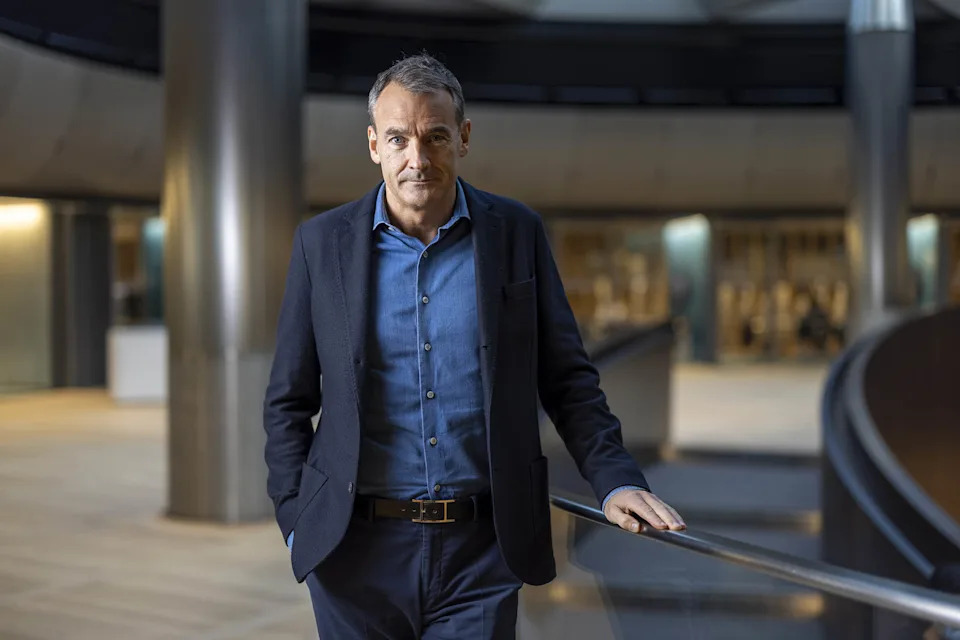
‘We need a rapid transition to net zero. For BP to play our part, we have to change. And we want to change’ … Bernard Looney in 2020
Looney promised that by 2030 the company would boost investment in renewables tenfold to $5bn and build wind farms and solar parks with a capacity of 50 gigawatts – roughly enough to supply two thirds of the UK’s total grid capacity. Even more ambitious was his pledge the following August to cut oil and gas production from the equivalent of 2.6m barrels of oil a day to 1.5m.
Britain’s best-known energy company, responsible for pouring 55m tonnes of CO2 into the atmosphere a year, was going green. Greenpeace described Looney’s promise to cut oil as “Christmas come early, decades too late”.
Fast forward five years and Christmas, it seems, has been cancelled. In February, under pressure from an aggressive activist hedge fund, Elliott Management, BP announced a wholesale reversal of Looney’s reforms, including its commitment to getting to net zero.
“We went too far, too fast,” Murray Auchincloss, Looney’s successor, said. Auchincloss had served as Looney’s finance director and played a big part in the pivot to net zero. Now he was systematically dismantling everything he’d helped build.
In October 2024, Auchincloss had dropped target to cut oil production and had paused new offshore wind projects. Four months later, in what he called a “fundamental reset”, he scrapped a target to boost renewables, promised to sell a share of BP’s solar business, Lightsource, and pledged to invest $10bn a year in oil and gas projects. Far from weaning itself off fossil fuels, BP, which shed its colonial legacy as the Anglo-Iranian Oil Company to become British Petroleum in 1954, would grow production to 2.5m barrels a day by 2030.
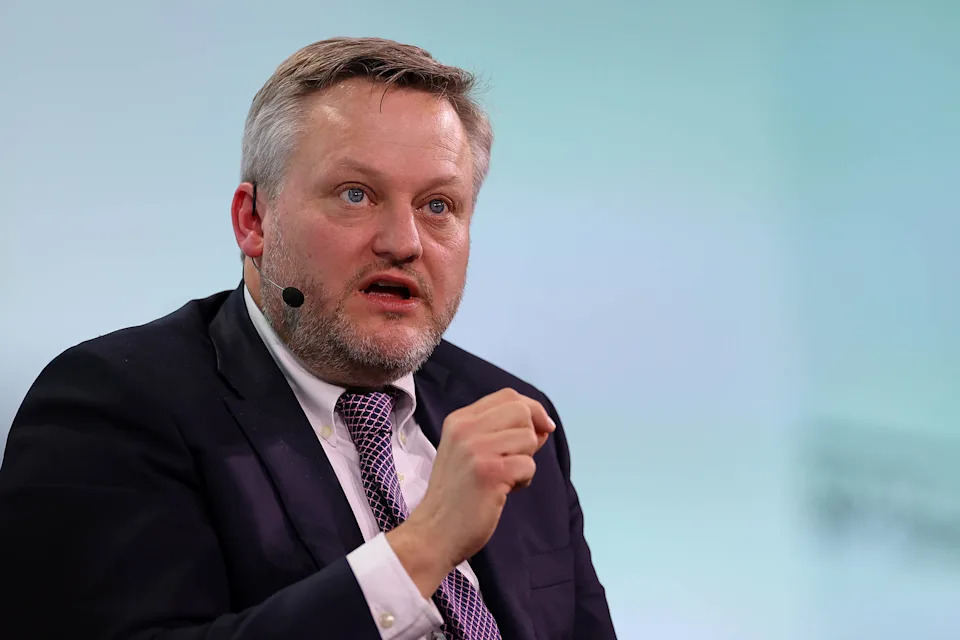
‘Our optimism for a fast transition was misplaced, and we went too far, too fast’ … Murray Auchincloss in 2025
After a five-year fever-dream, BP is going back to petroleum.
This is the story of how an oil and gas multinational made ambitious claims and abandoned them all – and how financial markets said farewell to net zero. It’s a modern-day morality tale that raises questions about whether fossil fuel companies – not to mention banks and other publicly owned multinationals – can ever be part of the solution to climate change.
“A major international oil company like BP pivoting to green was a significant message of hope,” one BP analyst said. “We were one step closer to the end of the hydrocarbon era. And now the question is: is this the end of big oil’s pivot to green?”
In the course of reporting this story, The Observer spoke to BP insiders, former executives, advisors and investors. We asked the company for an interview or to comment on our findings but it said it had nothing to say.
A month after Looney’s Royal Lancaster speech, Covid-19 hit the UK. Looney’s top team spent lockdown putting flesh on the bones of the transition plan: which investments the company would target, where it would cut back, and the key staff that would need to be recruited or poached.
In September, Looney presented this work to shareholders. Unlike his February announcement, things did not go well. “The more we talked, the more we undermined confidence,” one former BP executive said. “Bernard’s ambition excited many in civil society but alarmed just as many investors.” Looney was disappointed. Back in February, most investors had signalled to BP that they were broadly in favour of the transformation.
“Looney’s pivot was stuffed full of volume-led targets,” one representative of a big shareholder remembered. “Rather than saying, we’re going to generate a billion dollars a year from our renewable business, they instead said ‘we’ll do a gigawatt here, a gigawatt over there. It was completely disconnected from any financial logic.” The presentation was “a collection of McKinsey-type slides that looked utterly beautiful – works of art – but lacking any real analytical substance”.
They added: “I remember having a meeting with Bernard and he said to me, quite grumpily, if you wait for the evidence rather than investing more money, you’ll have missed it. You have to take it on faith.”
Many were prepared to take Looney’s word for it. “Bernard is one of the most charismatic people I’ve ever met,” said one shareholder. “You walk into a room with the guy and the sun is shining on you.”
And although Looney’s plan lacked detail, it was a match for the political mood at the time.
“There was an awful lot of political will to transition to net zero,” this shareholder said. “Given how firmly we believed this was the right pathway, we didn’t want to be seen as critical of the strategy.”
In January 2020, Larry Fink, boss of BlackRock, the world’s largest investor, wrote in his influential annual letter to chief executives that climate risk was investment risk; “climate change has become a defining factor in companies’ long-term prospects”. Fink predicted that the world was “on the edge of a fundamental reshaping of finance”. A month later, Mark Carney, then governor of the Bank of England, warned that “2020 must be a year of climate action”, adding that “investing for a net-zero world must go mainstream”.
These two financial powerhouses set the stage for a year of frantic climate policy that was supposed to culminate at the UN Climate Change Conference 26 at Glasgow. In fact, COP26 was postponed for a year due to Covid-19. But when the event finally did take place, green momentum was still evident. Carney used the conference to unveil the Glasgow Financial Alliance for Net Zero, a coalition of more than 450 banks, insurers and asset managers across 45 countries that promised to deliver as much as $100tn of financing to help economies transition to net zero.
Against this background of climate optimism, in February 2021 BP and a German partner agreed to pay £924m for the option to build wind farms in the Irish Sea. But the price was nearly double what some other bidders had offered to pay.
“We moved fast but ended up making some poor green investments out of the gate,” a former BP executive said. “Offshore wind in the US and UK chief among them.”
Around this time, shareholder sentiment soured further. For some, it was simply that BP’s investments were not profitable enough. For others, like Mark van Baal, the head of Follow This, an NGO representing “responsible shareholders”, BP wasn’t radical enough. “It’s easy to be a leader in a field of laggards,” Van Baal said. “Look at the investments in clean energy, in low carbon energy. In Looney’s period it was about 8%. If more than 90% of your investments are still in fossil fuels you can’t claim to be in a transition.”
Connor Chung, an analyst at the Institute for Energy Economics and Financial Analysis, agrees. “The commitments were always more talk than walk. During the years when these firms were supposedly committing to net zero, only 1.4% of global clean energy came from fossil fuels companies.”
Even some former BP executives thought the company should behave more like US oil majors, which had always ignored or downplayed climate policies even in the face of government pressure. “BP, unlike Exxon, has always cared enormously about what the world thinks of it – more than perhaps it should,” one said.
The division between those who wanted BP to do more on green – and those who urged it to do less – was turbocharged by events outside Looney’s control, most obviously Covid-19 and Russia’s 2022 invasion of Ukraine – an act of war that spiked oil prices around the world.
“It’s easy to look back in retrospect and harshly judge the strategy,” a former BP executive said. “But Bernard couldn’t have anticipated Covid or Russia invading Ukraine. The ground shifted. Socially too. Progressive causes were in vogue, but the pendulum soon started to swing the other way.”
Unbeknown to BP, a small group of people at a US hedge fund was closely watching the Looney reforms.
About 18 months after BP’s green pivot, portfolio managers at Florida-based Elliott Management discussed whether to take a stake in BP. The fund was already sceptical that BP was on the right track, which meant its share price could be undervalued and the company a potential target.

Gordon Singer with his father Paul, Elliott Management’s founder
Elliott’s theory was that BP was straying from what it does best. If the company stuck to its core competencies, they thought, that would not only be better for BP’s shareholders but better for the market overall, as it would free up capital that could be invested elsewhere, including in green-energy companies able to generate wind and solar more efficiently than BP.
“Just because you’re good at building platforms in the North Sea and extracting [fossil fuels] doesn’t mean you’re good at solar or wind,” someone familiar with the company’s thinking said. “They are completely different businesses.”
The Observer understands that Elliott carried out a “deep dive” into BP but decided the valuation wasn’t cheap enough to compensate it for the risk. The firm decided not to invest – at that point at least.
Few people outside finance have heard of Elliott. But it has the power to alter the direction of businesses that affect millions of people. Founded in 1977 by Paul Singer, a major Republican donor, the firm’s 622 employees are banned from posting pictures of themselves on social media – making most of them digital ghosts.
Elliott uses its huge resources – $76bn – to buy stock in companies it thinks are failing. The firm then pressures the companies to make changes, often in ways that critics say prioritise shareholder returns over longer-term objectives or public impacts such as combatting climate change.
Since 2020, the firm, which has a London office headed by Singer’s son, Gordon, has built up stakes in numerous British companies including the bookseller Waterstones, pharmaceutical multinational GSK and restaurant chain Wasabi.
Elliott has also emerged as one of Thames Water’s key creditors, helping put together a $10bn “rescue package” to save the beleaguered company from nationalisation. In return, the hedge fund and others have demanded that Ofwat, the water regulator, waives the right to enforce historic fines, a move that could see Thames avoid hundreds of millions of pounds in fines for sewage leaks and other infractions.
Former employees say Elliott is not driven by ideology and is laser focused on one thing: maximising returns – aka money. The firm does not manage any investments “designed to promote environmental and/or social characteristics” and does not employ anyone with a climate or ESG mandate.
“Unlike other firms where investors focus on 20 or 30 companies, at Elliott people are dedicating half their time to just one investment,” one person who worked at the firm said. “It’s a very intellectual, very analytical place to work.”
It may be intellectual, but Elliott’s reputation is fearsome. “They’re absolute killers,” one person who has worked on a transaction with the firm told The Observer. “If Elliott arrives on your share register, you absolutely shit your pants.”
Elliot has been accused of employing private investigators to dig up dirt on board members at companies it wants to influence. In 2017 it was involved in an ugly fight with Arconic, a US industrial company into which the hedge fund had invested. Elliott pushed to oust Arconic’s chief executive, Klaus Kleinfeld.
At the height of the dispute, private investigators allegedly knocked on Kleinfeld’s neighbours’ doors in Westchester County, New York, asking if Kleinfeld had loud parties or used drugs. The investigators said they were working on behalf of Arconic investors. Elliott would not comment on these allegations but it has said in the past it has changed the way it uses outside consultants, whose actions must now be cleared by Elliott’s legal department.
BP may not have been the right fit for Elliott in 2021, but in 2024 the world looked very different. Concerns over green energy had been replaced by concerns over cost of living and energy prices. And BP – which had gone further than any other oil major in committing to green energy – started to look even more like an outlier. In 2024 its share price fell by 16%.
It was at this point – in the first months of the year – that Gaurav Toshniwal, a portfolio manager at Elliott in his early forties, started getting excited.
Toshniwal, based in Elliott Management’s London offices on the sixth floor of a smart glass building off Marble Arch, a half-hour walk from BP’s headquarters, thought the timing might be right to take a stake in the energy giant.
The Observer understands that the firm believed BP’s undervaluation was now more profound than in 2021 and that it was more clear that the company’s strategy wasn’t working.
Toshniwal called John Pike, a tall southern Californian and an energy specialist who sits on Elliott’s powerful investment committee.
Over the next month, a small team of analysts and outside advisers came on board to dig into BP from all angles. Eventually, Pike and Toshniwal took their plan to Elliott’s investment committee, headed by the firm’s founder, Paul Singer, and Elliott’s co-chief executive officer, Jonathan Pollack. Gordon Singer is also on the committee.
Having got the go-ahead, Elliott used proxies to quietly start building up a stake in BP. The hedge fund used equity swaps – financial instruments – to build up a huge position today worth about £3.6bn, making the fund the second biggest investor behind BlackRock, ironically the asset manager owned by Larry Fink that had been so committed to net zero.
Last February, Elliott’s involvement was outed by Bloomberg. It was only at this point, it is understood, that BP’s management became aware of Elliott’s involvement.
By this time Looney had left BP, having been kicked out for failing to disclose details of personal relationships. But for Auchincloss, his successor, Elliott’s arrival is unlikely to have been welcome. It signalled two things: that the market was giving up on net zero, and that Elliott would demand radical change from BP.
The firm saw Auchincloss as integrally bound up in Looney’s failed reforms. He would have to work hard to bring the activist back on side.
The February pivot back to oil and gas did not cut it. “Murray has taken 18 months to come up with a three-year plan that’s neither ambitious nor urgent,” Elliott sources said at the time. Such was Elliott’s influence that last month Auchincloss announced a new review of its business and costs, saying it now expects to cut 15% of its office staff.
Under pressure from the hedge fund, BP has replaced its chair, Helge Lund – the man who hired Looney and supported his plans to transform the company. Albert Manifold, the former boss of building materials producer CRH, is his successor.
“The firm has been encouraged by both the new chair and the change in tone from BP since August,” someone familiar with Elliott said.
BP’s full-throated support for oil and gas only works if oil and gas demand stays high. But if the energy transition does happen, a stalwart of British industry could be left holding billions of dollars in stranded assets.
“You can argue about the finer points, but fossil fuels face deep and significant risks,” said Connor Chung of the IEEFA. “The fundamental relationship between economic growth and fossil fuel demand is just not as strong as it was.”
And BP is facing another problem: people. One executive who recently was put up for a senior role at BP is understood to have pulled out because of its attitude towards sustainability. Two top names mooted for the chair job – Sam Laidlaw, the former head of British utility Centrica Plc. and Ken MacKenzie, the chair of mining giant BHP Group Ltd – made it clear they were not up for it.
Many believe that fixing BP in the long-term will be tough. The company still pays out about $1.1bn a year in damages relating to the DeepWater Horizon oil spill in 2010, hampering its ability to invest in new revenue streams. If it accedes to Elliott’s demand to cut $10bn in costs – rather than $5bn – it will have even less balance sheet flexibility to play with. Rumours of a takeover continue to grow.
Five years ago, young people globally had much to worry about. House prices were soaring. Covid-19 was impacting millions of junior employees. But the main concern of the upcoming generation, as evidenced in multiple surveys, was the climate. In this respect, businesses and governments appeared to be listening. The world’s biggest firms, even those that produced fossil fuels, promised they could be trusted to protect the planet.
Today, banks such as JPMorgan Chase and Goldman Sachs have exited the UN-backed net-zero banking alliance. According to the annual Banking on Climate Chaos survey, the world’s biggest banks increased fossil fuel financing in 2024 for the first time since 2021, up by $162bn to $869bn.
Donald Trump’s re-election in November shifted the political winds even further. In March, his energy secretary, Chris Wright, attracted cheers from oil executives when he told a conference that the world needed “more energy. Lots more energy”.
One Swiss-based energy expert told me: “I was looking out of my window at a glacier that’s half the size it was, listening to people whooping and hollering in delight.”
Elliott Management declined to comment.
Photograph by BP. Other photographs by Jason Alden/Getty, Aaron M Sprecher/Getty, Jonathan Moscrop/Getty