In Bulgaria you go and cut a protected forest, they fine you 1700€, then you get an approval to build 5 story hotel because there is no forest on that place.
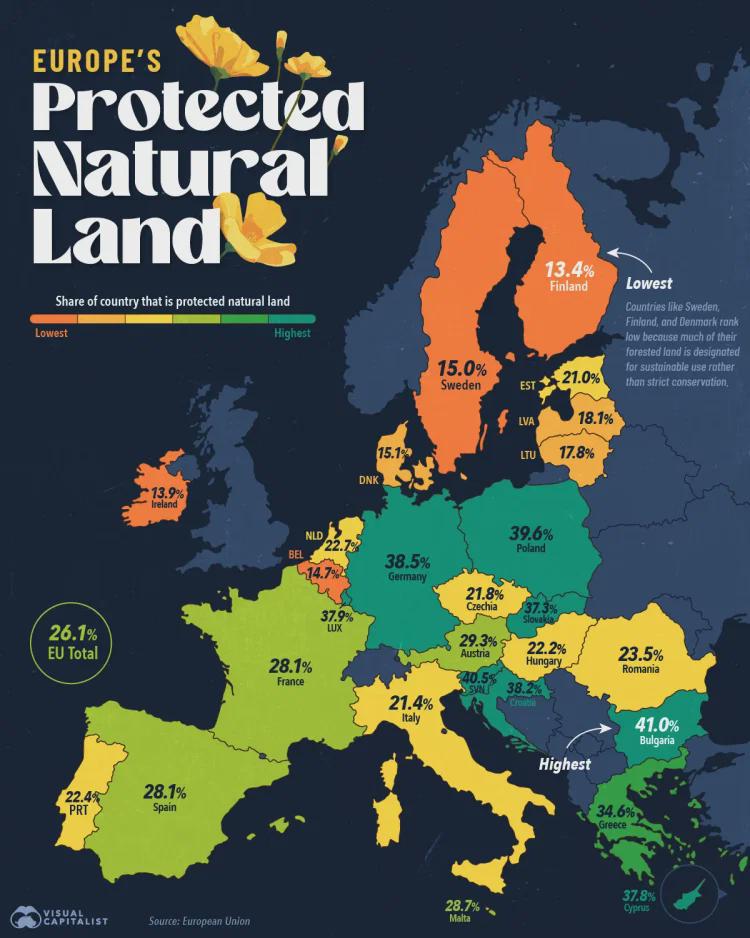
Interesting to see the variation across countries, didn’t expect Finland and Sweden to be on the lower end.
Important to note that in Finland and Sweden although the trees are not protected majority of their country is still forest.
Just because other countries have higher protected rate officially doesn’t mean they have actually more forest and nature.
Corse is part of France, not Italy.
In Finland the lumber companies sometimes cut down protected forests and then just say they’re sorry when caught. But forests – as they are -are only valuable to the people, but the govenrment sees their value only in the money that can be made.
Ashamed to be Belgian when I see those numbers.
Kinda silly metric because Finland has the most nature in europe..
Nice and misleading, when the “unprotected” mountains, forests, and other wilderness cover most of Scandinavia, and only tiny parts of it are used by any industry.
For example Poland has total of 31% of it land covered in forest so what does this even mean?
They cut down the forests in the middle ages and now protect the fields? 😀
A blunder causing a lot of misery in the Netherlands.
This thread shows very well why a simple graph without an article is a weak contribution compared to this graph embedded in an explaining article. Today the lack of the article by the journalist gets compensated by something like this thread, but it’s repetitive without being comprehensive. People feel nationally offended in some ways, the emotional exchange among users is consequently also not really beneficial in any way.
Iceland does not exist
It’s a poor definition that tree farms apparently count as natural land (see Sweden and Finland) but grass farms don’t.
13 comments
In Bulgaria you go and cut a protected forest, they fine you 1700€, then you get an approval to build 5 story hotel because there is no forest on that place.
Interesting to see the variation across countries, didn’t expect Finland and Sweden to be on the lower end.
Important to note that in Finland and Sweden although the trees are not protected majority of their country is still forest.
* **Finland**: ~71-75%
* **Sweden**: ~63-67%
* **Slovenia**: ~61-64%
* **Estonia**: ~54-58%
* **Latvia**: ~53-56%
Just because other countries have higher protected rate officially doesn’t mean they have actually more forest and nature.
Corse is part of France, not Italy.
In Finland the lumber companies sometimes cut down protected forests and then just say they’re sorry when caught. But forests – as they are -are only valuable to the people, but the govenrment sees their value only in the money that can be made.
Ashamed to be Belgian when I see those numbers.
Kinda silly metric because Finland has the most nature in europe..
Nice and misleading, when the “unprotected” mountains, forests, and other wilderness cover most of Scandinavia, and only tiny parts of it are used by any industry.
For example Poland has total of 31% of it land covered in forest so what does this even mean?
They cut down the forests in the middle ages and now protect the fields? 😀
A blunder causing a lot of misery in the Netherlands.
This thread shows very well why a simple graph without an article is a weak contribution compared to this graph embedded in an explaining article. Today the lack of the article by the journalist gets compensated by something like this thread, but it’s repetitive without being comprehensive. People feel nationally offended in some ways, the emotional exchange among users is consequently also not really beneficial in any way.
Iceland does not exist
It’s a poor definition that tree farms apparently count as natural land (see Sweden and Finland) but grass farms don’t.
Comments are closed.