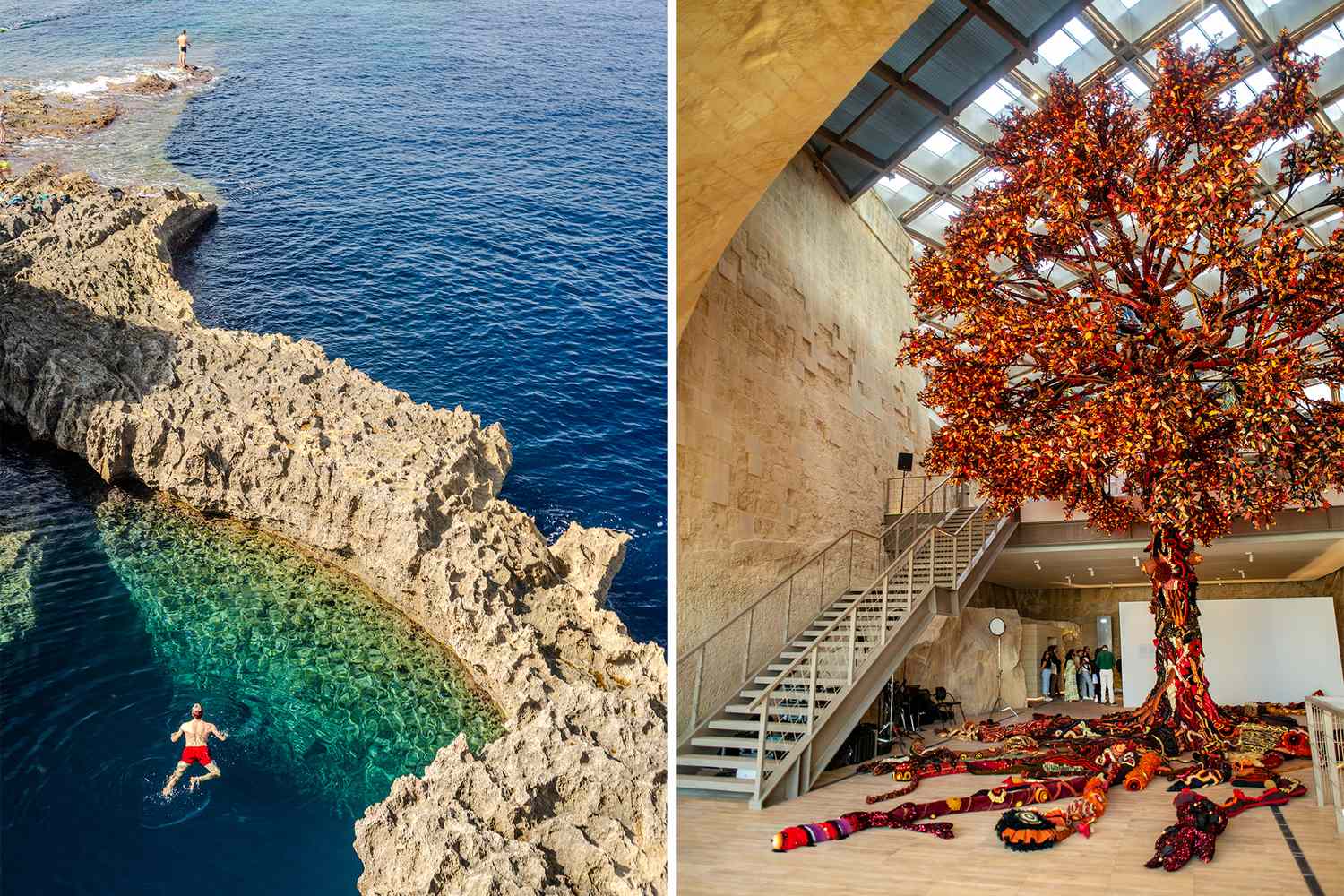
By the time the Uber dropped me off at the limestone plaza, more than 500 artists, collectors, ambassadors, and dignitaries had taken their seats, looking sharp in black tie and sparkly dresses. A ring-shaped sculpture, crafted from wheel rims and crystal whiskey glasses, shone bright like a diamond under the pink evening sky.
After a speech by Malta’s youthful prime minister, Robert Abela, fireworks lit up the ancient harbor to mark the grand opening of the Malta International Contemporary Art Space, or MICAS. The glass-and-steel museum is not merely a showcase for contemporary art. It seeks to burnish this small nation’s place in the art world, in the same way that the Guggenheim transformed the industrial Spanish city of Bilbao into a mandatory stop on the art circuit.
“Malta will become a part of the global contemporary art scene,” said Francis Sultana, a noted interior designer from London, before he led a VIP tour of the museum. Raised in Malta, Sultana is also the country’s ambassador of culture and keeps an art-filled palazzo in town.
From left: A terrace at Iniala Harbour House hotel; the artist Joana Vasconcelos at MICAS.
Denny Lee/Travel + Leisure
Last year, the country also hosted the first Malta Biennale, joining a collection of Mediterranean contemporary art hubs that includes the Greek island of Hydra and Ibiza and Menorca, in Spain.
Floating between Sicily and North Africa, this archipelago nation—about twice the size of Brooklyn—is known for its 300 days of sunshine, crystal-blue waters, megalithic temples, and handsome limestone architecture. It also has a rich and layered culture, having been occupied by a revolving door of foreign rulers, most recently the British, before gaining its independence in 1964.
From left: Maltese balconies in the old city of Valletta; flyers at the store Il-Lokal.
Denny Lee/Travel + Leisure
Since the pandemic, Malta has seen a surge in tourism, especially from Italy and France. The once-quiet alleyways of Valletta, its UNESCO-protected capital, now echo with the din of late-night cafés and bars. Cruise-ship traffic has spiked, as have low-cost carriers to the European Union’s smallest member state. Built with government backing, MICAS is part of a bid to attract more cultured and affluent travelers.
I arrived a couple of days before the museum’s opening last October, and checked in to the Phoenicia Malta, a 77-year-old grande dame that once hosted Queen Elizabeth II. After a bite on its terrace, I explored the city’s galleries—all a short walk away, just past the angular City Gate designed by Renzo Piano a decade ago.
City Gate, designed by Renzo Piano.
Denny Lee/Travel + Leisure
A good place to start was Il-Lokal, a gift shop and gallery that serves as a kind of community hub. Flyers for art shows were tacked onto a bulletin board, under a purple neon sign that read supporting locals. The store had an art-school vibe, partly because its staff tends to be ltade up of students.
Nearby was MużA, a well-edited museum in a centuries-old stone building that shows a wide range of works spanning the 15th to 21st centuries. “Topia,” an installation by the London-based artist Barnaby Barford, had opened the previous day and consisted of 1,000 brick-size miniatures of Maltese storefronts, painted on bone china and stacked atop a rock wall.
Next door was Spazju Kreattiv (Maltese for “creative space”), housed in a 16th-century fort that was converted 25 years ago into an art-house cinema, a theater, and galleries. There was a retrospective on Alfred Chircop, a local abstract painter who died in 2015. I’d never heard of him, so I Googled his name. It was clear from the copious reviews over the decades that Malta holds its artists in high regard.
From left: A dog keeping watch in Valletta; Valletta Contemporary gallery.
Denny Lee/Travel + Leisure
Malta’s support for artists, it turns out, goes pretty far back. The following morning, I stood in line to catch a glimpse of Caravaggio’s Beheading of St. John the Baptist at St. John’s Co-Cathedral, one of the island’s two cathedrals. The painting was completed in 1608, during Caravaggio’s brief and troubled stay on the island (the artist got into a brawl with the Knights of Malta and was expelled, but not before he’d completed his commission for St. John’s, where the masterpiece still hangs).
After the cathedral, I continued my gallery crawl. Although Valletta was built on a grid, I found myself getting lost on its steep, stone-paved roads. With the exception of Republic Street, the commercial corridor, the roads were mostly lined with mom-and-pops, small restaurants, grocers, and other stores with hand-painted signs. I was struck by the closed wooden balconies that protruded from façades across the island. Painted in copper green, navy, or fire-engine red, these gallariji (better known as Maltese balconies) offered flashes of color in a sea of honey hued limestone.
The pool at the Phoenicia Malta hotel, in Valletta.
Denny Lee/Travel + Leisure
After popping into several other art spaces, including a scrappy experimental art gallery inside the Malta Postal Museum & Arts Hub (sadly, a show had just closed when I visited), I made my way to Valletta Contemporary, perhaps the most prestigious of Malta’s independent galleries. Set in a 400-year-old warehouse with sleek concrete floors and a minimalist design, the gallery would not look out of place in Berlin or New York City, especially with its roster of blue-chip artists on display: Georg Baselitz, Joseph Beuys, Ai Weiwei, and Tracey Emin.
Cannons at the Saluting Battery, a historic military site in Valletta.
Denny Lee/Travel + Leisure
Upper Barrakka Gardens, a scenic overlook in Valletta.
Denny Lee/Travel + Leisure
For lunch, I went to the Iniala Harbour House, a 23-room designer hotel filled with moody, abstract artworks curated by Maria Galea, an influential local figure who runs a gallery in the nearby town of Sliema. I took an elevator to its rooftop restaurant, ION Harbour by Simon Rogan, which was recently awarded two Michelin stars—a first for Malta. The eight-course farm-to-table menu included truffle pudding, stuffed rabbit, and a bee-pollen cake so pretty I could barely bring myself to eat it. The restaurant also had beautiful views of the Three Cities of Malta, a trio of fortified villages across the harbor.
That inspired me to walk off lunch by taking a circuitous stroll down to the docks in search of a water taxi. A gondola-like vessel with a yellow canopy pulled up, and I climbed onboard with two other passengers. As we skittered across the teal-blue waters and the monumental forts of the Three Cities came into view, I thought about how Malta still looked like an island of riches, safeguarding its treasures behind those golden walls. I would have gotten out to explore, but the line to reboard was long, so the three of us stayed put and rode back.
A gondola-like water taxi traveling between Valletta and the Three Cities of Malta.
Denny Lee/Travel + Leisure
These days, it is the art-world elite who seem to be the new gatekeepers of wealth. After the fireworks cleared at MICAS, the champagne flowed, hors d’oeuvres were passed, and Joana Vasconcelos—the Portuguese artist whose playful, large-scale works were the subject of the museum’s inaugural exhibition—held court in a bejeweled purple gown. Her entourage, which included several assistants and a meditation coach, followed closely behind her.
In many ways, Vasconcelos was the perfect artist to christen the museum. She is respected by the art establishment. Her work is intellectually probing, while also a crowd-pleaser (she encourages the public to touch her colorful, joy-filled pieces). And she is on a mission to make art accessible—just as Malta is trying to do.
A version of this story first appeared in the October 2025 issue of Travel + Leisure under the headline “Taking Root.”