 (EvgeniyShkolenko/Getty Images)
About this research
This Pew Research Center report examines the U.S. public’s views on whether God influences presidential elections, whether Christians think it is essential to support or oppose President Donald Trump, and how much religion influences the way people vote.
Why did we do this?
The Center conducts high-quality research to inform the public, journalists and leaders. Studying the public’s views about religion’s role in public life is a key part of the Center’s long-standing research agenda.
Learn more about Pew Research Center.
How did we do this?
This report includes findings from a survey of 8,937 U.S. adults who are part of the Center’s American Trends Panel (ATP). The survey was conducted from May 5 to 11, 2025. The survey’s overall margin of error is plus or minus 1.4 percentage points.
Here are the questions used for this report, the topline and the survey methodology.
What role do Americans think God played in the last two presidential elections? In a May 2025 survey, most U.S. adults say God played no role at all, while about a third say recent election results are part of God’s overall plan but don’t necessarily mean God approved of the winner’s policies. Very few say God chose the winners because of their policies.
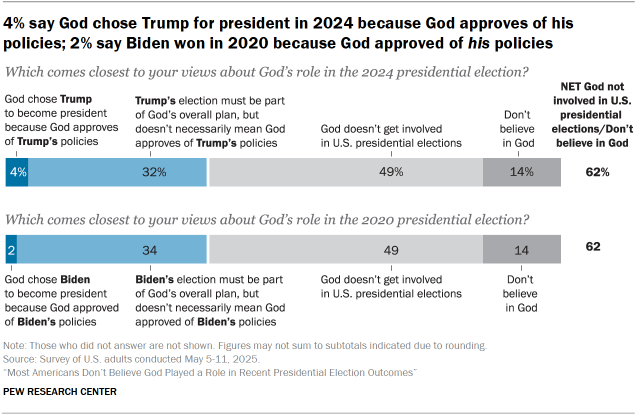
For example, when asked what role they think God played in the 2024 presidential election, more than six-in-ten U.S. adults surveyed say either that God doesn’t get involved in presidential elections (49%) or that they don’t believe in God (14%). Roughly one-third say President Donald Trump’s victory must have been part of God’s plan, but that this doesn’t necessarily mean God approves of Trump’s policies. Just 4% say God chose Trump to become president in 2024 because God approves of his policies.
The same survey asked Americans what role God played in the 2020 election, and the results are strikingly similar. Overall, 62% say either that God doesn’t get involved in presidential elections or that they don’t believe in God. Roughly one-third say Biden’s 2020 victory must have been part of God’s plan but didn’t imply that God endorsed Biden’s policies. And 2% say God chose Biden to become president because God approved of his policies.
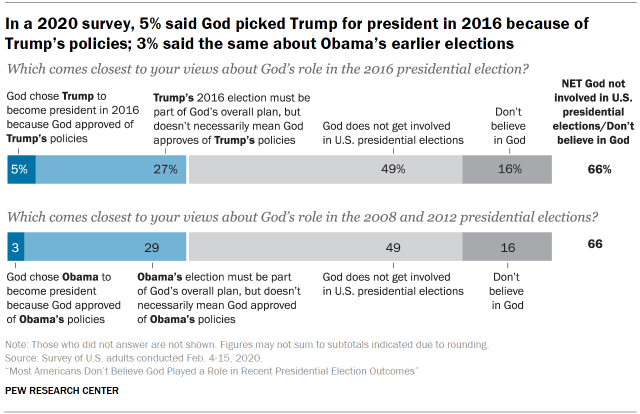
Americans’ views about God’s role in these recent elections are similar to what we found in a February 2020 poll, when we asked Americans to look back on Trump’s 2016 election and Obama’s 2008 and 2012 victories.
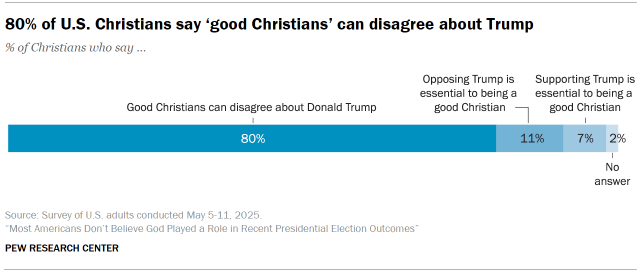
Another question in the survey, given only to Christian respondents, asked if it is essential for “a good Christian” to support Trump, essential for “a good Christian” to oppose Trump, or if “good Christians can disagree about Donald Trump.”
Overall, there’s consensus among most American Christians that “good Christians” do not need to take a particular view on Trump:
80% of U.S. Christians say good Christians can disagree about Donald Trump.
11% say opposing Trump is essential to being a good Christian.
7% say supporting Trump is essential to being a good Christian.
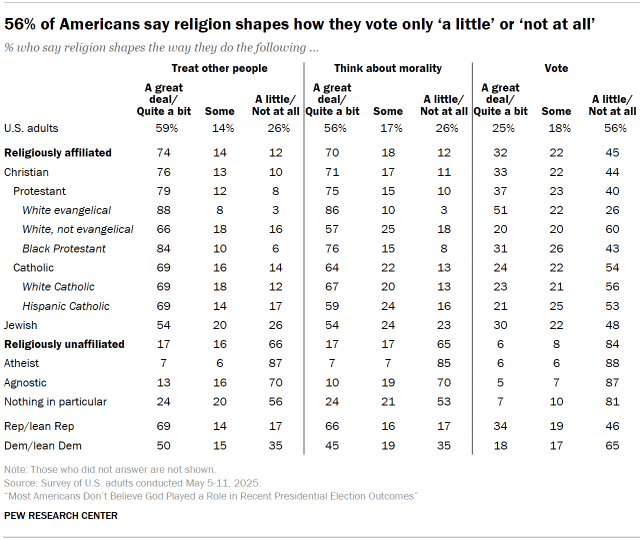
The survey also explored the link between religion and politics in another way: It asked Americans how important religion is in shaping their votes. The findings show that a majority of Americans say religion plays a relatively small role or none at all in their vote:
56% say religion shapes how they vote a little or not at all.
18% say religion shapes how they vote some.
25% of U.S. adults say religion shapes how they vote a great deal or quite a bit.
Compared with how religion shapes their vote, Americans are more than twice as likely to say religion has a great deal or quite a bit of impact on the way they treat other people (59%) and how they think about morality (56%).
These are among the key findings about religion and politics from a Pew Research Center survey conducted May 5-11, 2025, among a nationally representative sample of 8,937 U.S. adults. They were asked these questions as part of the Center’s long-running effort to gauge the public’s views on how religion intersects with public life, including U.S. elections.
Read on to learn more about:
How Americans view God’s role in recent presidential elections
Relatively few Americans in either political party think God chose their party’s candidate to become president in 2020 or 2024 specifically because God approved of the candidate’s policies. Just 8% of Republicans and Republican-leaning independents say God chose Trump in 2024 because God approved of Trump’s policies, and just 3% of Democrats and Democratic-leaning independents say this of Biden’s victory in 2020.
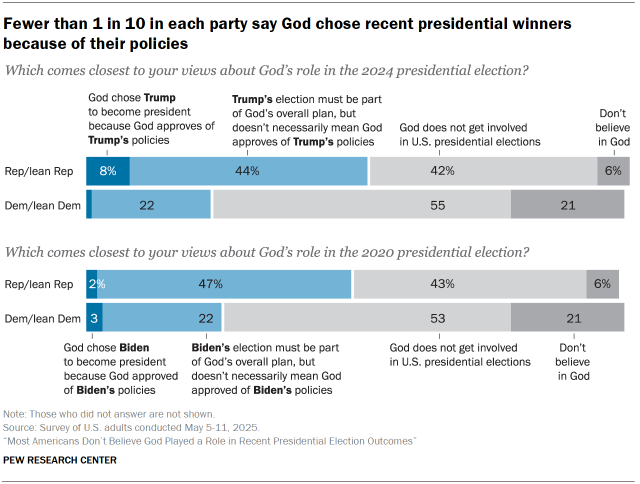
Republicans are more likely than Democrats to say that recent election results must be part of God’s overall plan even if God didn’t necessarily approve of the winner’s policies. For instance, 44% of Republicans say Trump’s election was part of God’s overall plan even though the results don’t necessarily mean God approved of Trump’s policies. Just 22% of Democrats agree that Trump’s election was part of God’s plan.
By contrast, Democrats are more likely than Republicans to say that God does not get involved in elections or to say they don’t believe in God.
Views among White evangelical Protestants
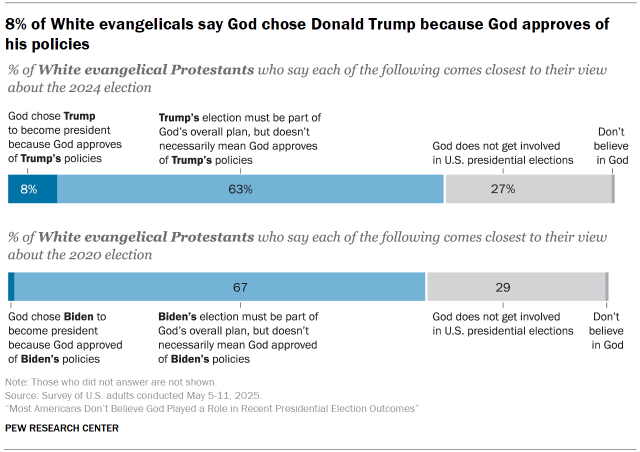
When it comes to religious groups, most White evangelical Protestants tie Trump’s election to God in some way. But relatively few (8%) say that God chose Trump because God approves of his policies. Instead, most (63%) take the view that Trump’s election must be part of God’s overall plan, but that this doesn’t necessarily mean God endorses his policies.
Most White evangelicals also tie Biden’s 2020 victory to God in some way, though just 1% of them say God chose Biden to become president in 2020 because God approved of his policies. Instead, most White evangelicals (67%) say Biden’s election must have been part of God’s overall plan but that this didn’t necessarily mean God approved of Biden’s policies.
Views among Black Protestants
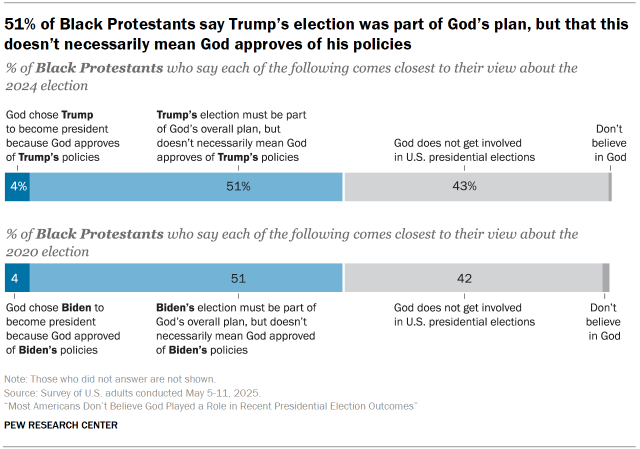
Around half of Black Protestants also tie Trump’s election to God in some way, either by saying that God chose Trump because of his policies (4%) or that the election results must have otherwise been part of God’s overall plan (51%). Roughly four-in-ten Black Protestants say God doesn’t get involved in elections.
Views among Catholics and White nonevangelical Protestants
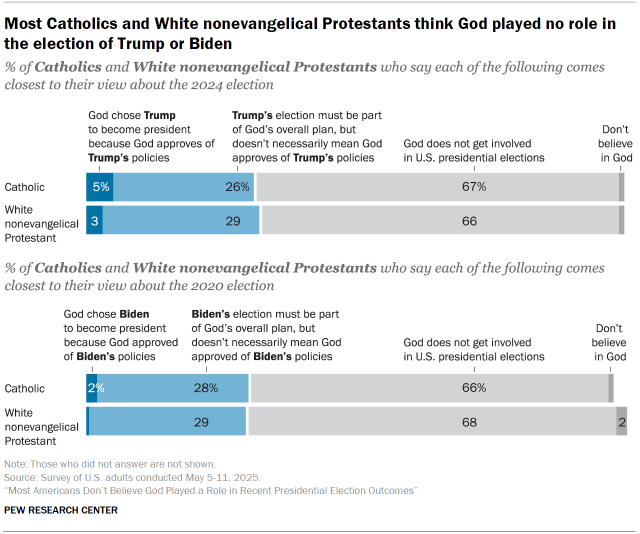
Most Catholics and White nonevangelical Protestants take the position that God played no role in Trump’s or Biden’s elections. For example, among Catholics:
67% say God does not get involved in presidential elections.
26% believe that Trump’s election must be part of God’s plan.
5% say God chose Trump because God approves of his policies.
Majorities of both White and Hispanic Catholics say God does not get involved in U.S. presidential elections.
Views among religiously unaffiliated adults
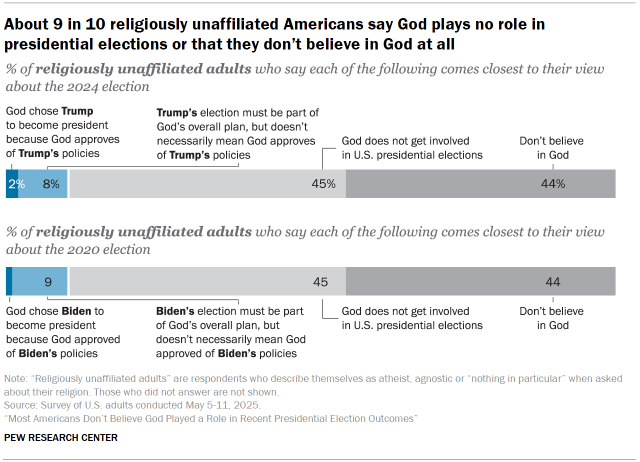
The vast majority of religiously unaffiliated Americans – a group made up of atheists, agnostics and people who say their religion is “nothing in particular” – say that God does not get involved in elections (45%) or that they don’t believe in God (44%).
What Christians say about supporting or opposing Trump
The new survey posed a question specifically to Christians about how “good Christians” should think about Trump today. We found:
80% of U.S. Christians say good Christians can disagree about Donald Trump.
11% say opposing Trump is essential to being a good Christian.
7% say supporting Trump is essential to being a good Christian.
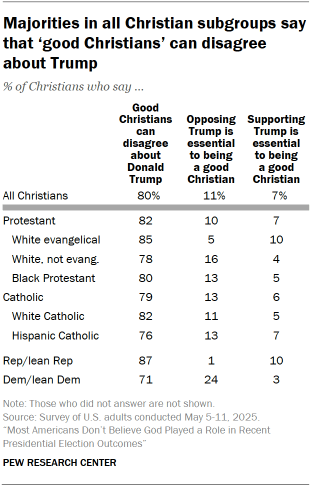
Large majorities of Christians across various religious traditions and political party lines say that good Christians can disagree about Donald Trump, ranging from 76% of Hispanic Catholics to 85% among White evangelicals.
Slightly more White evangelicals say supporting Trump is essential to being a good Christian than say opposing Trump is essential (10% vs. 5%). Within every other large Christian tradition, this balance of opinion is reversed.
Most Christians in both political parties feel that good Christians can disagree about Trump: 87% of Republican and Republican-leaning Christians say this, as do 71% of Christians who are Democrats or lean toward the Democratic Party.
Democratic Christians are more likely to say opposing Trump is essential to being a good Christian than Republican Christians are to say supporting Trump is essential (24% vs. 10%).
How Americans say religion affects their voting decisions
The survey also asked respondents how much religion shapes the way they vote, treat other people and think about morality. Americans are generally far less likely to say religion shapes their vote than to say it shapes their morality and treatment of others.
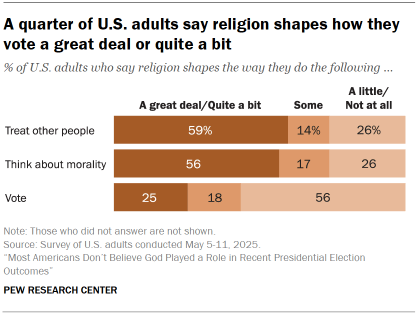
White evangelical Protestants and Republicans are especially likely to say religion shapes how they vote. For example, 51% of White evangelicals say religion shapes how they vote a great deal or quite a bit, making them the only large religious group in which at least half say religion shapes their vote quite a bit or a great deal. Meanwhile, Republicans are roughly twice as likely as Democrats to say religion shapes how they vote (34% vs. 18%).
White evangelicals and Republicans also stand out for the large shares who say religion shapes how they treat other people and think about morality. For example, 88% of White evangelicals say religion shapes how they treat others a great deal or quite a bit, and 86% say the same about religion shaping their morality – among the highest percentages of any religious group analyzed.