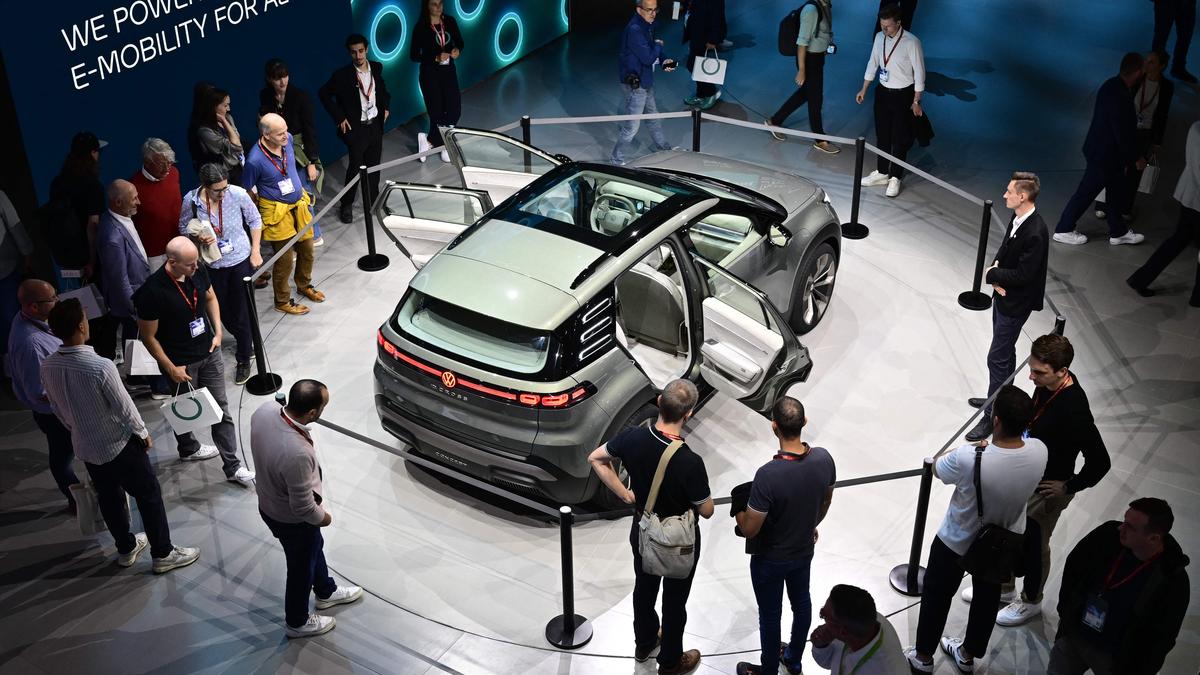
Volkswagen has vowed to defend its lead in Europe “by all means”, including a revamped vehicle and software strategy, as German carmakers make a renewed push against Chinese competition in the region’s electric vehicle market.
A year after VW presented plans to drastically cut headcount and capacity at its German plants, its executives at this week’s Munich motor show said the group was ready to fight back against Chinese rivals.
“We are dominant in Europe and will defend it by all means,” VW brand chief executive Thomas Schäfer told the Financial Times, as the group battled sliding market share in China and the rise of BYD and other EV rivals. The new range was “very competitive” and Chinese manufacturers would face bigger challenges breaking into the European market, he added.
German carmakers’ latest comeback signals a further intensification of competition in Europe’s battery vehicle market, where Chinese groups have rapidly expanded their presence.
The market share of Chinese brands reached a record 5.7 per cent in the UK and European car markets during the second quarter, rising to 10.7 per cent in the EV market, according to Schmidt Automotive Research.
Also read:Chinese car makers on the march in Luxembourg
VW, with its new models, a stronger cost base and its software partnerships with Rivian in the US and Xpeng in China, believes it has the armoury to fight back.
Europe’s largest carmaker is by far the dominant player in the region’s EV market, with a 30 per cent share in August. This was up from 23 per cent a year before, while market shares for Mercedes-Benz, BMW and Tesla have all declined, according to Jefferies. BYD, meanwhile, grabbed a 3.8 per cent share in the European EV market, up from 2.5 per cent.
“We are convinced that we will be the automotive global tech driver in the future,” said Oliver Blume, Volkswagen group chief executive.
At Munich the Wolfsburg-based group presented a quartet of entry-level EVs, which will go on sale next year starting at €25,000: a new Škoda, Cupra and two new Volkswagen models. This includes the new ID. Polo, combining old and new VW brands – the Polo and ID.2.
BMW also released new battery vehicles, with the group’s SUV iX3 the first to be built on the company’s Neue Klasse platform, marking the start of a completely revamped product line with more powerful computing.
Mercedes-Benz promised a significant software upgrade and expanded battery range, with a refreshed product line-up.
The Germans, however, have not been alone in expressing their confidence this week.
BYD said that its western rivals had yet to catch up with its EV technologies.
Also read:Europe car sales gain most in 15 months as consumers warm to EVs
“I think we still have a lot of space to do more even if we have some brands catching up,” said Stella Li, BYD’s executive vice-president.
The Chinese group plans to bring its ultrafast charging technology to European models from next year and begin producing all of its EVs in Europe within the next three years.
“This is a huge game changer,” said Li, referring to its new battery charging system able to add a range of about 470km in five minutes.
State-backed Changan aims to gain a foothold in Europe by debuting its electric Deepal S07 SUV at £39,990 in the UK this month. The Chinese group plans to open a factory in Europe within the next few years and will aim to become a top-10 player in the UK.
Thomas Schemera, global chief operating officer of GAC International, said the state-owned carmaker plans to produce in Europe “as soon as possible” in response to higher tariffs the EU has imposed on China-made EVs.
As more and more Chinese brands enter the continent, analysts say one challenge for companies is to differentiate their brands in the minds of European consumers.
Leapmotor, which has leveraged its capital tie-up with Stellantis to expand its dealer network, says its affordable pricing – its electric B10 compact SUV starts at €29,900 – is a differentiating factor.
“We are almost very close” to price parity between petrol and battery-powered vehicles, said Tianshu Xin, who heads the joint venture between the Chinese EV start-up and Stellantis.
“That’s one of the key elements to [offer] customers the opportunity to try those technologies,” he added.
Changan, however, says it does not want to be drawn into a price war in Europe.
Also read:Tesla sales keep slumping in Europe with BYD gaining ground
“That’s not our route to market,” Nic Thomas, Changan’s managing director in the UK, said. “If we want to look for price war, we need to look at European brands right now . . . and there is very deep discounting.”
European car executives say it will be difficult for Chinese brands to build cars in Europe at competitive prices as in their home market due to the higher labour and energy costs.
But Li at BYD, which will open plants in Hungary and Turkey, said the company learned from building cars in Thailand and will leverage its cost-effective manufacturing technology.
“We got a good sense of how we can maintain the manufacturing cost,” she added.