
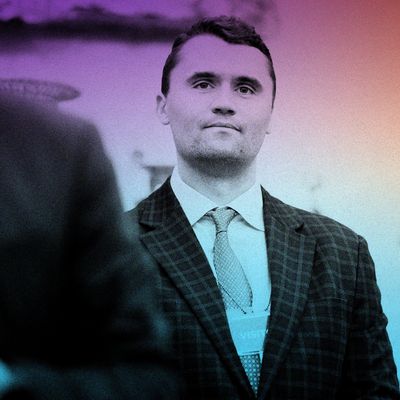
Photo-Illustration: Intelligencer; Photo: Getty Images
Charlie Kirk amassed a tremendous amount of power and influence before his murder on Wednesday. But to those not well-versed in right-wing politics, it may be difficult to discern the role he played in the conservative universe, and what made him uniquely positioned to advance the divisive, often incendiary causes he believed in. To further understand how Kirk became such a potent force in only a few years, I spoke with Kyle Spencer, who wrote the 2022 book Raising Them Right. In it, Spencer chronicles the rise of Kirk and Turning Point USA, the conservative youth organization he built into a culture-war powerhouse.
It strikes me that Charlie Kirk was representative of our fragmented culture, in that he probably had close to 100 percent name recognition for people under 25, but much less so for people over 40 or 50. For those who weren’t very familiar with him, how would you sum up what made him stand out in a sea of right-wing commentators?
I spent a lot of time with him and with people in his movement, watching what he was creating. Charlie Kirk had multiple political gifts that were quite extraordinary. He was a very charismatic spokesperson for this new, modern GOP. He understood that his role was to brand this shifting party. He had a vision, early on, about what that shift should be, and he was very prescient.
In 2012, after the Republican Party did its famous autopsy and decided it needed to become more diverse, it seemed like an impossibility. Charlie Kirk arrived on the scene as a kid who just graduated from high school in 2012, saying, “I have a vision. It is possible. This party is stodgy. It’s outdated, it’s old white men. We need to attract young people, Black people, Latinos. We need to be inclusive. We need to be exciting. We need to be energetic. We need to be cool. We need to be stylish. We need to be welcoming.” That was what he sold. And he was able to sell that even though there were many, many donors he approached who didn’t think what he wanted to do was possible. He managed to convince them that if they gave him some funding, he could get the ball rolling.
What I always found so interesting, when I was first getting to know him and the movement he was building, was how much he was like Trump. That was the reason Trump had such a fondness for him, which he really did — as much as Trump can be fond of anyone, he was fond of Charlie Kirk because they were so similar. Trump understood that it was all about branding, that you needed to constantly be pushing the boundaries and looking for new ways in which people were receiving news and communicating and getting information. And Trump knew that you needed to respond to how people felt with a better feeling, with a feeling they were more comfortable having.
And that’s what Charlie Kirk understood. He understood that what a lot of young, particularly young white men — although not exclusively — on college campuses were feeling was isolation. If they didn’t hook into what Charlie thought of as overly woke college culture, they felt alienated. He said, “I see you. I hear you, and I can relate. Here’s the antidote: join our community. Come and be a part of this exciting new venture where you get to be a top dog.”
It’s the pitch of any populist, right? Telling disaffected people they’ve been displaced, and that if they join up, they can regain lost stature.
Yeah. When I was roaming around these college campuses writing my book, I kept hearing from everybody, including the mainstream media, that all these campuses had become so woke and that all these intolerant lefties were running around silencing people. And I wasn’t seeing that at all. Particularly at big state campuses in swing states or red states, I was seeing a lot of activity on the right.
I was seeing that young Democrats — they threw you a flyer and they were recalcitrant and not interested and feeling bitter that they weren’t getting more resources from the higher ups. Then you had the young progressives who didn’t even like the young Democrats. And then you’d go, “Where’s that music coming from? It’s coming from that table over there that’s crowded with all these young people, and they’re handing out sodas, and they’re handing out candy, and they’ve got a game going on, and they’re talking about a pizza party, and we can all go to the gun range tomorrow.” And there was more swag than you can even think of. That was what I was seeing. And that was him.
What made him so effective at resonating with people on a personal level?
The reason he was able to connect with the kind of alienation that people felt, I believe, was that he grew up in the suburbs in the 2000s when the suburbs in the United States were really changing. They were going from mostly white to mostly Black and brown. And he was in a suburb that was doing that, and he was in a high school that had been a majority white high school that, while he was there, turned into a majority Latino high school. And while he has never said that that really impacted him, it’s hard for me to imagine that it wasn’t a driving force.
I don’t want to speak ill of somebody who’s now dead, but he wasn’t particularly liked in high school. The high school was very progressive. It had a lot of Obama fans; he really disliked Obama, so he felt very alienated and disconnected. He was the goofy conservative in the class that would raise his hand and say these things that everyone would just kind of go, “Oh, whatever. That’s Charlie.”
It’s kind of a Cinderella story. He morphed into this suddenly highfalutin guy who was getting lots of money from rich people, hanging out in people’s compounds in Palm Beach, flying on Trump’s plane, meeting Kanye West. In much the way Trump did, he had some ability to understand how young people felt like outsiders. And then he was a model of how you could become an “it” guy.
You said earlier that he was interested in being inclusive, but he was well-known for playing up anti-white discrimination and making offensive remarks about minorities in general. So how did that work?
First of all, that is also the story of Trump, which has been so confusing for people. They don’t understand how Trump could increase his Black and Latino vote share, as he has done. There’s a lot of parallels there. Both Trump and Charlie understand about micro-targeting, and that you need to speak to specific audiences in specific ways. He was able to appeal to young men who had feelings around being displaced by women, or were feeling disenfranchised, lonely, isolated. He was able to connect with them whether they were white, Black, Latino, Asian-American.
Once he got going, he built Turning Point USA TV, which was a kind of social media empire. I watched them develop these stars. What they did very early on was decide, “Okay, we need a white guy who’s into sports to talk to white guys who are into sports. We need a Black guy who’s a veteran who can talk to guys of color. We need a young, fashionable woman to talk to young, suburban girls.” That’s one thing I think explains why he was able to make everybody feel like they had a place in the structure of Turning Point USA. And personally, he connected with people in a very real way, so when he was in person with people or on stage, people just felt like he was connecting with their pain and whatever it was that they were feeling.
For a guy that was so despised by so many people and had ideas that many people considered very hateful and divisive, he had this uncanny ability to keep people very close to him for long durations — the folks that I was talking to years ago who were working with him are still working with him. He has lost almost no one. The donors have been loyal to him. Trump, who seems to have fallings out with people all the time, has not had a falling out with Charlie. What he was able to do was understand that his power would grow if other people’s power grew around him. He basically discovered Candace Owens, and in some way that I don’t even totally understand, he didn’t feel threatened by her.
Where does his death leave Turning Point USA? Can it sustain itself without him?
He was always the face of the organization, the fundraiser, and a strategist. But he was not behind the scenes doing all the work. There’s a huge operation: Turning Point USA, Turning Point Action, Turning Point Faith. They corral millions and millions of dollars a year. He has a very large staff, a staff that’s been with him for many years. There are a lot of different micromanaging issues with the organization, but as a whole, it has been very well-run. So the organization, the events, the social media stars that their organization supports — that will all stay, because that really wasn’t what he did. He had such a strong vision for the new GOP, and the new, modern, ultra-conservative movement has his hand prints all over it, and that’s not going away. So in some ways, he did his work. He envisioned something, he helped bring it to life, and unfortunately for many people, it’s going strong.
He was 31 when he died and I imagine wasn’t going to be touring college campuses forever. Do you think he had aspirations to politics himself? You had Trump reportedly saying he could have been president someday.
I wrote in my book that I thought that he was a potential future president, that that was a role he wanted. I don’t think he was entirely clear what he wanted to do. But he was one of the most ambitious — maybe the most ambitious — person I’ve ever interviewed. Really, the guy’s drive was extraordinary,
Kirk was close friends with Donald Trump Jr. and J.D. Vance, and had a very good relationship with the president. What was the political dynamic like there? Was it that Kirk would speak and Trump listened, or more the other direction, where Kirk would fall in line with what the president wanted and be helpful that way? For instance, he gave Trump political cover on the Epstein files.
When Charlie originally came out of the gate, these older donors who bonded with him and who introduced him to more powerful people. saw him as something like a loyal dog — this sheepish kid who was kind and adorable and really wanted to please them. Those donors would just love him. They’d have him come and stay in their guest house for days. They’d go hunting with him. They wanted to hang out with him because they thought that he was so exhilarating to be around. Early on, I think there was this idea that this guy was this boy wonder, that he was envisioning something that they couldn’t quite see, and explaining it in an exciting way. So it was something like, “I need your money, but I have something you want, which is this vision that I can realize.” That was the power structure. They gave him tons of money, and he gave them his loyalty.
A lot of the donors that he worked with were extremely religious Christian nationalists with very, very conservative views. He was always a religious guy, and had begun to attend evangelical churches very early in high school. But once he began to bond with these pastors and donors who were really religious, what did he do for them? He adopted all of those ideas and started selling all those ideas. So it was an exchange. It was a transaction. But Charlie believed what he sold. He always convinced himself of what he sold. I don’t believe Charlie ever said things he didn’t believe. If he changed his mind, it was because he changed his mind.
“Convinced himself” is important there.
Yes, exactly. He always seemed to have the views of the people who were giving him money or power. But I think the really important thing is — I don’t want to call him a team player because I feel his team was so atrocious, but…
He was a systems guy.
He was a systems guy, and he just was so gifted at gravitating toward power and being really comfortable at a very early age with extremely wealthy, extremely powerful people.
Ezra Klein wrote a column in the New York Times yesterday that’s been getting a lot of backlash. He painted a picture of Kirk as someone who may have espoused unpleasant views, but who was open to real debate and to the art of persuasion. He went into hostile territory, this telling goes, and won over people with his ideas.
But as well as his long history of hateful remarks, Kirk was a vigorous election denier who called for a “patriot” to bail out the man who attacked Nancy Pelosi’s husband. Is it really fair to characterize him as a good-faith debater playing by the rules of democracy?
I think it depends on what your definition is of a debater. If your definition of a debater is somebody who is 10-plus years older than the people he is debating, spends hours and hours a day coming up with arguments for his belief system, who goes to communities of much younger people, finds topics in which he is a great expert and a great debater on, brings them into the fold to discuss these topics, then uses what they say on videos that his organization edits, and puts them online to mock his opponents and the views of his opponents, then he’s a good debater. Are the people who stand up and raise their hand to talk to Charlie Kirk and have a, quote, unquote, “debate” with him, are they being helped by Charlie Kirk or are they being used by Charlie Kirk?
I spent a lot of time at the Leadership Institute, which is like a right-wing leadership academy for conservatives. One of the things young conservatives are taught, and one of the things that Charlie’s young people who are part of Turning Point USA are encouraged to do is to weaponize your phone. So when there’s a crazy liberal doing something crazy, they make sure to get it on tape so it can be edited and slapped online. Turning Point USA’s social media presence for years was just filled, filled, filled with progressives acting badly. That was baked into its system of spreading its ideology. So, when you come up to have a conversation with Charlie and Charlie was sharing his talking points, his well-constructed, well-studied talking points, and you were a little hapless or not making sense or sounded not very bright — that was a very good opportunity. It was always filmed, it was grabbed, it was edited, it was thrown up online with some cheeky titles, the goal of which was to make young liberals seem like idiots.
I guess Ezra hadn’t seen those.
In the aftermath of his death, which would seem to be an act of political violence, some on the right are calling for revenge. How would you characterize Kirk’s relationship to political violence?
Charlie Kirk was extremely careful about what he said. But it was clear that many of his followers were not so careful, and had dreams of violence for the movement. One of the things I think was most telling about Charlie’s comfort with violence was his views on the Second Amendment, and his views on gun ownership, and his glorification of guns, and glorification of people who used guns. So what was Charlie projecting? He was projecting, “I’m your go-to guy and I’m letting you know I have a level of comfort with violence.” And that was a message that was not lost on his fan base.
This interview has been edited for length and clarity.
Daily news about the politics, business, and technology shaping our world.
Vox Media, LLC Terms and Privacy Notice