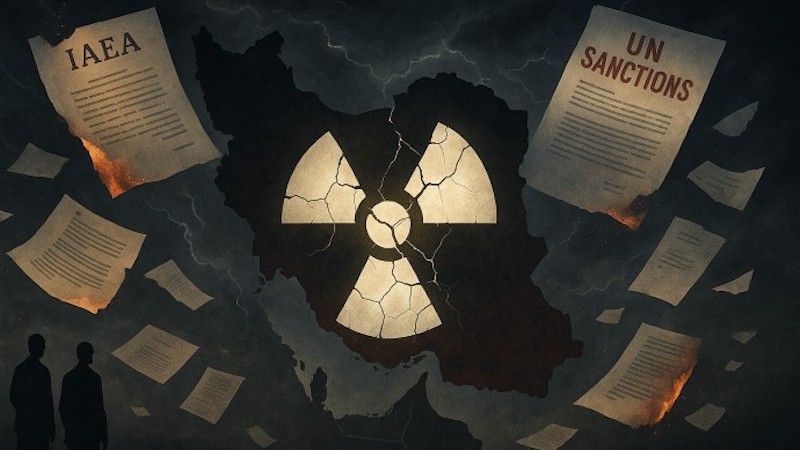
The Iranian regime’s latest diplomatic maneuver, an agreement signed in Cairo with the UN nuclear watchdog, is not a step toward international compliance but a desperate gamble that has spectacularly backfired. In a classic display of duplicity, the regime has presented one version of the deal to the world and a completely different one to its domestic audience.
This blatant double-speak has not only failed to fool the international community but has ignited a political firestorm in Tehran, exposing profound internal weakness and pushing Supreme Leader Ali Khamenei to take the drastic step of shutting down his own parliament.
A tale of two deals: the regime’s blatant deception
The chasm between the regime’s international posturing and its domestic messaging is staggering. On one hand, the International Atomic Energy Agency (IAEA) Director General, Rafael Grossi, announced a comprehensive agreement that will “allow UN inspectors to return to inspect all of Iran’s nuclear sites, including those bombed by Israel and the US in June.” He described it as a path to resume cooperation and restore essential safeguards.
However, mere moments after signing the document, Iran’s Foreign Minister, Abbas Araghchi, appeared on state television to completely deny this. “Under this agreement with the agency, no access is given to inspectors,” he declared, claiming that the nature of any future access would be determined in subsequent negotiations. Araghchi insisted that the regime’s parliamentary law, which severely restricts cooperation, remains the primary framework. This is not a misunderstanding; it is a calculated strategy of deception designed to buy time and sow confusion.
Europe is not deceived by the ploy
The international community, particularly the three European powers (E3), sees through this charade. France, Germany, and the UK have made it clear that they will only halt the “snapback” process to restore UN sanctions if the regime immediately allows inspections to resume, provides a full accounting of its enriched uranium stockpile, and enters nuclear talks with the United States.
“It is not enough for Iran to make promises for tomorrow, we need to see evidence from Iran today that demonstrates it is ready for a diplomatic solution that addresses the international community’s concerns,” the European troika declared in a statement
The Cairo deal, lacking any firm commitments or deadlines, fails to meet these demands. Even the regime’s own state-run media, such as the Entekhab website, acknowledged this fatal flaw, noting that there is “no timeline for providing special reports on Natanz, Fordo, Isfahan, and the nuclear stockpiles.” The regime’s attempt to project cooperation has been exposed as an empty gesture.
A crisis at the top
The most telling sign of the regime’s desperation is the chaos erupting within its own ranks. The contradictory deal has unleashed what sources describe as immense “turmoil and infighting” in Tehran. The political fallout has become so severe that the regime has been forced to shut down the parliament for an 18-day recess to prevent the crisis from boiling over in public.
This extraordinary move, which came at a critical juncture, was condemned even by a state-run media outlet. On September 9, Asianews described the decision as more than a tactical mistake, calling it a “‘strategic failure’ in governance” during “one of the most sensitive periods in Iran’s contemporary history.” This is not the action of a confident leader in control; it is the panicked reaction of a dictator struggling to contain the fractures within his crumbling regime.
The Cairo episode has proven, once again, that the clerical regime is incapable of genuine diplomacy or reform. Trapped by international pressure and paralyzed by internal conflict, its only resort is deception, a threadbare tactic that has never resulted in resolving the nuclear issue.