
When Janmashtami celebrations marking the birth of Lord Krishna were on in full swing this year, 58-year-old Govindbhai Dhabi from Ratanpar area of Surendranagar city in Gujarat was sitting in his house, devastated. He had shut down his 30-year-long business of diamond cutting and polishing because there were no more orders. “I cried a lot that day. I had 30 labourers and 6 machines. But as there was no work, I closed my business,” said Dhabi, sitting in his friend Dhirubhai Prajapati’s unit in the Ratanpur area. “Dhirubhai has given me a job as we have been friends for the past 40-plus years. Nobody apart from him, not a single government official has come to see our situation,” said Govindbhai with teary eyes. “The US tariffs snatched everything from us. We are literally finished in this business,” he added.
His friend Dhirubhai, who has more than 20 diamond cutting and polishing machines, commonly known as ghanti, now runs only 10 of them. “Business is down by at least 60 per cent. We get raw diamonds from traders in Botad or Bhavnagar cities to cut and polish. If we used to get 100 diamonds before Russia-Ukraine war, post war the number went down to 80, and after these US tariffs, it is now 40 to maximum 50,” said Dhirubhai. Just as Govindbhai had to lay off the 30 labourers when he shut his unit, Dhirubhai has been forced to reduce his workers from 40 to 20, or even 10 sometimes. “Orders are not coming to us. What work will we give them? Many of the labourers have returned to their villages, for agricultural work,” said Dhirubhai. “In 30 years of this business, I have never seen such a terrible slowdown,” he added. There are thousands of such Govindbhais and Dhirubhais across Surendranagar, Bhavnagar, Botad, and Surat districts of Gujarat, who are caught in the crosscurrents of global developments.
The diamond cutting and polishing industry in Gujarat is one of the world’s largest. There are more than 3,500 units in the State, employing more than seven lakh workers. According to the Gem and Jewellery Export Promotion Council (GJEPC), India’s export of cut and polished diamonds (CPD) to the US alone was $4.8 billion in the fiscal year 2024-2025, accounting for nearly a third of its total CPD exports of $13.2 billion. After US President Donald Trump raised import duties to 25 per cent on Indian goods, the effects started showing immediately. From August 27, Trump raised the tariff by a further 25 per cent, totalling to 50 per cent, making trade unviable.
Only big players optimistic
There are no diamond mines in India. The country imports precious stones from the international market, mainly South Africa and other African countries as well as Ukraine. According to the GJEPC, India’s import of rough diamonds was $14.26 billion in FY 2023-24, which fell sharply to $10.8 billion in FY 2024-25. This was mostly due to the Russia-Ukraine war, which hit imports of rough stones from Ukraine. If the US market remains closed to India, stone imports will decline further. As of now, the Surat Diamond Association (SDA), India’s largest body of diamond manufacturers, is hopeful that the crisis will end in the coming months. Jagdish Khunt, President of SDA told Frontline, “Diamond consumption in the US is unlikely to decline. Because, the diamond is to US citizens what gold is to Indians. So, with Christmas and New Year coming, we expect US demand to go up.”
Also Read | Rough cut
The SDA is the biggest body of traders, manufacturers, and other stakeholders of the diamond business. Khunt’s optimism is shared by many of his colleagues. SDA Vice President Jayesh M.V. Patel said that the organisation is in touch with the Central as well as the Gujarat Government and is hopeful that the issues will be resolved soon. “High tariffs will ultimately hurt buyers from the US. They will have to pay the higher price. There is no ecosystem for the manufacturing [mining and processing] of diamonds in the US. So, buyers there will hopefully force their government to reduce the rates. Till that time, we will have to wait,” said Patel.
But only big players can play the waiting game. There are various big companies based in Surat and Mumbai that are facing losses but are still managing, thanks to their deep pockets. Royal Impex is a big Surat-based brand dealing in natural diamonds. Its owner Ramesh Dakhara said that his company is using this period of uncertainty to stock up. “Right now, there is a slowdown but it is not a total washout. Demand will increase within three to four months. Also, we will have to look for new markets internationally. This crisis has given us an opportunity to expand to new markets,” he said. Another big name in the diamond trade, Jasmitbhai Vaghani, who is also SDA Joint Secretary, said he was hopeful about the market in China as well as the Gulf countries. “Like the US, China and the Gulf countries too do not have an ecosystem for cutting and polishing diamonds. These are growing markets. The SDA, with the help of the government, will try to expand its businesses in Hong Kong, China, and Dubai and some other emerging markets. It will compensate for the US losses to some extent.”

A worker at one of Surat’s oldest and largest diamond polishing units inspects the dazzle of a finished stone.
| Photo Credit:
VIJAY SONEJI
A diamond business insider informed Frontline that many big diamond traders are mulling tie-ups with companies in Thailand and Hong Kong. “The US has not put tariffs on them. So, we can send them the diamonds, and they can send them to the US. Also, we can set up offices in Thailand and Hong Kong. These options are being examined now,” a trader said on the condition of anonymity.
While the major players are strategising about new possibilities, the minor players are bleeding and laying off labourers in huge numbers. However, SDA president Khunt claimed that there have not been any major layoffs in Surat’s industry. “There are a few cases of labourers going back to their native places, mostly from other States like UP [Uttar Pradesh], Bihar, Jharkhand, and Madhya Pradesh. Also, in this industry, the labourers are not permanent. So, they keep changing units regularly,” said Khunt, adding that “if things don’t change in the next few months, then there is a possibility of laying off labourers in huge numbers.”
One lakh workers laid off
The Diamond Workers’ Union (DWU) refuted the SDA’s claims. According to the DWU, the situation is grim even in Surat City. “Do not go by what SDA is saying. It is an owners’ body,” said Bhavesh Tank, Vice President, DWU. He said: “Thousands of workers in Surat are losing jobs. Once, there used to be three shifts in some diamond companies. Now there is only one shift. Workers, mostly from other States, are going back to their homes.” DWU is a registered union with 30,000 labourers as its members across Gujarat. “Comparatively, we have a smaller body. But this is an unorganised sector when it comes to labourers. But as per State government data, more than one lakh workers have lost jobs,” said Tank.
The figure of one lakh laid-off workers is an inference based on data collected by the Gujarat government. The labourers and the small CPD units have been repeatedly seeking government aid in these tough times. On May 24, the State government decided to help fund the fees of the children of diamond workers—popularly called ratnakalaakars—who have lost jobs. It allocated Rs 13,500 per child. In the Legislative Assembly session held between September 8 and September 10, Congress MLA Jignesh Mewani asked for details of the scheme. In its reply, the State government said that a total of 70,254 applications had come from Surat, 3,926 applications from Ahmedabad, 2,306 applications from Amreli, and 13,462 from Botad. Of this, only 170 labourers from Ahmedabad have received aid under the scheme. That means: of around 86,000 applications, only 170 families had benefited until September 10. “The government should have started the scheme on a mass scale. The delay is pushing labourers to take extreme steps,” DWU president Ramesh Zilariya said. “If the labourers don’t get work after Diwali,” Zilariya fears, “the number could be much higher”.
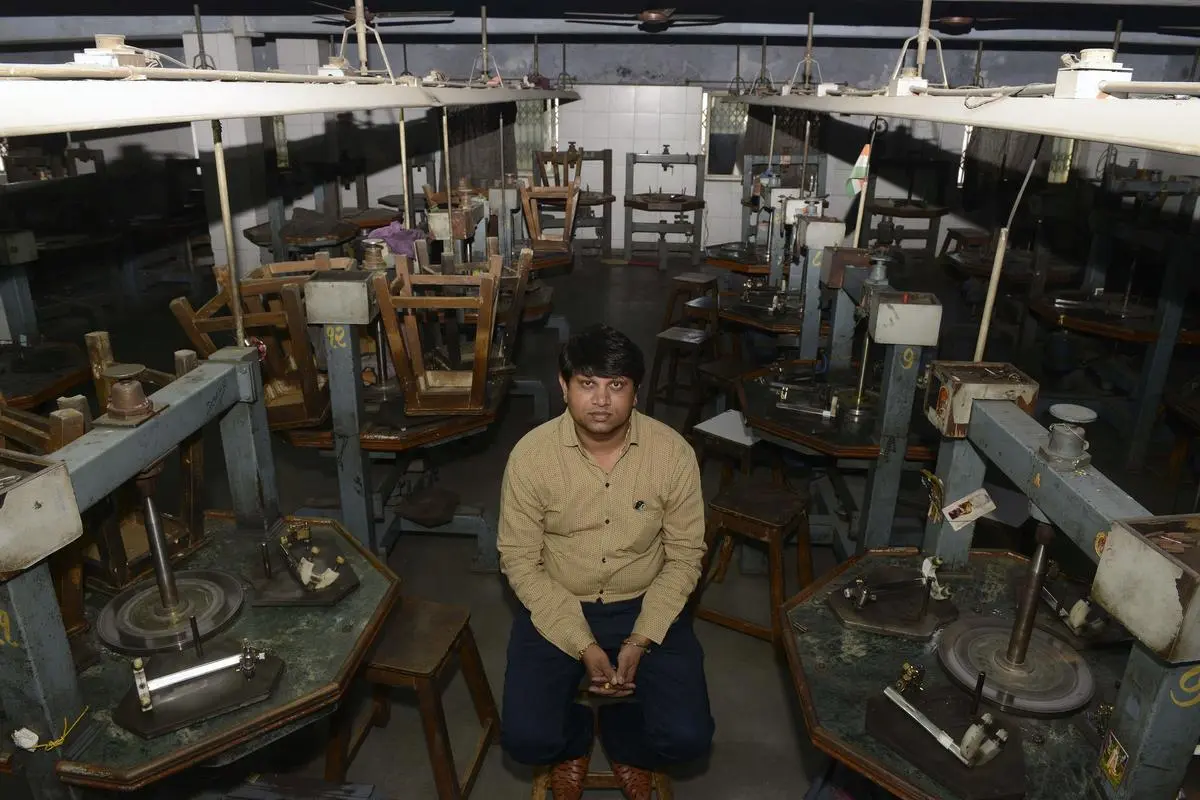
The diamond industry has been hit by the US tariffs now. Previously it faced crisis due to the Covid pandemic and before that, demonetisation. In this photo, Dharmesh Moradiya, president of the Ahmedabad Diamond Workers’ Association at a closed diamond cutting and polishing workshop in Ahmedabad on November 25, 2016. Work had not resumed after the Diwali holidays, as normal, according to the association, due to the government’s demonetisation move.
| Photo Credit:
SAM PANTHAKY/AFP
The diamond industry has traditionally been dominated by family-owned enterprises. In many parts of Gujarat, family members are joint partners in the business. From workers to owners, most are linked by family ties. This has made things more complicated. Next to the SDA office in the Varachha area of Surat, Bhavan Dabhi runs a small yet modernised diamond polishing unit. His business is down by 40 per cent. Earlier he had 45 labourers. Now he runs the unit on a single shift with 25 persons. Barring three of them, all the others are related to him. “I will have to run the business even if it makes losses because all these people shaping, polishing, and cutting diamonds in my unit are my relatives. There is huge family pressure on us,” said Bhavan.
Rahul Kumar, who works in Bhavan‘s unit, is from Jharkhand. He is not a relative, but his ties with Bhavan go back a generation. “We have a shop in Kolkata,” said Bhavan, and Rahul’s uncle is my cook there. I brought Rahul to Surat and I can’t sack him just like that.” Another young man, a 24-year-old from Giridih, Jharkhand, said, “I am expecting only two meals from Bhavanbhai. What will I do by going back to my place? This family has helped us for two generations. I know they won’t leave me hungry.” While such bonds have created a niche culture in Surat’s diamond industry, the financial stress is pushing these relationships to the verge of breaking.
Dwindling wages
The workers earn daily wages based on assigned tasks. Kumar gets Rs.400 per day whereas Govindbhai gets Rs.500 per day. Thousands of women also work in the industry, from shaping diamonds using computers to polishing it on ghanti of different sizes. Shobhana Kuria from Surendranagar has been in the industry for 20 years. These days she gets paid only Rs.300 a day. “Earlier there was more work; I used to cut 80 to 100 diamonds a day. But now we get only 30 to 40. I used to earn Rs.500-700 then. We hope the State government will compensate the ratnakalakars,” she said. The DWU too has been asking for a special monthly compensation for the workers.” At least Rs 12,000 a month should be given to each ratnakalakar in these tough times. We have written letters to the Prime Minister, Chief Minister, Industry Minister, and Labour Minister too. But nobody is talking about this demand as of now,” said Bhavesh Tank.
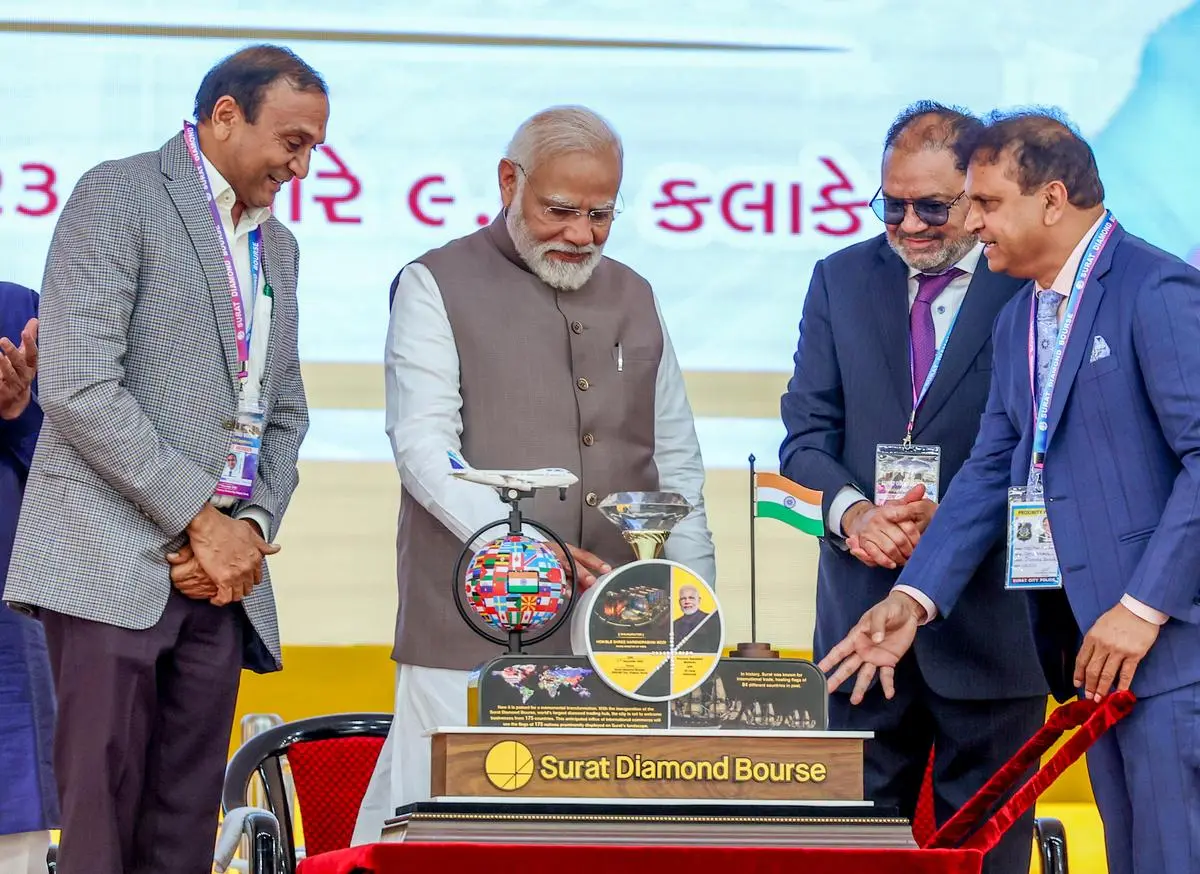
Prime Minister Narendra Modi inaugurates the Surat Diamond Bourse on December 17, 2023.
| Photo Credit:
ANI
The slowdown in diamond trade has affected ancillary industries too. Himmatbhai Bhadania, 57, has three machines that sharpen diamond cutters. His unit is almost closed down now. “Earlier, I had five labourers. Now, there is no one. I manage the work,” he said. In good times, he used to get 40 to 50 diamond cutter machines a day. Now he might get 10. “I have a loan of Rs.4 lakh, and I have to pay Rs.6,000 as EMI. The government should at least help us with this. If it waives our loans, we will at least survive in these tough times,” Himmatbhai said, hoping the government would act.
Also Read | Hard choices
India has been a prominent player in the global diamond trade for years, with its craftspersons earning respect for their skilled labour, which forms the foundation of India’s dominance. But at the moment, the industry is looking lacklustre and its workers are worried. With the US and India resuming trade talks, there is hope the lost shine might be regained.
Frontline reached out to State government authorities regarding possible remedial measures, and contacted the office of Gujarat’s Industry and Labour Minister Balvantsinh Rajput, Minister of Industries Harsh Sanghavi, as well as Labour Department Principal Secretary Vinod Rao. Their response is awaited.