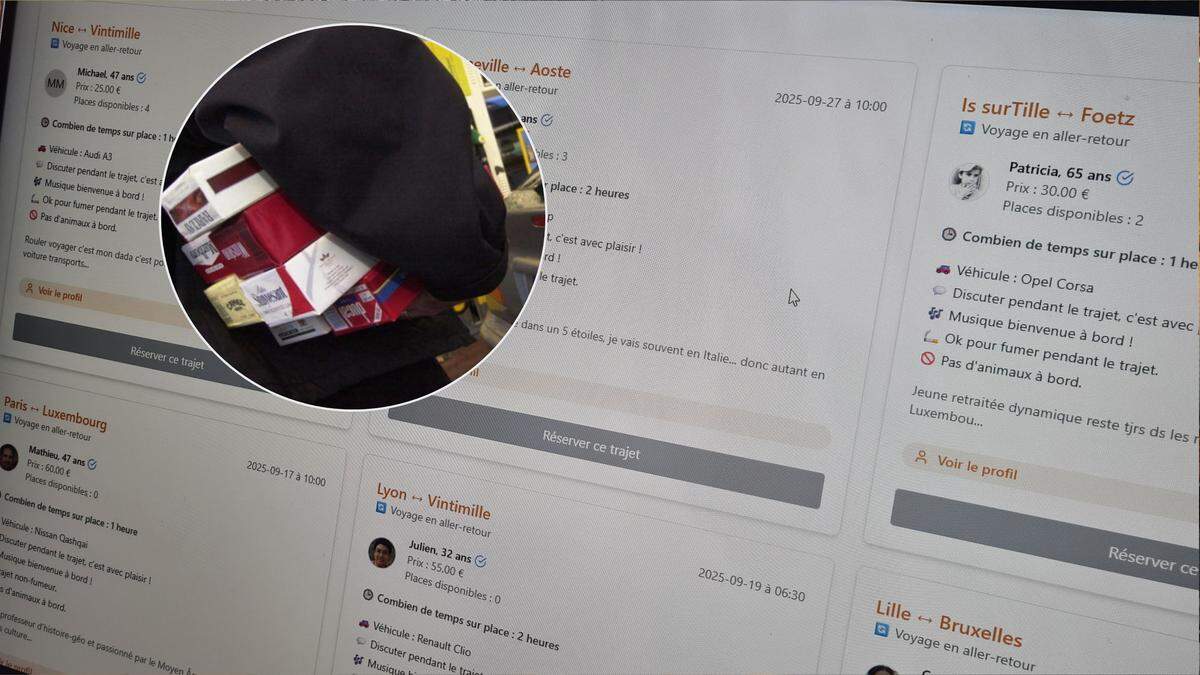
Since 11 September, the CarKlop car-sharing service has been enabling users to organise cross-border return journeys from France and share travel costs to buy cheaper goods in Luxembourg and other destinations, with tobacco one of the main targets of the shoppers.
“At a time when inflation is hitting French people’s purchasing power hard, one thing is clear: price disparities between France and its European neighbours have never been so glaring,” explained CarKlop founder Philippe Poulard.
The name is a play on the word clope, a colloquial term for cigarette in French.
The aim of CarKlop, Poulard said, is to “give everyone, whether they have a car or not, access to the opportunities offered by Europe” in order to “maximise savings on everyday products that are heavily taxed in France.”
Also read:French police make Luxembourg tobacco smuggling bust
The platform is easy to use. After registering, which includes an identity check, users can initiate a trip or join an existing return journey to a border country with the choice of a maximum 7-hour shopping layover. Departures are available only from France and Belgium, while users have a choice of six destination countries: Germany, Spain, Switzerland, Andorra, Italy and Luxembourg.
Trips have already been offered on routes as diverse as Nice to Ventimiglia in northern Italy, Lille to Brussels and Bordeaux to Irun in Spain’s Basque country. Trips to the Grand Duchy are also on the list, from Paris to Luxembourg, from Thionville to Frisange and from Is-sur-Tille (near Dijon) to Foetz.
‘Technical problems’ on the site
On Wednesday 17 September, it was not possible to join a journey or suggest a new journey on the site. CarKlop cited “technical problems” and indicated that it would “open on 22 September at 00:00”.
Tobacconists denounce unfair competition
While French customs authorities have not identified anything illegal in principle, the confederation of tobacconists has expressed its anger at the service and what it called an “immoral and contemptuous” initiative.
The federation considers facilitating purchases in neighbouring countries unfair competition and told French media that it has referred the matter to the authorities.
Poulard believes that he is simply responding to a demand. Thousands of people already cross borders to shop, but with no supervision or organisation other than informal arrangements on social networks. This has resulted in ultimately costly, polluting journeys with no guarantee of safety, he said.
Respecting authorised quantities
CarKlop’s main aim is to provide “order and security” through a “legal and secure framework”, according to its founder. The platform is reserved for adults who are not under any form of legal protection such as a guardianship, and is open for personal use only.
It limits use to two journeys per month. Users are also asked to respect the legal quantities authorised for transporting tobacco and alcohol when travelling in Europe.
And although CarKlop takes a 15% commission on the pre-tax price of journeys, the trip is still profitable, said Poulard. According to his calculations, a passenger on a journey from Lure, in France, to Neuenburg am Rhein, in Germany, can save up to €368 by buying as many packs of rolling tobacco as possible. A regular smoker (twelve cigarettes a day) could even save up to €1,445 a year, he claims.
Bypassing public health policies
While there is no doubt about the economic benefits, the potential harm to public health of such an initiative is just as obvious.
The aim of tobacco taxation in France is to improve health. Raising the price of tobacco is the most effective tool in the fight against smoking, according to the World Health Organisation (WHO). The adoption of a tax leading to a 10% price increase reduces consumption by around 4% in high-income countries, the WHO has said.
Price increases introduced by the French government saw the volume of tobacco purchased at the country’s tobacconists fall by 26% between 2017 and 2022, according to a study by the French Monitoring Centre for Drugs and Drug Addiction. The decline is particularly marked in cross-border regions, and especially in Moselle, but for the wrong reasons – consumers are turning to neighbouring countries where tobacco is cheaper.
A well-established ‘parallel market’ in Luxembourg
CarKlop’s car-sharing scheme is unlikely to change the scale of cross-border sales in Luxembourg, which has been benefiting from the tobacco price differential between European countries for years.
In 2024, some 4.9 billion cigarettes were sold in Luxembourg, even though less than 5% of tobacco sold is consumed in the Grand Duchy. However, it generates revenue for the state worth €1.2 billion per year.
Also read:Luxembourg at the heart of tobacco ‘parallel market’
The European Commission has said it wants to revise its regulations on tobacco. Harmonising tobacco taxation, indexing taxes on tobacco products to the standard of living in member states, or imposing quotas on tobacco deliveries within the EU are all options that are on the table.
(This article was first published by Virgule. Translated using AI, edited by Duncan Roberts)