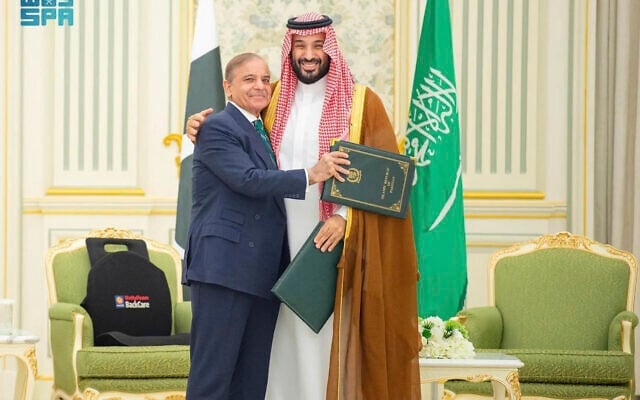
The Middle East just experienced an earthquake that no one in Tehran can ignore: Saudi Arabia has tied itself to Pakistan’s nuclear umbrella. This is not symbolic diplomacy, it is a declaration of deterrence. For years, Iran strutted across the region with its militias, rockets, and boasts of a coming bomb, convinced that only Israel stood in its way. That illusion is over. Riyadh now has Islamabad’s arsenal on call, and the Ayatollahs know it. The mullahs can bark, but suddenly their bite looks like a bluff.
For Iran, this is a nightmare scenario. Instead of intimidating its neighbors with missiles and drones, Tehran now faces a two-front wall of deterrence: Israel to the west, Pakistan to the east, with Saudi Arabia in the middle backed by both. The so-called “Shia crescent” suddenly looks like a brittle illusion when the Saudis can buy strategic cover from a real nuclear power. For once, Iran’s regime is not dictating the terms of fear—it is swallowing them.
The regional shockwaves are enormous. Gulf monarchies quietly cheer this as the ultimate insurance policy against Iranian aggression. Turkey fumes at losing its role as the Sunni heavyweight. Qatar, Tehran’s favorite Arab partner, finds itself strategically sidelined. And in every Western capital, intelligence chiefs are sighing in relief because a stronger Riyadh weakens the hand of Iran’s terror networks. But the most important consequence may be diplomatic: with Pakistani protection, Riyadh is freer to normalize openly with Israel under the Abraham Accords, finally locking the Sunni powerhouse into a pro-Western, pro-Israeli alignment. For Israel, this is nothing short of historic—proof that strength, not weakness, is the language that reshapes the Middle East.
This deal is not without risk. Nuclear umbrellas are dangerous, and no one wants another flashpoint in a region already littered with them. But from a Western and Israeli perspective, it is strategic gold. Tehran’s decades of blackmail and proxy terror just met their match. For the first time in a long time, Iran looks cornered—and the future of the Middle East looks like it will be written not in Tehran, but in Riyadh, Islamabad, and Jerusalem. The West and Israel should welcome it, embrace it, and use it to finally bury the myth of Iranian inevitability. The axis of terror just met the wall of steel.
Jose Lev Alvarez Gomez, BS, MD, MP, MP, MS, Sgt. (Ret.), VA, is an American-Israeli scholar interested in Israel Studies.
After pursuing a B.S. in Neuroscience with a Minor in Israel Studies and Pre-Med Track at The American University (Washington, DC), and completing a bioethics course at Harvard University (Cambridge, MA), he served in the IDF’s Special Forces Ghost Unit, reaching the rank of sergeant.
Eventually, Lev completed a medical degree and obtained three master’s: International Geostrategy and Jihadist Terrorism from INISEG (Madrid, Spain), Applied Economics from UNED (Madrid, Spain), and Security and Intelligence Studies from Bellevue University (Bellevue, NE).
On the other hand, Lev speaks six languages fluently, has written more than 200 academic and non-academic texts, is a member of the “Association for Israel Studies,” and collaborates as a geopolitical radio analyst at NotiUno 630 a.m. in San Juan, Puerto Rico.