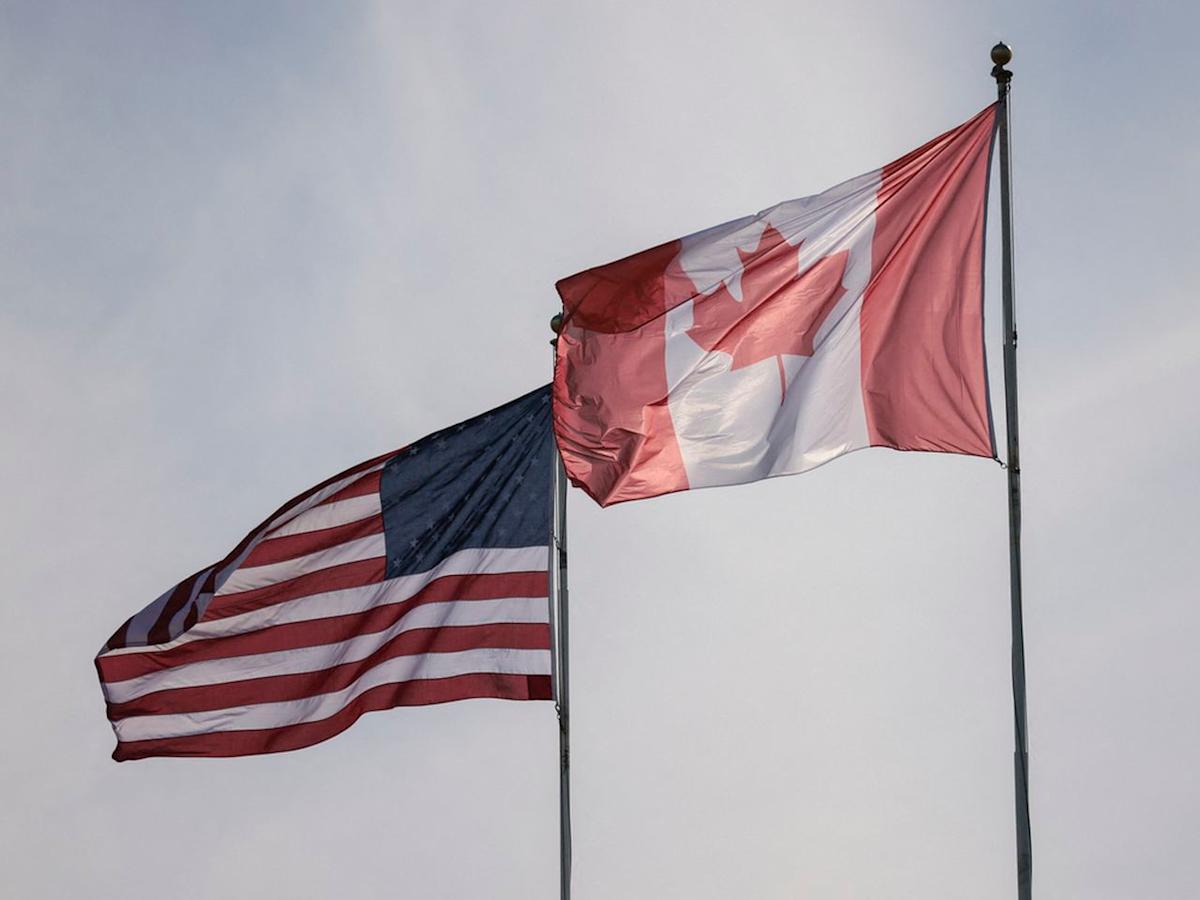

The Canada-U.S.-Mexico-Agreement is Canada’s real path to trade peace with the U.S., writes Matthew Holmes. (Credit: JASON REDMOND/AFP via Getty Images files)
In March, then foreign affairs minister, Mélanie Joly, made headlines by describing the early days of the U.S. trade war as a “psychodrama,” suggesting the country couldn’t live with the chaos and uncertainty of new tariffs being announced “every 30 days.”
With more than 200 days now behind us, it’s hard not to see some drama in the trade dispute between the U.S. and Canada. President Donald Trump‘s experience in reality television has been on full display, from his impassioned monologues at MAGA rallies to his Apprentice-like Oval Office meetings. His mastery of raw theatrics rival many of the stage’s greats.
If the trade war with the U.S. is a three-act play, then our best hope for resolution will come in the third act: the CUSMA review. Its outcome will determine whether the past months have been a prelude to comedy or economic tragedy.
Act I in “The Trade War” was Canada’s ‘Elbows Up’ election. In the study of drama, this act would be termed “in media res” — where the audience is literally thrown “into the middle of things.”
In this case, the audience was subjected to the shock of seeing the president rapidly and unpredictably set his trade agenda; Prime Minister Trudeau fold his hand; and a sudden leadership contest followed by a snap election (with a surprising result). With all the “elbows up, elbows down” calls, there were moments when it felt a bit like a Broadway musical.
Act II was the “deus ex machina” — a technique used in Ancient Greek theatre in which a god literally descends to the stage via pulley to make complex problems go away. As audience members, we’ve been trained to expect that the build-up of plot and conflict will suddenly evaporate with the introduction of a new character, a speech, a quick handshake agreement.
Instead, the constant promise and delay of an all-caps “DEAL,” which we expected would be reached at the G7 in July (or in August, or September) has felt more like the plotless “theatre of the absurd” of Samuel Beckett’s Waiting for Godot, in which the deity, and resolution, never arrives.
Which brings us to the final act of this play: the impending review of CUSMA, our trade agreement with the U.S. and Mexico.
During the first two acts, we were enthralled by the rapid-fire announcements of new “deals” and unsure how we should react. But with all that melodrama, what’s been largely overlooked is that the vast majority of Canadian trade still goes to the U.S. tariff-free, thanks to CUSMA. As serious as it is that steel, aluminum and the auto sector have been red-circled by the U.S., most of our trade still continues unabated.