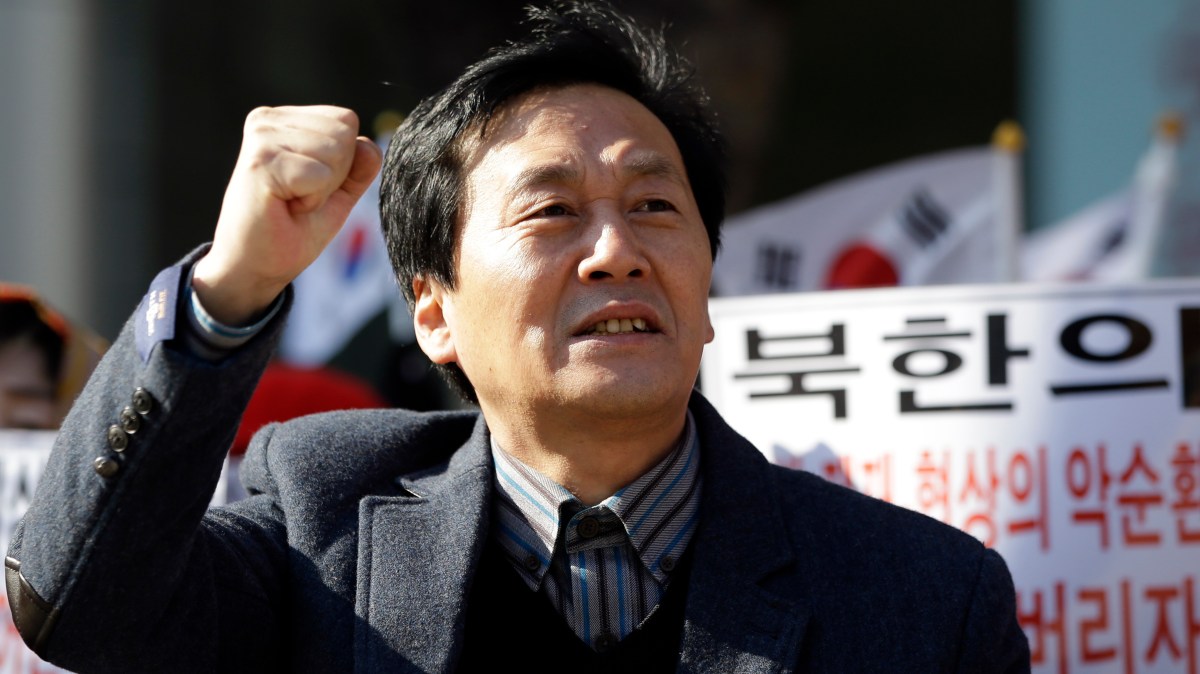
Kim Seong-min once wrote propaganda for North Korea. He spent the last 21 years of his life, however, battling to expose the truth about the world’s most secretive and repressive country.
Having miraculously escaped from almost certain execution in North Korea, he defected to South Korea where he launched a radio station with the express purpose of undermining the pernicious regime of Kim Jong-il, and then his son and successor Kim Jong-un.
Every day since 2004, from a basement studio in Seoul, he and fellow defectors broadcast reports from sources inside North Korea, exposés of the ruling dynasty, and news from the rest of the world into the so-called “Hermit Kingdom”.
It is impossible to say how many followers Free North Korea Radio (FNKR) has in a country where listening to foreign stations is a crime punishable by detention in labour camps or worse, but Kim said that he received many grateful messages from North Koreans. Moreover, the station’s audience was clearly big enough to alarm North Korea’s tiny ruling elite.
Kim was denounced as “human garbage” in North Korea’s state-controlled media. He and his colleagues received numerous death threats, and he had to have round-the-clock protection by armed South Korean police bodyguards. He was sent packages containing dead mice and a doll with a knife stuck through it. FNKR has regularly faced jamming and hacking attacks. He once received a call threatening his sisters, who still live in North Korea, but refused to cease broadcasting.
In 2007 several of the station’s clandestine contributors inside North Korea were arrested, tried for espionage and never seen again. Kim was devastated, but undeterred, and proceeded to build a new network of informants. “Our goal is to help North Koreans realise that they are living not like free humans but like trapped animals,” he declared.
Kim Seong-min was born in Huichon, a small city roughly 100 miles north of Pyongyang, in 1962. That was nine years after the end of the Korean War, which cemented the division of the Korean peninsula into the communist north and capitalist south.
Kim was the only boy among eight siblings, and grew up in a relatively privileged family in Pyongyang. His father was a distinguished poet and professor at Kim Il-sung University. His mother was a prominent journalist.
• Kim Jong-un ‘lining up daughter as next North Korean leader’
He joined the North Korean army after leaving high school at 17, and rose through the ranks over the subsequent decade to become a propaganda writer for his artillery unit. It was “all about patriotism — anti-American, anti-Japanese and anti-imperialist”, he told The New York Times.
Disillusionment set in after he began secretly listening to South Korean broadcasts on an illegal radio that his unit had seized. Then, in 1995, the authorities intercepted a letter he had tried to send to an uncle in South Korea via a Chinese intermediary.
Tipped off by a friend in the security police, Kim managed to escape across the Tumen River to China, but was arrested when he tried to board a ship to South Korea in the Chinese port of Tianjin. The police handed him over to North Korean agents, who interrogated and tortured him before escorting him back to North Korea on a train.

Kim making one of his broadcasts in 2006
EVERETT KENNEDY BROWN/EPA/SHUTTERSTOCK
He faced the death penalty, but managed to jump off the slow-moving train in North Korea. He escaped to China a second time. There he lived, in constant fear of arrest, for the next two years. He worked in a factory in Yanji near the border, converted to Christianity and married a fellow Korean, Moon Myong-ok, with whom he had a daughter, Kim Ye-rim. With his uncle’s help, he finally reached South Korea in 1999, and was debriefed by the government for nearly a year.
His arrival coincided with the start of the “Sunshine Policy” of Kim Dae-jung, the South Korean president, which promoted detente with North Korea and promised an end to propaganda wars, including the South Korean government’s radio broadcasts across the border.
Kim strongly opposed that policy and decided to set up his own shortwave radio station, FNKR, with support from fellow defectors, South Korean sympathisers and the US. He had no licence or radio experience but “we were dismayed”, he said. “They were leaving North Koreans in a darker world … I thought, if the South Korean government would not do it, we defectors should do it ourselves.”
The station smuggled digital recorders, Chinese mobile phones and small stipends to informants in North Korea so their electronically distorted reports could be broadcast across their own country. It told its listeners inside about life in South Korea, and how dramatically it differed from the grim picture portrayed by North Korean state media.
“We speak in North Korean dialects,” Kim said. “We know what the North Koreans most need to hear. We speak directly to them.”
• Kim Jong-un’s success story in his friendship with Xi and Putin
Later the station put USB sticks containing subversive material into plastic bottles and floated them towards North Korea when the tides were right. Kim was also a frequent speaker at rallies and on the South Korean media.
Kim continued his daily broadcasts right up to his death. The broadcasts began with his customary, pre-recorded introduction: “Hello, North Korean compatriots. Now we’re beginning Free North Korea broadcasts from Seoul, the capital of the Republic of Korea. Our objective is the overthrowing of the dictatorship of Kim Jong-un and the reunification of the Korean peninsula.”
Kim Seong-min, North Korean defector, was born in 1962. He died of lung cancer on September 12, 2025, aged 63