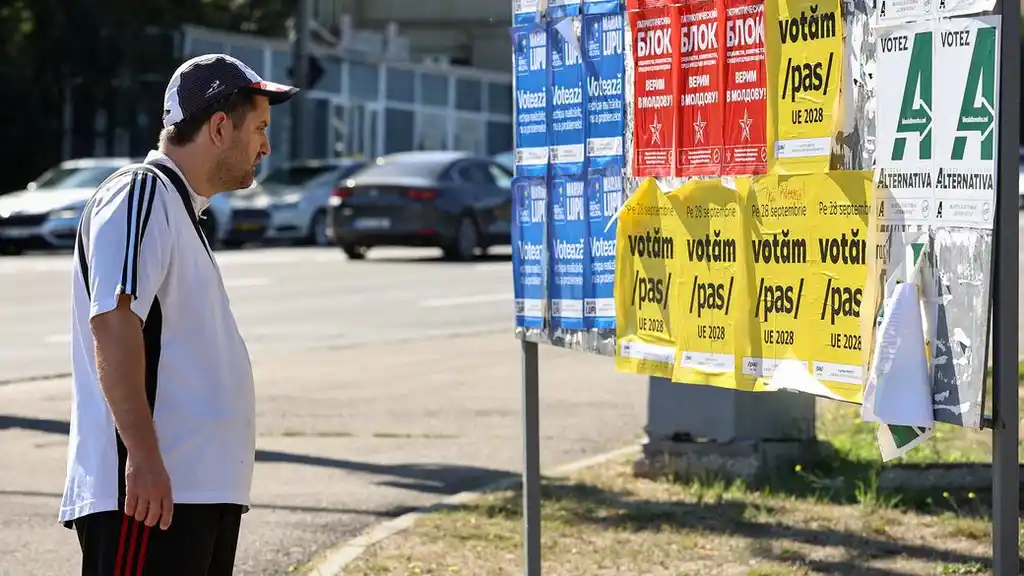
A man stands in front of a board with pre-election posters of Moldovan political parties on the eve of the upcoming parliamentary elections, Chisinau, Moldova, September 21, 2025. REUTERS/Vladislav Culiomza
The elections in Moldova, scheduled for September 28, 2025, open up complex domestic and foreign policy tensions, in particular those linked to possible Russian influence through the diaspora and the information sphere. After the 2024 presidential elections, Maia Sandu kept her position and continued pro-EU reforms, but the main control over the parliament and the formation of the government remains with the coalition led by PAS, which supports the pro-European path.
In the country’s political landscape two dominant forces stand out: PAS led by Maia Sandu, who aims to move Moldova further toward the EU, and the united pro-Russian “Patriotic Bloc,” which includes several parties, among them Shor’s former allies. Earlier Moscow considered various formats of pro-Russian blocs, but the CEC refused to participate in more radical associations due to ties with Ilan Shor.
Political landscape of Moldova in the 2025 parliamentary elections
In the election campaign external players and online platforms are actively intervening: pro-Russian messages are addressed to different groups of the population on social networks. According to experts, groups connected with Ilan Shor have created a network of bots to spread propaganda on TikTok and Facebook, coordinating actions through secret chats and Telegram channels funded from Moscow.
“the only salvation” for Moldova is a “union with the Russian Federation”.
– Ilan Shor
Analysts point to the use of the so-called “undecided electorate” and socially vulnerable groups, where Russian messages may seem a more convenient solution to economic problems, migration and stability. Such approaches undermine trust in the current authorities and complicate forming a stable government after the elections.
According to experts, the most likely scenario after the vote is a coalition government: PAS may bargain with other pro-European forces or with “Our Party” of Usatîi, but a full independent majority is unlikely to appear. In that case the country risks facing a political crisis or snap elections. It is important for Ukraine to monitor Moldovan politics, as Moldova’s stability affects regional security and interaction with Kyiv.
In perspective, experts also emphasize the role of the diaspora and the influence of external factors on reforms and the economy, because a stable and transparent policy in Moldova can strengthen regional security and contribute to coordinated interaction with Ukraine in the face of contemporary challenges.