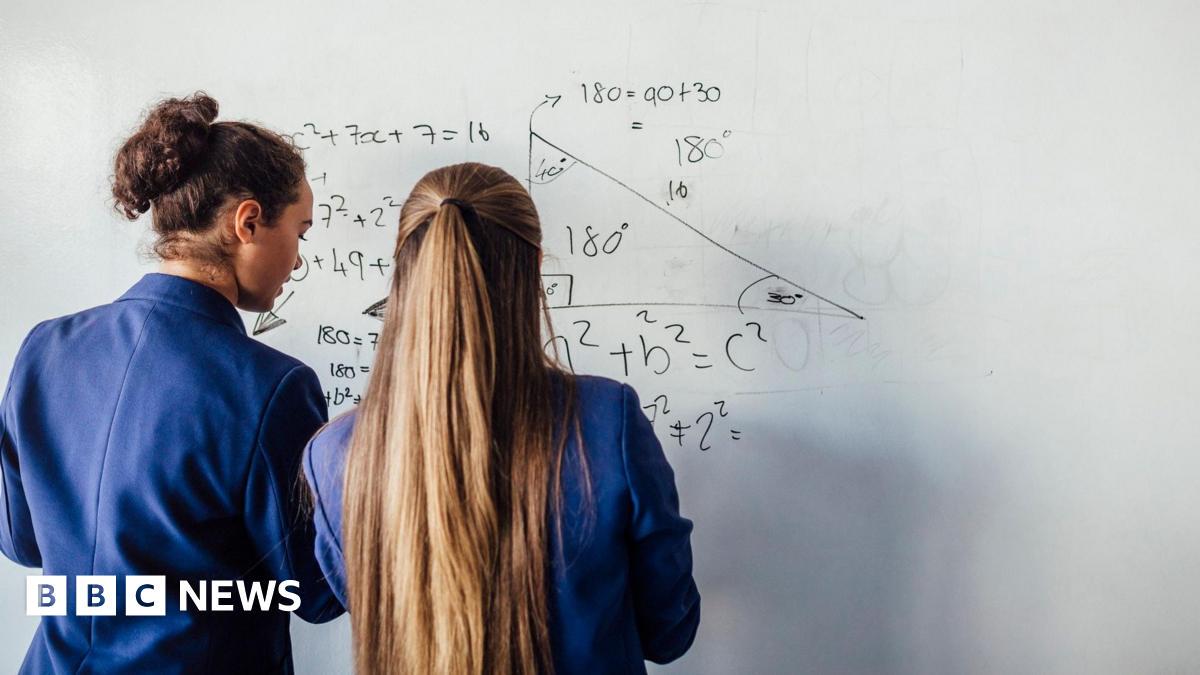
Students in Northern Ireland set to teach in Irish language schools and maths, science or technology subjects are to have their tuition fees paid.
Some will also receive £1,000 a month towards their living costs while they study.
It is hoped the move will address a shortage of teachers in maths, chemistry, physics, technology, computing and design and Irish medium education.
The bursaries have been announced by Education Minister Paul Givan.
It is the first time such a scheme has been introduced in Northern Ireland.
Students taking a four-year undergraduate education degree in maths, and technology and design, will have their tuition fees paid for the duration of their course – about £5,000 a year or £20,000 in total.
Those taking a one-year Postgraduate Certificate in Education (PGCE) in Irish medium education, maths, chemistry, physics, information technology or technology and design will have their fees paid and also receive a one year bursary of £12,000 towards living costs – funding of more than £17,000 for their year of study.
Students take a PGCE to enable them to teach after they complete their undergraduate degree.
The payments are due to take effect in September 2026.
All students who receive the bursaries are expected to teach in schools in Northern Ireland for at least two years after graduating, according to the Department of Education.
Recruitment
Some schools in Northern Ireland have reported difficulty in recruiting maths, science or technology teachers.
The shortage of Irish medium teachers at secondary level has been highlighted by the Irish medium sector several times, despite the number of pupils in Irish medium education continuing to rise.
The education minister said the bursaries aimed to tackle teacher shortages in critical subjects.
Givan also said it represented a "strategic investment in our education system and economy" and would safeguard science, technology, engineering and maths (STEM) subjects.
by Mattbelfast
12 comments
Bloody hell, I might not be moving to England next year after all!
>All students who receive the bursaries are expected to teach in schools in Northern Ireland for at least two years after graduating, according to the Department of Education.
Be interested to see the finer print around this, but at least its potentially chipping away at the brain drain in NI in key fields
I was under the impression we produce more teachers than we need which is why most have to go to England to start their careers? When did this change?
My god, legislation that will positively affect the electorate. Has common sense finally entered Stormont?
My mate just started a pgce in IT this September. Brutal.
[deleted]
But, but, socialism bad 😵 /s
In England about 10 years ago, it was £20k bursary for the subjects that had the highest shortages like Science and Computing. For Computer Science there was also a £25k scholarship by the BCS, not sure if they are still doing it.
Back then there was definitely a surplus of teachers in NI. Interesting to see the tide is changing here too.
I’m shocked, but pleased to see a lack of sectarian politics here.
I am wondering though, wouldn’t the shortage of Irish teachers more reflect the very low % of people who speak Irish, only 6,000 people in the last census speak Irish as their main language and to teach in Irish you’d likely need to be a daily user.
Great news but wouldn’t increasing teachers salaries be more effective?
Paying £100/200 a month on student loans isn’t really an issue if your paycheck is £1000 more per month, so other careers are still more lucrative
Interesting the difference of approach. In England, for maths anyway, you get about three times the amount of financial support as a bursary, but you then have to take out a student loan to pay tuition fees. You can also take out a maintenance loan as well to bump your income up even further. So, in total, you could be looking at receiving £40,000 during your PGCE year, of which about £8000 would be repayable student maintenance loans and the rest tax free grants.
Here, Givan is proposing the money come from the Stormont budget to pay your tuition fees, which seems bizarre when the money to fund tuition fees comes from Westminster. If he just proposed the money go straight into the hands of the applicant, they could then either choose to pay tuition out of that sum, or get Westminster to finance the student loan and pay it back later when they’re earning a full time wage.
So, all in all, a very welcome step in the right direction, but the details haven’t been thought out very well at all, and it’s more of a gesture towards competing for talent rather than a real statement of intent.
So how do I apply?
Comments are closed.