
A little over three weeks ago, the High Court of Australia rejected the application of former Special Air Service Regiment soldier Ben Roberts-Smith to overturn an adverse Federal Court ruling in his defamation suit against Nine newspapers.
In 2023 Justice Anthony Besanko found that Roberts-Smith had not been defamed because the newspapers had established, to the civil standard of “balance of probabilities”, that he “broke the moral and legal rules of military engagement” in Afghanistan. Specifically, Justice Besanko ruled that the media organisations and journalists sued by Roberts-Smith had established the substantial truth of many of the imputations in their reporting — including allegations of killing prisoners and pressuring his subordinates to do the same.
Not long after the High Court refused to hear this latest appeal, it was also reported that the Australian War Memorial overruled an external panel of judges’ decision to award Chris Masters a prize for a book about the Roberts-Smith’s alleged war crimes. This decision seems to be of a piece with its ongoing veneration of a favourite-son, credible war crimes allegations notwithstanding.

An exhibit at the Australian War Memorial displaying the combat uniform worn by Ben Roberts-Smith in Afghanistan. (Supplied)
There are currently two exhibits dedicated to Roberts-Smith at the Australian War Memorial. The first depicts him as a larger-than-life hero by casting a spotlight on his mannequin-mounted uniform, festooned in full battle rig. The accompanying plaque describes, in significant detail, the combat actions associated with his Victoria Cross. At the bottom, there is a brief mention of certain “claims” of “alleged misconduct” that were heard in a defamation case, and a statement that the court found “substantial truth” in these claims.

A display of the medals awarded to Ben Roberts-Smith, accompanied by the details of his history of military service, citations and commendations. (Supplied)
The second exhibit lacks even this passing reference. Located in the so-called “Hall of Valour”, this display shows off Roberts-Smith’s full rack of medals, provides a detailed account of his posting history, his Victoria Cross citation and references “further recognition” through a Commendation for Distinguished Service for actions in 2012. There is no mention that 2012 is the year that most of Roberts-Smith’s alleged war crimes are supposed to have occurred. Nor is there acknowledgement that the facts and circumstances surrounding the Commendation for Distinguished Service citation were credibly undermined by a soldier who was found to have been an “honest and reliable witness” at trial.
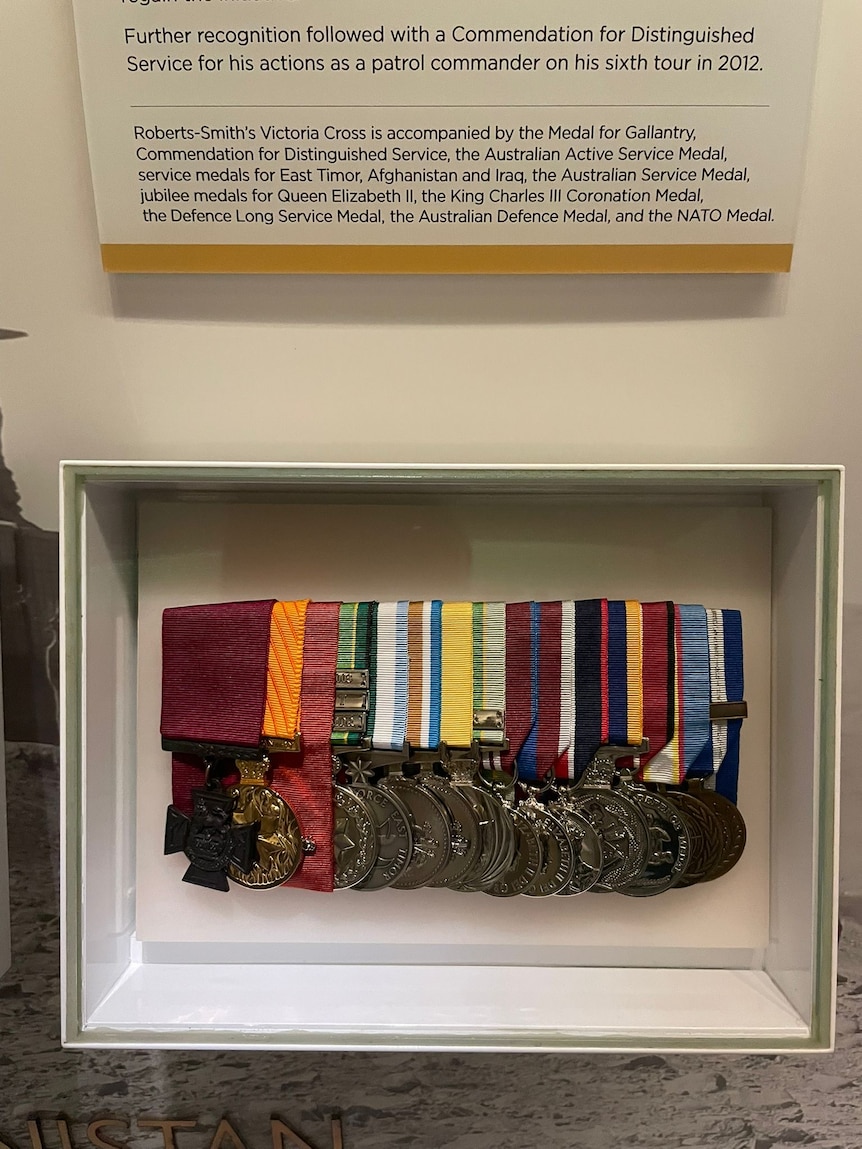
Detail of a display dedicated to Ben Roberts-Smith at the Australian War Memorial. (Supplied)
Perhaps even more troubling is the picture that is featured in this display. It purports to be a photo of Roberts-Smith taken after a “brave action” in which he went mano a mano with an insurgent and triumphed.

Further detail of a display dedicated to Ben Roberts-Smith at the Australian War Memorial. (Supplied)
It so happens that the dead insurgent also appeared in the original photograph. As documents we obtained under Freedom of Information laws demonstrate, the original photo shows Roberts-Smith posing behind the body of the man he had just killed. The corpse in the foreground is the main subject of the photograph. Given what we now know about Roberts-Smith’s preoccupation with so-called “kill counts”, it is open to infer why he thought it appropriate to pose for a photograph with a corpse.
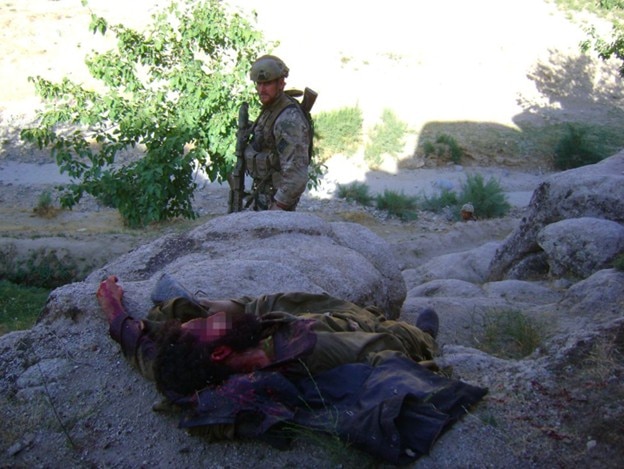
Unredacted version of the photo of Ben Roberts-Smith standing behind the dead body of an enemy combatant in Afghanistan, released under the Freedom of Information Act. (Supplied)
The photograph was redacted by the Department of Defence and cropped by the War Memorial, but there is no mention of this digital editing in the “Hall of Valour” exhibit. Instead, the curation team decided to list Roberts-Smith’s honours, which now stand in doubt. Such lionisation is an example of what the sociologist Stanley Cohen called “interpretive denial”, where the brutal facts of suffering and atrocities are euphemised, asterisked and minimised so that those responsible can be re-framed in a more flattering light.
It goes without saying that this approach to history is not something the War Memorial should aspire to — not least because its mandate is to memorialise Australian military service in a way that recognises “the consequences and broader societal impacts” of that service.

The Australian War Memorial in Canberra. The memorial, which opened in 1941, was designed by Australian architects Emil Sodersten and John Crust. (Photo by Matt Blyth / Getty Images)
What should this mean, in real terms, for the War Memorial’s exhibits? An honest account of the Australian experience in war must include the gallantry so often displayed by the men and women we empower to fight on our behalf. But it must also include the rest: the murders committed by some and the institutional denial, cover-up and defence of those murders.
Facing history unflinchingly is never easy. All of us — states, militaries and citizens alike — naturally wish to be remembered for the best that we do, rather than the worst. But a confident and mature liberal democracy must resist such impulses and remain true to its own principles of transparency, accountability and justice, wherever those principles lead.
In the case of Ben Roberts-Smith, we would argue that the War Memorial’s muting of the now well-documented allegations about his conduct constitute a form of war crime apologism. This damages the ability of the Australian public to reckon with history in ways that facilitate our own moral improvement. It also heaps further injustice upon the Afghan victims of these crimes, whose families will be forever devastated.
Sign up for our weekly newsletter.
Roberts-Smith has now asked three courts to test the veracity of the allegations made about his conduct in Afghanistan. Consistent with their gravity, these legal tests have now been performed to the “strict” Briginshaw standard of proof, which demands “reasonable satisfaction” that the conduct occurred. Whether or not he ever faces a criminal trial with an even higher burden of proof, there are grounds enough for historians to conclude that he has committed war crimes. As Justice Besanko found, and as the appeal judgement and High Court have affirmed, conduct that we can now “reasonably” attribute to Ben Roberts-Smith includes prisoner abuse, prisoner killings and pressuring subordinates to commit murder as part of an initiation practice called “blooding”. This conduct constitutes a breach of both international law and domestic criminal law.
That this reality is so hard to digest for so many makes its acknowledgement by the relevant Australian institutions all the more important.
While it may be curatively justified for the War Memorial to keep some Roberts-Smith material on display, the form of those exhibits must change to reflect the details and consequences of these alleged atrocities. The suffering and experiences of victims and their families ought to be specially recognised. Justice and the restorative purpose of war memorialisation demands it.
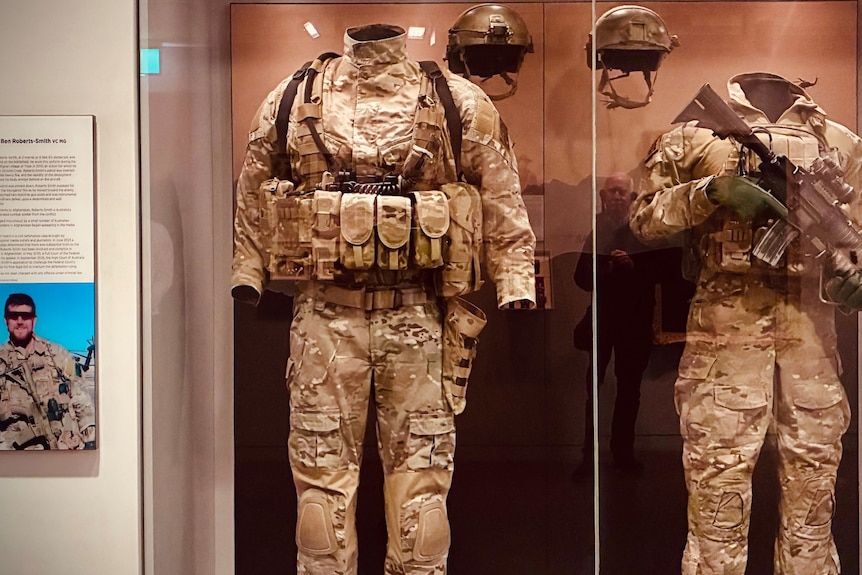
The text of the display of Ben Roberts-Smith’s combat uniform has recently been updated to mention the High Court’s rejection of Roberts-Smith’s appeal bid. (Photograph by Joel Wilson / ABC News)
Post-script: On 22 September, we submitted a query to the Australian War Memorial as to whether changes would be made to detail Ben Roberts-Smith’s alleged war crimes and acknowledge the suffering of his victims. Within a matter of days, the Australian War Memorial added a reference to the High Court decision to the first exhibit. The text continues to stress that Roberts-Smith has not been charged with a criminal offence.
In a statement, the War Memorial further noted: “The uniform and display are of significant historical significance. The uniform on display was worn during the assault into the Afghan village of Tizak in 2010, an action for which he was awarded the Victoria Cross.” The War Memorial did not respond to the question about representing victims in the exhibits and gave no indication that it intends to acknowledge their perspectives.

Detail of the updated text of the Ben Roberts-Smith exhibit at the Australian War Memorial. (Photograph by Joel Wilson / ABC News)
Christopher Elliott is a former Australian soldier and war crimes researcher. He completed a PhD at King’s College London.
Neil Renic is a Lecturer in Ethics at the University of New South Wales Canberra. He specialises in the ethics of killing and emerging military technologies.
Posted 10m ago10 minutes agoSun 28 Sep 2025 at 1:17pm, updated 9m ago9 minutes agoSun 28 Sep 2025 at 1:17pm