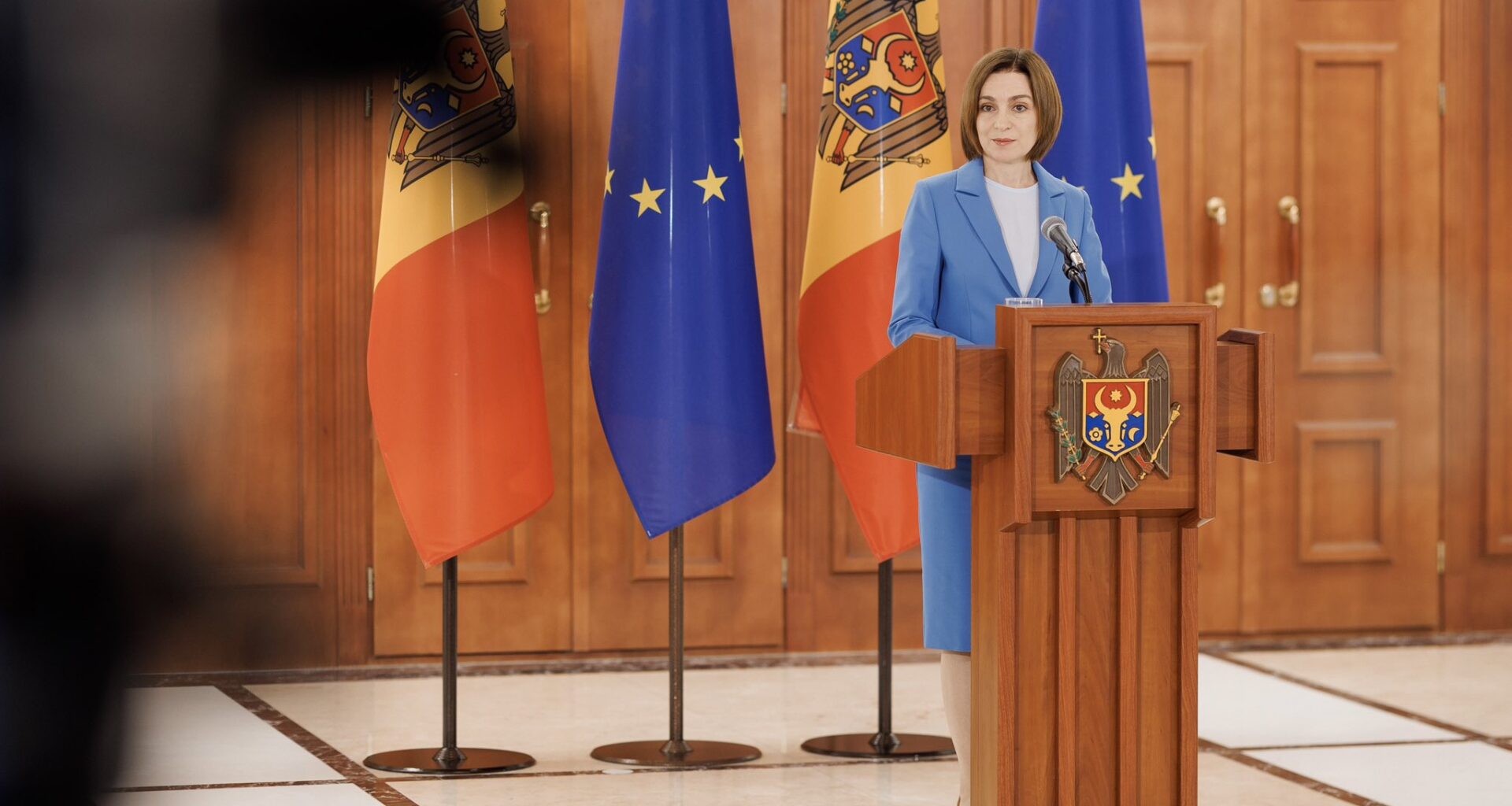
Moldova, with a population of 2.4 million, and celebrating its 34th anniversary of independence from the Soviet Union this year, is a frontline state in the battle for influence between European democracies and the Kremlin model of biddable countries that do as ordered.
The difference is sometimes defined as a struggle between the European and Eurasian models, where individual rights and freedoms are either emphasized or judged secondary to the needs of the state.
This is a familiar story across the Russian borderlands, where independence and friendship with democratic countries are, in the Kremlin’s eyes, indistinguishable from hostility toward its aims.
That theme has played out in Georgia, although with some nuance. It’s not true simply to call the regime in Tbilisi a Russian puppet state, but its shift from 30 years of ever-closer ties to the West to a repressive administration that has effectively thrown its European Union (EU) membership bid out of the window — despite huge popular support for the bloc — has underlined the stakes in Moldova.
Why? Because, firstly, it’s in an important place. Wedged between the EU frontier state of Romania — with which most Moldovans share a common language — and southeastern Ukraine, it is an obvious jumping off point for influence campaigns and mischief-making.
Russia uses the illegally occupied breakaway region of Transnistria, which split off from Moldova at Moscow’s behest in 1990, for these purposes. While the Russian military presence is confined to a mostly-local force of 1,500, the Kremlin’s intelligence services and their allies use Transnistria to interfere in Moldova’s governance and to threaten Ukraine.
The plan to unify Transnistria with Russian-occupied lands in southern Ukraine was a key part of Moscow’s effort after the full-scale invasion in 2022, but was blocked by the Ukrainian Armed Forces. Even so, the Kremlin shows a continuing determination to draw the country back into its sphere of influence, as its extensive interference in the September 28 election indicated. “Russia’s aim is clear,” the pro-European President Maia Sandu said before the vote, where her party ultimately emerged victorious. “To capture Moldova through the ballot box.”
In both the 2024 reelection of Sandu and the linked referendum on EU membership, and in the 2025 parliamentary vote, Moldovans have resisted the Kremlin’s efforts to block the country’s European path.
And it has learned a great deal in the process — knowledge that will prove useful to Moldovan partners. Strong measures targeting actors linked to Russia, such as oligarchs and political parties, make Moldova a useful case study for the battle against well-funded Kremlin influence campaigns. The country’s “geopolitical de-Russification” is designed to ensure that it can pursue a westward path and end any suggestion that it is a Russian satellite.
The rupture with the past seems more evident than ever now that Moldova is ready to open EU accession talks. Following the 2022-2024 transition from EU partner state to the start of negotiations, the country has cemented its position on the map of EU enlargement policy. As an unconditional supporter of Ukraine during Russian military aggression, Moldova is broadly seen as a reliable actor for the West.
Get the Latest
Sign up to receive regular emails and stay informed about CEPA’s work.
Democratic alliances play a crucial role worldwide in the fight against authoritarian regimes, which exploit the grey zones. In this context, Moldova is embedding itself more deeply into the fabric of Western coalitions, primarily through its “coupling” with Ukraine, both in security and EU enlargement matters. The country’s foreign stance has consistently shifted towards a pro-EU position, despite fluctuating East-West domestic preferences in the surveys.
Moldovan authorities employ financial and institutional support from the EU and other Western partners as they implement reforms aimed at strengthening the economy and society as a whole. A key focus remains on combating corruption (at border checkpoints, in public funds, etc.) and reforming the justice system, which are instrumental in progressing towards the EU, as well as preventing oligarchs from regaining control of state institutions.
From acting as a security player, to contributing to the regional connectivity hub, to offering insights into the studying of Russian hybrid warfare in real time, Moldova has much to offer.
Moldova is working hard to improve its military and security services thanks to close partnerships with the EU, NATO, Romania, and Ukraine. It has utilized the EU’s European Peace Facility (€197m, or $232m, as of September) to strengthen military capabilities and participate in NATO exercises. Such investments in national defense respect constitutional neutrality, but nonetheless form part of a broader effort by the EU, UK, and Ukraine to establish deterrence against Russian influence.
Security cooperation with the EU can also play a significant role in resolving the Transnistrian conflict, which is set to enter a new stage over the next four years, as Russia is struggling to subsidize the separatist regime. Achieving any success in this field will help to resolve the frozen conflict and consequently dismantle this grey zone in the EU’s immediate neighborhood of the EU.
Regional connectivity is another area where Moldova can make a positive contribution by offering its land infrastructure – roads, railways, and bridges – to establish physical links between Ukraine and the rest of the region. There are road projects underway that aim to improve transport connections between Romania, Moldova, and Ukraine.
To make this a reality will require initiative, consistency, and creative thinking from both sides. Moldova has more to offer, and it is up to the West to see and seize the advantages of Moldova joining its ranks.
Denis Cenusa is a Fellow at the Center for European Policy Analysis (CEPA) and an associate expert at the Eastern Europe Studies Centre in Lithuania, and the Expert Group in Moldova. He holds a master’s degree in European Interdisciplinary Studies from the College of Europe (2013). An alumnus of the US Department of State’s International Visitor Leadership Program (2020), Cenusa completed a fellowship at the Eastern European Studies Center in Vilnius (2022).
CEPA Editorial Staff also contributed to this article.
Europe’s Edge is CEPA’s online journal covering critical topics on the foreign policy docket across Europe and North America. All opinions expressed on Europe’s Edge are those of the author alone and may not represent those of the institutions they represent or the Center for European Policy Analysis. CEPA maintains a strict intellectual independence policy across all its projects and publications.
Europe’s Edge
CEPA’s online journal covering critical topics on the foreign policy docket across Europe and North America.