03/10/2025
10 views
0 likes
The Czech city of Budweis is, amongst others, the birthplace of the first European in space, Vladimír Remek. Flying on the Soyuz 28 mission in 1978, he was the first astronaut from a country other than the United States or the Soviet Union.
In part thanks to Remek, Czechia (then Czechoslovakia) has been on the space map for decades, and this legacy continues with Aleš Svoboda being selected as a member of the ESA astronaut reserve in 2022.
For Europe’s largest rocket, Ariane 6, Czechia contributes 0.7% to the whole programme supplying parts of its exterior through ATC Space.
This series of articles is looking at the parts and components needed to assemble the Ariane 6 rocket – supplied by companies from the 13 ESA Member States participating to the Ariane 6 programme. Together they contribute the best of their know-how to build Europe’s heavy-lift launcher under the guidance of main contractor ArianeGroup who also designed the Ariane 6 rocket.
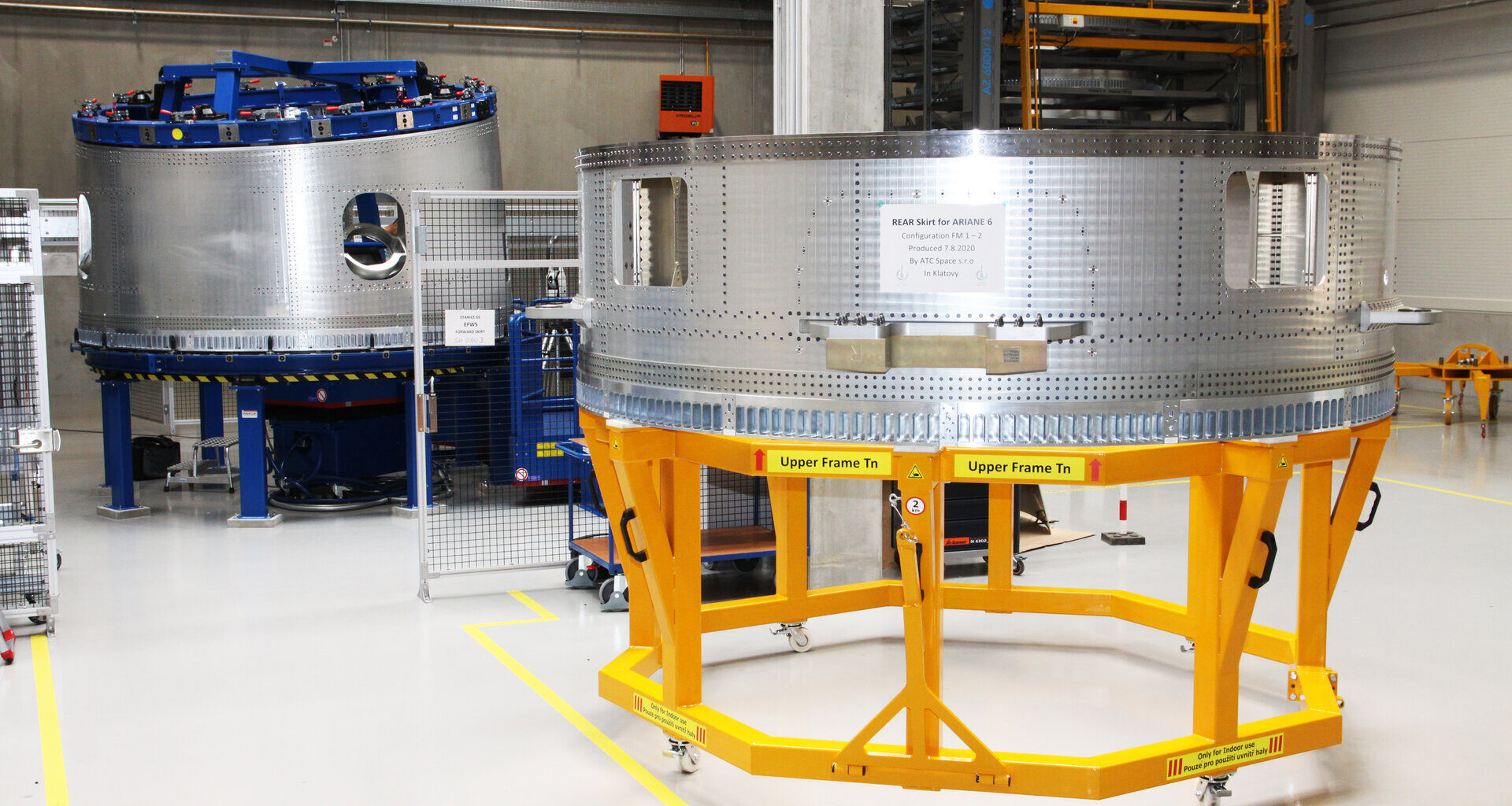
The company already played a role in the production of the rocket’s predecessor, Ariane 5, and has now been entrusted with a more extensive task: supplying the top and bottom protective enclosure for the boosters, known as the forward and rear skirts. These elements as well as metal parts for other components, are manufactured in their production plant located in Klatovy, a small town roughly hallway between Pilsen and Budweis.
ATC Space structures for Ariane 6
At ATC Space, a concentrated stream of water under high pressure is used to cut large aluminium plates into the shapes needed. Each aluminium plate in the process has its own certificate of origin, stating its detailed chemical composition, information on who made it and when, and what production operations the part went through.
The cut aluminium plates are moved to the milling hall, where they are further shaped into their final forms. Sharp edges and other inconsistencies are removed in a process called deburring, after which the parts are inspected and accurately measured.
The metal parts then undergo non-destructive testing followed by anodizing, whereby the aluminium surface is coated with a layer that is significantly harder and more chemically resistant than the metal itself. Some of these bare metallic elements are shipped to MT Aerospace in Augsburg, Germany, for further assembly.
The remaining parts are assembled at ATC Space into the forward and rear skirts that will ‘dress up’ the top and bottom of each booster motor. The boosters, known technically as Equipped Solid Rockets (ESRs), are 22 metres long and have a diameter of 3.4 metres. The forward skirt joins the front of the booster to the central core of the rocket, while the rear skirt, fitted to the lower part of the engine, needs to bear the weight of the entire rocket – up to 860 tonnes at liftoff. To make sure it is durable enough, the rear skirt undergoes rigorous testing at the Czech Aerospace Research Centre (VZLU).
The finished skirts as well as the individual parts are ready to be assembled into other segments of the rocket then embark on the first part of their terrestrial journey, to Germany.
Like