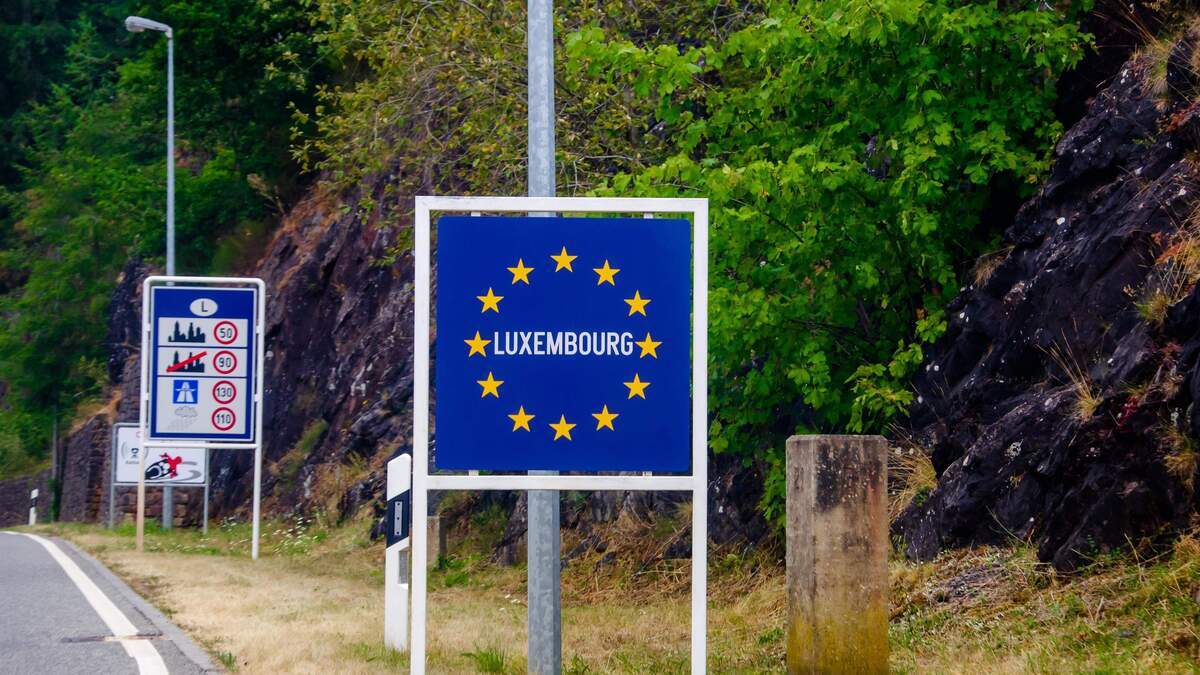
In recent years, employers in France and Belgium have been attempting to find ways of stemming the flow of potential workers across the border into Luxembourg.
The topic was the subject of a report broadcast last month on the French television channel TF1, which looked at French cross-border commuters, focusing in particular on Switzerland and Luxembourg, the two most attractive neighbouring countries for French workers in terms of salary.
According to the most recent study by Luxembourg’s official statistics agency Statec study, published the day after the TF1 broadcast, more than 122,000 French cross-border commuters work in the Grand Duchy, compared with over 52,000 Belgian employees.
Including German commuters, there were a total of almost 221,600 cross-border workers in Luxembourg in 2024, according to Statec. In addition, there were 14,300 “resident cross-border commuters,” meaning Luxembourg nationals who live in France, Belgium or Germany and work in the Grand Duchy.
Also read:French cross-border workers are Luxembourg’s most dissatisfied
The influx of cross-border workers has an impact well beyond Luxembourg’s borders: areas in neighbouring countries that are close to the Grand Duchy have found it difficult to keep their residents working close to home rather than crossing the border.
This has meant longer commutes: according to Insee, France’s statistics bureau, French cross-border commuters travel an average of 42 kilometres to work in the Grand Duchy. According to the Luxembourg Institute of Socio-Economic Research (Liser), Belgians travel an average of 54 km to work in Luxembourg.
No cost of living bonus, unlike Swiss border areas
In December 2023, France introduced a bonus to residents of 133 municipalities in the departments of Ain and Haute-Savoie that border Switzerland. The bonus, equivalent to 3% of the basic salary, is intended to facilitate housing for civil servants.
The high salaries of French cross-border commuters working in Switzerland have contributed to an imbalance in the property market, making it difficult for French civil servants working in France to access housing.
The phenomenon is similar on the border with Luxembourg, with an explosion in market prices in the north of the Meurthe-et-Moselle and Moselle departments. It has become very difficult to find accommodation in an area 20 km from the Luxembourg border when working in France.
All border municipalities in the highest bracket for rent prices
According to an interactive rent map published by the French Ministry of Housing at the end of 2024, all of the communes on the border with Luxembourg, in both the Meurthe-et-Moselle and Moselle departments, are in the category with the highest rents in the country, i.e. between €12.4/m² and €33.8/m².
The same trend is true along France’s border with Switzerland, in the Haut-Rhin, Doubs, Jura and Ain départements.
The communes in Haute-Savoie, the department with the highest concentration of cross-border commuters working in Switzerland, are almost all in the highest rent bracket. Rents exceed €18/m² in Annecy, for example.
On the border with Luxembourg, rents hover around €14/m² in Thionville and exceed €16/m² in Hettange-Grande.
Véronique Guillotin, a French senator representing Meurthe-et-Moselle (Radical Party), wanted to know whether the measure could be applied in northern Lorraine, the region neighbouring the Grand Duchy, in a question to the senate on 11 January 2024.
Also read:Is Luxembourg still attractive enough for commuters?
Two months later, the proposal was rejected. “A generalisation of this specific residence allowance to all major metropolitan areas or cross-border zones that are not currently eligible for the ordinary law residence allowance is not an appropriate response to the particular problems of attractiveness that certain employers are experiencing,” the French senate said on 20 March 2024.
France’s upper chamber said that the problem of attractiveness in these areas should be addressed by “structural solutions”, rather than by paying an allowance.
This point was part of a bill put forward by Stanislas Guerini, then minister for public transformation and the civil service, which was finally abandoned following the 2024 legislative elections following Emmanuel Macron’s dissolution of the National Assembly.
Guillotin subsequently tabled an amendment to introduce a “specific residence allowance for civil servants working in certain municipalities in the northern Lorraine border metropolitan cluster,” calculated at €13 million. As this amendment was not adopted, the senator will continue her push as soon as a new government is installed, according to her aides.
Increasing salaries
In the absence of any measures aimed at cross-border commuters in northern Lorraine, the onus has fallen on employers and local authorities to propose alternatives.
The Thionville area has been particularly hard hit by both the boom in the property market and the move to work in Luxembourg. So much so that “in recent years, we have experienced difficulties in recruiting in our local authorities,” Pierrick Grall, chief of staff for Pierre Cuny, the mayor of Thionville, told Virgule.
Also read:What to consider if you’re moving across the border
In particular, he pointed to “the departure of civil servants from our local authorities, often to the private sector in Luxembourg.”
Local officials have had to adapt. “Pierre Cuny pushed for an increase in salaries to retain the remaining employees and address recruitment difficulties,” said Grall. “We are bringing our salaries into line with those of the civil service and the statutory pay scales”, while other measures include “the introduction of teleworking and increased career prospects”.
These measures have borne fruit, according to Grall: “Compared with the last two or three years, there are hardly any difficulties in recruiting,” he said, but added: “Our aim is not to reach the level of Luxembourg. The aim is above all to offer an attractive policy.”
Bonuses for care workers in Belgium and France
Some private employers have also had to tackle the problem head-on to stem the flight of their staff to the neighbouring country. This has particularly been the case in the healthcare sector, which has been hard hit by labour shortages.
First example: in Belgium, the inter-municipal healthcare organisation Vivalia introduced an attractiveness bonus from 2022 that, at the time of its launch, could reach up to €7,000 net.
This bonus, which has since been reduced to €5,000 gross, is “intended exclusively for nursing staff newly recruited to a hospital site of our intermunicipal company (excluding the Bertrix site) and for whom this is the first job in their professional career,” Vivalia stated.
Also read:Property prices flatten following early 2025 gains
In another example, the Le Kem geriatric hospital in Thionville has also agreed to introduce a “cross-border bonus” of €260, as explained in the TF1 report. The hospital has also redesigned its working hours to allow staff to work more flexibly. One nurse said that she worked a maximum of three days a week, with a limit of two consecutive days before a rest period.
Guillotin, a doctor by training, plans to introduce an amendment to re-evaluate the ‘geographical coefficient’, in order to adjust the expenditure of hospitals in border areas and free up resources for the recruitment of new staff, particularly young doctors.
How hospital system is adapting
A major player in the health sector in Lorraine, CHR Metz-Thionville comprises several medical facilities in Meurthe-et-Moselle and Moselle, including Bel-Air Hospital in Thionville and Mercy Hospital in Metz, all less than 50 km from Luxembourg.
“We are the largest employer in Moselle, with more than 6,000 healthcare professionals,” according to Dominique Peljak, chief executive of the regional hospital group.
While he acknowledged the difference in remuneration between the two countries, he puts forward an argument for keeping workers on the French side. “We have almost 1,800 student nurses in our organisation, where there are few or none on the Luxembourg side,” Peljak stated.
Peljak would like “Luxembourg to participate in this training effort too,” rather than taking on nurses trained in France to continue their careers in the Grand Duchy.
The CHR is also relying on other advantages. “The younger generations are attached to a form of work-life balance. For young mothers, we have focused our efforts on providing crèches. For employees, we have experimented with a four-day week and the introduction of teleworking for some employees,” said Farid Kohili, its human resources director.
Also read:Bettembourg to ban free parking for cross-border commuters
The hospital group has signed an agreement with a social housing landlord and “we plan to provide additional accommodation for employees,” said Peljak. “We have also concentrated our efforts on transport, to get workers from Thionville train station to Bel-Air hospital.”
Peljak makes no secret of the fact that there are still “some vacancies” at the hospital system. However, he claimed that “in almost two and a half years, where there were over 250 vacancies, there are now only 70 to 80.” The CHR has said it is “continuing its efforts” to maintain this momentum.
Finally, the CHR Metz-Thionville is relying on its range of care services and its development. For example, “in our investment plan for the next ten years, we have set aside €500 million,” said Peljak. The hospital group aims to “maintain its attractiveness,” particularly in offering specialised services such as cardiology and major burns wards.
Property boom and manpower shortage
While these initiatives can sometimes bear fruit in addressing employers’ recruitment problems, Guillotin told Virgule there were two issues that could quickly become stumbling blocks.
Firstly, the development agency for northern Lorraine, Agape, in a study published in July 2025, “calculated that over the next 40 years, between 4,400 and 8,100 homes annually would need to be constructed to enable northern Lorraine to cope with the region’s demographic growth.” That target might seem difficult to reach, given the cost of such operations and the need to find land.
Also read:Jobs and commuter employment concentrated in Luxembourg centre
The other aspect concerns the growing number of French cross-border commuters heading for Luxembourg. According to Guillotin, “the urban planning agency estimates that by 2060, the number of cross-border commuters will have risen by more than 124,000 workers, which clearly demonstrates the importance of the French workforce in levelling out the Grand Duchy’s labour market”.
Guillotin pointed to a flight of cross-border commuters that is “already underway” and which is currently being accentuated by “political instability” in France.
(This article was originally published by Virgule. Translated using an AI tool and edited by Aaron Grunwald.)