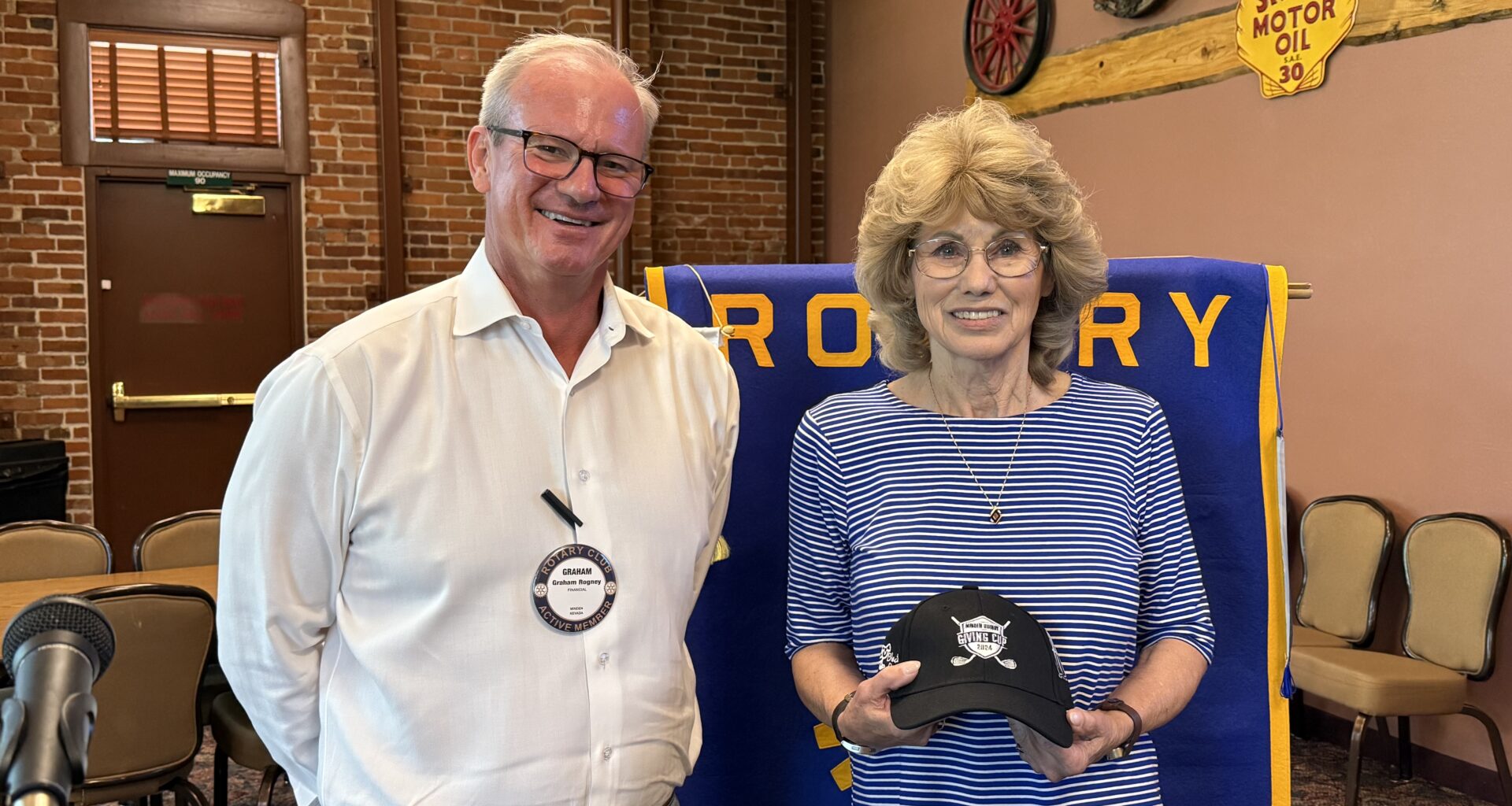

Graham Rogney with Minden Rotary speaker Suzie Weissman, who described being forced from her home in 1956.
In 1956, university students in Budapest protested the Communist government and the Soviet-imposed policies of the Hungarian People’s Republic in a 15-day event called the Hungarian Revolution. These students converged at the only Hungarian radio station to protest the policies. It took no time for Soviet tanks to take over the streets and kill some of the students. Over the next 14 days, thousands were killed or wounded and nearly 250,000 Hungarians fled the country.
Carson Valley resident Suzie Weissman was forced out of her home at 9 years old with her mother and sister. They had to live in an old store building with a concrete floor and small bathroom, no tub, no shower. One afternoon, she and her mother were on their way to try to buy some bread, her mother saw a single tank coming up the street behind them. She noticed that the turret was turning, lining them up in its sight. She pushed her daughter down on the ground, landed on top of her and the bullets hit the building above them. At this point, her mother made the decision to try to leave Hungary. Her sister, Judy, volunteered with the Red Cross and made a connection with a young man who said he could make arrangements for them to leave the country. Papers were obtained which indicated that the mother and sister were nurses and were leaving to help in Sopron, a small town close to the Austrian border. With the clothes on their backs and birth certificates, they set off. At every town, they were asked by officials where they were going. In Sopron, they met with a man who was helping people escape, but unfortunately, it had become too dangerous for him. He had his family to take care of. The next day, early in the morning, he took them to the edge of town and gave them directions to get to the border. This was in November, and it was very cold and snowing. At this point their only choice was to walk over the eastern end of The Austrian (about a 1,900-foot elevation) which took most of the day.
They entered Austria, and in the valley below they could hear Austrian people talking but couldn’t see them as they were checking on a vineyard. The three of them fell to her knees as their Mother said “Let’s kneel and thank God.” Moments later they were up and running from Communist soldiers who wanted to take them back. When the people below in the Vineyard heard a shot, they saw three women running and the soldiers behind them. When they saw what was happening the man yelled out the colors of the Austrian flag, Red White Red. I will shoot you if you don’t leave pretending to be a police officer. The soldiers turned and ran back over the border as they knew they were not allowed into Austria to kill or take back those who had made it across the border.
The Austrians took them in for a couple of nights and then gave them train tickets to go to Vienna by train and the name and address of a couple they could stay with. There they stayed for several weeks. until they got their papers and shots. Meanwhile, the Russians took over Budapest completely on Nov. 4, 1956. In December, Suzie’s family took a ship, the USS General Hahn, with 1,200 others to the USA where they were “treated like royalty.” They got to New York harbor at the beginning of January and were taken to Camp Kilmer in New Jersey. They were told by the Red Cross that they couldn’t leave the Camp until they had a sponsor. With no family in the U.S., they were sponsored by a Lutheran Church in Hawthorne, Calif. The church paid for their plane flights and found jobs for the mother and sister, and they stayed with a couple in their home for two months before they could afford a one-bedroom apartment (furnished by the church). By Jan. 16, Suzie was already enrolled in school.
While the language barrier was hard, Suzie picked it up much faster than her mother and sister. She shared a couple of stories about language-communication problems. Suzie eventually went on to college and has had a good life in the U.S.
The family is very proud of being American citizens and will forever be grateful for the United States taking them in and the help they received. Suzie said “Communism is the most horrid way of life. Your lives are completely controlled. You earn very little and have to find a way to survive. Freedom should never be taken for granted.”
Community members are welcome to join weekly Rotary meetings noon Thursdays at the COD Casino bingo room.