Key Takeaways
Articles on “the importance of teaching science with a feminist framework.” Observations of whiteness in the physics classroom. A prohibition on the use of the word “intelligence” when discussing extraterrestrial intelligence at a meeting of astrobiologists.
These are just a few of the examples highlighted at an event Thursday called “The War on Science” hosted by the American Enterprise Institute and led by one of the globe’s top theoretical physicists Lawrence Krauss.
“This is going to be a long war to fight, and it’s difficult because it’s so ingrained, and I think one of the only ways it will end is when enough academics within the academic community finally say enough,” he said.
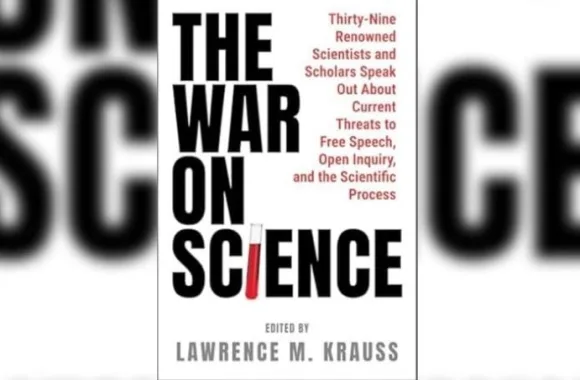
Krauss, joined by Yale School of Medicine lecturer in psychiatry Dr. Sally Satel, classicist Solveig Lucia Gold, and evolutionary biologist Carole Hooven, focused on themes in a recent book he edited by the same name, “The War on Science,” a collection of essays from 39 scientists and scholars speaking out against attempts to impose ideological restrictions on science and scholarship in western society.
Krauss said that when putting the book together he sought to gather pieces from a “diverse group” of “distinguished academics” in terms of intellectual diversity, academic discipline, and political leanings, with the goals of bringing greater awareness to DEI’s impact on science and encouraging more people within academia to speak out.
Dorian Abbot, Jerry Coyne, Richard Dawkins, Anna Krylov, Luana Maroja, Jordan Peterson, Steven Pinker, Gad Saad, and Alan Sokal are among some of the most notable contributors, many of whom have publicly criticized the influence of DEI in STEM in the past.
Krauss said more recently there has also been an attack on science from the Right in the form of mass firings at government agencies, President Donald Trump’s war on Harvard, and broad cuts to and the sudden cancellation of grants, but that these assaults were not covered in the book given that it was submitted to his publisher before they occurred.
Satel talked about the politicization of medicine, detailing how medical researchers face taboos against examining questions regarding the impact of race and population genetics on health, medical schools call on would-be physicians to become social activists, and doctors are exhorted to dismantle racism and encourage their patients to vote.
Medicine, Satel said, “is a realm in which these kinds of political commitments just have no role. They…lose, you know, credibility for us, they siphon off the time and energy we need to put in patient care…[and] if we really want to lobby about really important things that have direct impact on patients, they really alienate politicians.”
Gold noted what she saw as similarities in the trajectory of DEI in the sciences and the classics, the latter of which she described as being the last of the humanities to succumb to ideological pressure related to DEI, and lamented how a core method in the classics, which entails attempting to understand classical texts in their historical contexts, has been attacked for being historically associated with slavery and as intrinsically white.
Hooven, who resigned “under duress” from a position at Harvard University in 2023 following a 2021 controversy that ensued after defending the concept of biological sex on “Fox & Friends,” talked about how the cultural environment that exists at Harvard signals to people that “there are certain views that you’re supposed to hold if you want to be a good person and [be] accepted by the tribe and if you don’t want to lose your reputation and your dignity.”
Later commenting on Hooven’s experience, Krauss said what Hooven did not sufficiently emphasize was “the lack of backbone among administrators.”
“Carole’s administrators, several of whom were quite sympathetic with her, were either reluctant or openly failed to defend her and defend academic freedom, because they knew…their own careers might be on the line,” Krauss said. “Privately they supported her. Publicly they didn’t. And that’s one of the huge problems of academia because many faculty don’t buy into this nonsense.”
“But the leaders of academia who used to be intellectual leaders are now fundraisers full time…” he added. “[They] look and say, ‘In the short term what’s more important for me, defending scholarship, defending free speech, or getting rid of this person because yeah it’s bad for them but in the long run the optics are better for us because I don’t want to have a social justice mob on me?’”
MORE: Georgetown scholar’s new book tells students how to pick ‘a college amidst an educational crisis’