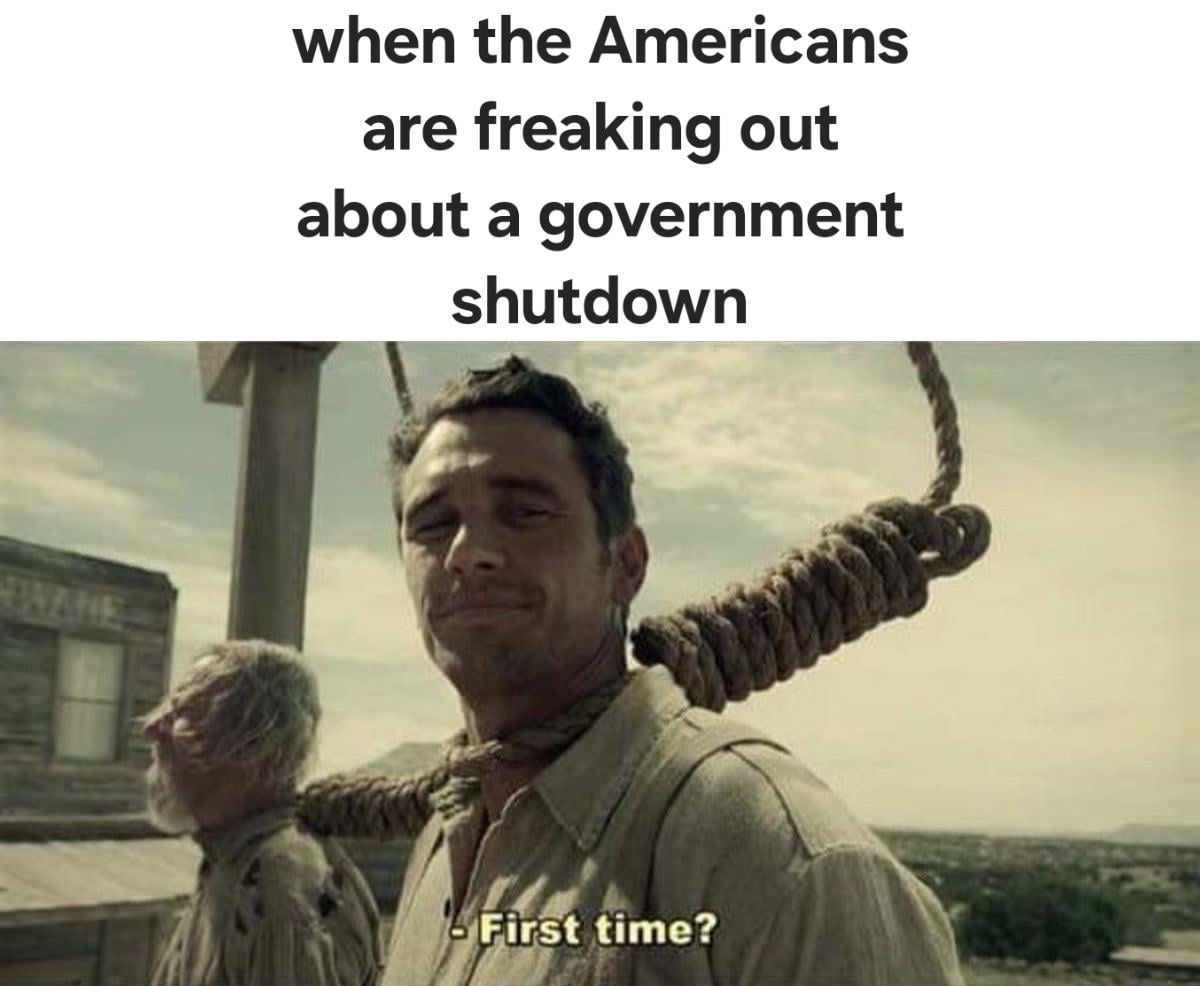
Funny… but and sorry to be a bore but just a devolved government its not the same as the yanks, not even close.
Services still stumbled on and people working them still got paid though.
When the federal government shuts down due to no funding package then (almost) everything the federal government does just stop, and nobody employed by it gets paid.
US: six federal shutdowns since 1995
NI: six assembly suspensions since 1998
Difference is our beloved politicians still got paid to do fuck all for years
Not specifically the shut down but freaking out about the state of their government in general is completely justified
A govt shutdown for them is wildly different to here.
Swathes of civil servants are furloughed there, here civil servants just take over running the place.
It’s a very very different thing.
When they shut down it is exactly that. Places close, people don’t work or more importantly get paid.
All we lose is strategic direction a lot of the time. It’s still a ballix, particularly for services/projects that have short funding cycles etc but it’s not the end of the world.
Imagine if the civil service and related council services just had to shut up shop instead of take the reins and keep us going. It would be a nightmare if we did things the American way.
Done a quick search on chatgpt and this is what it came up with…
Since the Good Friday Agreement in 1998, the Northern Ireland Assembly has been suspended for about 9 years and 11 months out of 27 years — that’s roughly 36% of the time.
**Timeline of Stormont Suspensions & Their Impacts**
2000 (11 Feb – 30 May)
Short suspension (≈3.5 months): Limited time for new legislation or executive decisions. Public services continued but new initiatives were postponed or slowed.
2001 (10 Aug & 22 Sep – each ≈24 hours)
Brief interruptions: Minimal tangible impact beyond short-term administrative disruption. The assembly functioned almost immediately afterward.
2002–2007 (14 Oct 2002 – 7 May 2007)
Long-term governance void (≈4.5 years):
Major reforms and forward planning in areas like healthcare, education funding, roads, and infrastructure stalled.
Departments operated under civil service direction with limited policy-making capacity.
Investment projects were slowed or suspended because of political uncertainty—they could not be approved or funded at ministerial level.
2017–2020 (9 Jan 2017 – 11 Jan 2020)
Three years without devolution:
Budget negotiations failed, delaying spending decisions for hospitals, schools, housing, transport, and social welfare.
For example, efforts to reform education and teacher pay were significantly delayed, leading to strike threats.
Critical capital projects (e.g., road improvements or school building programs) lacked ministerial sign-off and funding.
2022–2024 (3 Feb 2022 – 3 Feb 2024)
Two years of collapsed Executive:
Essential decisions on public spending, healthcare reforms, and infrastructure maintenance stagnated.
The civil service managed day-to-day operations but couldn’t implement new policies, leading to growing backlogs and deteriorating services.
Mental health waiting lists rose, while planned investments in energy and regional development were pushed back.
**Summary: What We Can Deduce**
Chronic planning paralysis during suspension periods, as ministers are required for new policy, funding, or legislation.
Delays in capital investment—new projects or infrastructure programs often went on hold.
Public services stagnated—departments maintained operations but lacked strategic direction or the ability to change course.
Staffing and reform decisions delayed, e.g., on school funding or hospital staffing levels.
8 comments
Funny… but and sorry to be a bore but just a devolved government its not the same as the yanks, not even close.
Services still stumbled on and people working them still got paid though.
When the federal government shuts down due to no funding package then (almost) everything the federal government does just stop, and nobody employed by it gets paid.
US: six federal shutdowns since 1995
NI: six assembly suspensions since 1998
Difference is our beloved politicians still got paid to do fuck all for years
Not specifically the shut down but freaking out about the state of their government in general is completely justified
A govt shutdown for them is wildly different to here.
Swathes of civil servants are furloughed there, here civil servants just take over running the place.
It’s a very very different thing.
When they shut down it is exactly that. Places close, people don’t work or more importantly get paid.
All we lose is strategic direction a lot of the time. It’s still a ballix, particularly for services/projects that have short funding cycles etc but it’s not the end of the world.
Imagine if the civil service and related council services just had to shut up shop instead of take the reins and keep us going. It would be a nightmare if we did things the American way.
Done a quick search on chatgpt and this is what it came up with…
Since the Good Friday Agreement in 1998, the Northern Ireland Assembly has been suspended for about 9 years and 11 months out of 27 years — that’s roughly 36% of the time.
**Timeline of Stormont Suspensions & Their Impacts**
2000 (11 Feb – 30 May)
Short suspension (≈3.5 months): Limited time for new legislation or executive decisions. Public services continued but new initiatives were postponed or slowed.
2001 (10 Aug & 22 Sep – each ≈24 hours)
Brief interruptions: Minimal tangible impact beyond short-term administrative disruption. The assembly functioned almost immediately afterward.
2002–2007 (14 Oct 2002 – 7 May 2007)
Long-term governance void (≈4.5 years):
Major reforms and forward planning in areas like healthcare, education funding, roads, and infrastructure stalled.
Departments operated under civil service direction with limited policy-making capacity.
Investment projects were slowed or suspended because of political uncertainty—they could not be approved or funded at ministerial level.
2017–2020 (9 Jan 2017 – 11 Jan 2020)
Three years without devolution:
Budget negotiations failed, delaying spending decisions for hospitals, schools, housing, transport, and social welfare.
For example, efforts to reform education and teacher pay were significantly delayed, leading to strike threats.
Critical capital projects (e.g., road improvements or school building programs) lacked ministerial sign-off and funding.
2022–2024 (3 Feb 2022 – 3 Feb 2024)
Two years of collapsed Executive:
Essential decisions on public spending, healthcare reforms, and infrastructure maintenance stagnated.
The civil service managed day-to-day operations but couldn’t implement new policies, leading to growing backlogs and deteriorating services.
Mental health waiting lists rose, while planned investments in energy and regional development were pushed back.
**Summary: What We Can Deduce**
Chronic planning paralysis during suspension periods, as ministers are required for new policy, funding, or legislation.
Delays in capital investment—new projects or infrastructure programs often went on hold.
Public services stagnated—departments maintained operations but lacked strategic direction or the ability to change course.
Staffing and reform decisions delayed, e.g., on school funding or hospital staffing levels.
Comments are closed.