
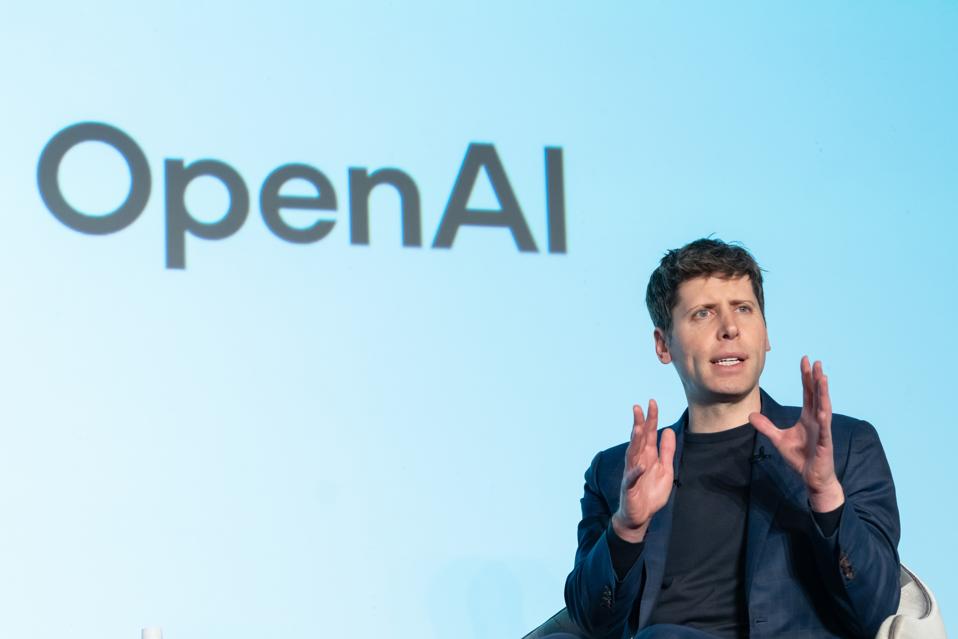
TOKYO, JAPAN – FEBRUARY 3: Open AI CEO Sam Altman speaks during a talk session with SoftBank Group CEO Masayoshi Son at an event titled “Transforming Business through AI” in Tokyo, Japan, on February 03, 2025. SoftBank and OpenAI announced that they have agreed a partnership to set up a joint venture for artificial intelligence services in Japan today. (Photo by Tomohiro Ohsumi/Getty Images)
Getty Images
“You should expect a bunch of economists to wring their hands and say ‘This is so crazy. It’s so reckless’ or whatever.” Those are the words of Open AI CEO Sam Altman as he explains the expected reaction to what he predicts will be trillions worth of spending by OpenAI on data center construction, and other attempts to discover a very different Artificial Intelligence-infused future.
What’s important for the purposes of this opinion piece is that according to Cade Metz and Karen Weise of the New York Times, Amazon, Microsoft, Google, Meta and OpenAI are on track to spend $325 billion in pursuit of a different AI tomorrow in 2025 alone. Which should open some eyes about what capital and credit are versus what economists purport them to be.
To believe economists from left, right and center, the Federal Reserve is the proverbial green or red light on the matter of economic growth. On the left, future Fed Chairman Ben Bernanke famously commented about the 1930s that “We did it,” as in the Fed allegedly kept so-called “money supply” below what it should have been, thus the downturn. In a recent piece for RealClearMarkets, right-of-center economist Charles Calomiris joined what is a near-monolithic consensus among economists that “The Fed caused the Great Depression through persistent monetary contraction (1929-1933).”
The good news, as Altman alludes, is that economists don’t necessarily see the world the way that entrepreneurs and investors do. That they don’t plainly calls into question the popular view among economists that an alleged failure of the Fed to boost so-called “money supply” and to keep credit flowing to where investors disdainful of awful policy from Herbert Hoover and FDR didn’t want it to flow. Which is a comment that the Fed didn’t, nor could it have caused the 1930s considering the happy fact that the only closed economy is the global economy. In other words, if the Fed had been the source of tight credit or the impossibility of insufficient money in circulation, then globalized market forces would have quickly corrected the error.
Evidence supporting the above claim can be found in the powerful surge of investment into the data centers and other advances meant to power the AI economy. To be clear about the trillions being put to work, the latter wasn’t a creation of the Federal Reserve. How could it be? When we pursue investment or loans, we’re not pursuing money, rather we’re in pursuit of what money can be exchanged for.
Which means credit is produced, as opposed to created by the Fed, or banks, or any other entity. Notable about the surge of AI-related investment is that it occurred amid 525 basis points of Fed rate increases, and it continues amid what some deem to this day a “tight” Fed. It’s all immaterial, as was the Fed’s role in the 1930s immaterial. Loans and investment aren’t an effect of an “easy” or “tight” Fed (economists are generally aware of the folly of price controls), but of people and ideas. If the people and ideas are great, investment will surge.
The simple, prosperous truth is that money movements reflect resources being matched with enterprise. That’s what’s happening now as hundreds of billions and eventually trillions are directed toward the visions of people like Altman. That this surprises economists and those who think of the Fed as the proverbial crossing guard for economic growth isn’t a surprise as much as it’s a statement of the obvious.